
4th Amendment

This is a sample motion from Maryland asking the court to exclude tangible evidence recovered during a stop and arrest based on lack of probable cause for the search. The motion includes arguments about implicit racial bias, structural racism, procedural justice, racial justice, and adolescent brain development.

The D.C. Court of Appeals reversed Mr. Miles’s convictions after concluding the police lacked reasonable suspicion to subject him to a Terry stop. Distinguishing the case from Wardlow v. Illinois, the Court found the anonymous tip and the circumstances around Mr. Miles’ flight from the police were not indicative of criminal activity and offered the following language in support: “While Wardlow is not directly controlling here, the case…

The New York Supreme Court Appellate Division reversed the judgement and conviction, vacated the plea, and granted the motion to suppress all evidence after finding the police lacked an objective, credible reason to justify an initial approach and request for information. The court, citing a lack of evidence to support the police encounter, offered the following language in support: “In evaluating police conduct, a court “must determine whether the action taken was justified…
From the abstract: “A monumental shift in juvenile justice is underway, inspired by the wide recognition that incarceration is not the solution to youth crime. In its place, “electronic monitoring” has gained widespread support as a new form of judicial control over youth offenders. Supporters herald it as “jail-to-go”: a cost-efficient alternative to incarceration that…
On October 2, 2015 the DOJ filed a Statement of Interest in a federal lawsuit on behalf of two students who were seized and handcuffed by a school resource officer (SRO), alleging violations under the Fourth and Fourteenth Amendments and Title II of the Americans with Disabilities Act (ADA). The DOJ asserted that the Sheriff’s…

On September 18, 2015, the U.S. Department of Justice entered into a settlement agreement with the city of Meridian to address the practice of arresting students in schools. The settlement agreement includes provisions that limit school-based arrests, including “for behavior that is appropriately addressed as a school discipline issue, including incidents involving public order offenses…

On September 18, 2015, the U.S. Department of Justice entered into a settlement agreement with the state of Mississippi about their probation and diversion practices. The settlement agreement includes provisions on protecting a youth’s right against self-incrimination, requiring probation orders to be written in simple terms to prevent arbitrary and discriminatory enforcement, and ensuring the…

This article summarizes a study conducted by Yale Law School, Columbia Law School and Mailman School of Public Health at Columbia University, examining the influence of street stops by police on the legal socialization of adolescents and emerging adults ages 18-26 in New York City. The study showed an association between the number of police…

A practice guide for youth defenders in delinquency cases when litigating suppression issues. This guide covers all aspects of litigating a suppression motion: from drafting the motion, securing witnesses, evidentiary considerations, appellate preservation, and procedural aspects of the suppression hearing that may arise at the suppression hearing, during trial. and on appeal.
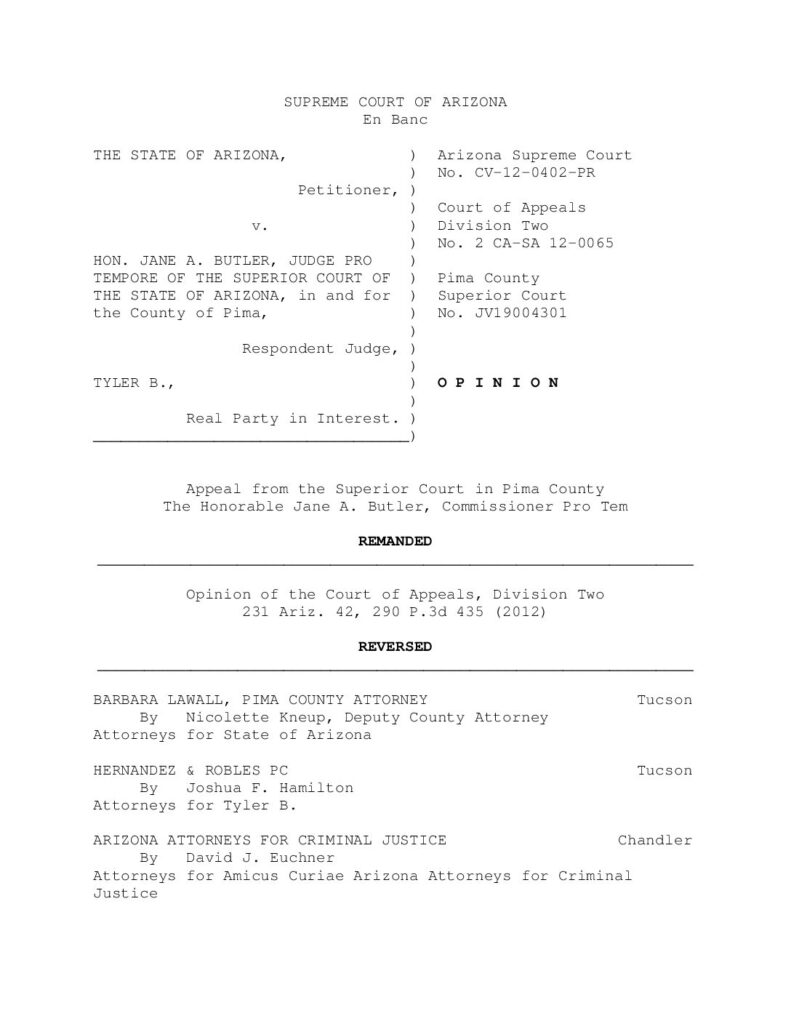
The Arizona Supreme Court ruled the juvenile court did not abuse its discretion when it found a 16-year old youth’s consent to a warrantless blood draw was involuntary and granted his motion to suppress. The court offered the following language in support: “We hold now that, independent of § 28-1321, the Fourth Amendment requires an…

On October 24, 2012, the U.S. Department of Justice filed a complaint in the United States District Court, Southern District of Mississippi asserting that the City of Meridian, County of Lauderdale, and State of Mississippi are engaging in a “pattern or practice of unlawful conduct through which they routinely and systematically arrest and incarcerate children,…

On August 10, 2012, the U.S. Department of Justice released a findings report regarding their investigation of Lauderdale County Youth Court, Meridian Police Department, and Mississippi Division of Youth Services. The findings included the following violations: “(1) The City of Meridian Violates the Fourth Amendment by Arresting Children Without Assessing Probable Cause; (2) Lauderdale County…

This amicus brief by Advocates for Children’s Services of Legal Aid of North Carolina, American Civil Liberties Union, The Gault Center, and others argues the suspicionless search of all female students at an alternative school is unconstitutional under the 4th Amendment where the search’s main purpose was arrest and prosecution by law enforcement. Further, the…

On January 29, 2010, the Department of Justice issued a findings letter regarding an investigation of the Indianapolis Juvenile Correctional Facility (ICJF) pursuant to the Civil Rights of Institutionalized Persons Act, 42 U.S.C. § 1997 (CIPRA), and the pattern or practice provision of the Violent Crime Control and Law Enforcement Act of 1994, U.S.C. §14141…

This research paper from the Journal of Interpretation looks at the intersection of a subset of deaf people, who are classified as semilingual (meaning they are functionally illiterate (reading level grade 2.9 or below) and lack proficient English or sign language skills.), and their involvement in the legal system. The research paper examines eleven frequently…

The U.S. Supreme Court held the 4th Amendment of the U.S. Constitution applies to searches by school officials and is not limited to searches carried out by law enforcement officers. The Court reasoned that children in school have a reasonable expectation of privacy, and that searches must be reasonably justified at inception and in its scope so as not to be excessively intrusive given a child’s age,…
- « Previous
- 1
- …
- 3
- 4
- 5
