Detention

By understanding the conditions facing incarcerated youth, the responsibility of the justice system, and strategies designed to improve outcomes, stakeholders can make informed decisions. After arming readers with the historical timeline necessary to understand Texas’ complicated history with its juvenile justice system, LSJA’s Reimagining Reform report issues a challenge to stakeholders during a crucial time…

This one-page infographic illustrates statistics from the Office of Juvenile Justice and Delinquency Prevention’s Juvenile Residential Facility Census

NJDC Executive Director, Mary Ann Scali and NJDC Gault Fellow, Aneesa Khan, host a webinar on decreasing the pretrial detention of young people in the juvenile justice system. Presenters review juvenile cash bail laws and discuss a national snapshot of states where cash bail is being used to detain rather than release youth. The webinar…

The COVID-19 pandemic, declared a public health emergency in the United States on March 13, 2020, had an impact on the policies, procedures, and data collection activities of juvenile courts relating to the referrals and processing of youth. Mitigation efforts such as stay-at-home orders and school closures impacted the volume and types of law-violating behavior…


This checklist can be used to assess the presence of constitutional violations throughout the course of a client’s case. Please refer to the National Youth Defense Systems Standards and their accompanying User Guide for litigation strategies to challenge potential constitutional violations noted in this checklist.

This User Guide provides advocates with a step-by-step outline of how to actualize the vision of the National Youth Defense System Standards to equip and invest in youth defense teams to fight for the liberation of all youth.The User Guide outlines constitutional rights detailed in the System Standards, provides a checklist to assess the presence…
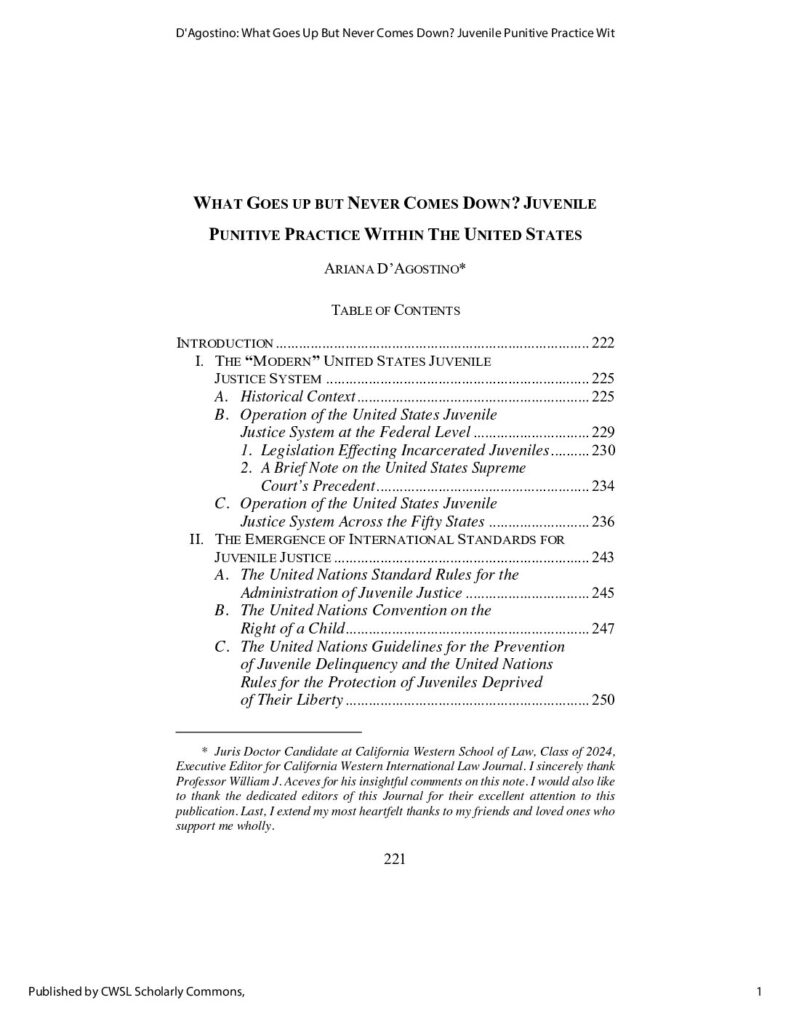
From the Introduction of the Paper: “The U.S.’s failure to implement an internationally abiding federal law regulating juvenile justice has important implications on the treatment of incarcerated adolescent populations while incarcerated, rehabilitated, and reintegrated into society. This article will analyze the harmful and outdated legal frameworks and institutional structures of the U.S. juvenile justice systems.…


In February 2024, the American Psychological Association released a resolution detailing evidence-based recommendations to limit and eventually eliminate the use of solitary confinement on youth. Key recommendations include prohibiting solitary confinement except under exigent circumstances, the duration of which generally should not exceed four hours, and prioritizing evidence-based strategies that promote positive youth development in…


The Annie E. Casey Found. (2023). The Annie E. Casey Foundation undertook a three-year analysis from January 2020 to January 2023 of the effects of the Covid-19 pandemic on juvenile detention rates. The analysis concluded with three main findings: 1) Black youth were ten times more likely to be detained than white youth in 2023;…

In January 2024, the National Center for Juvenile Justice released their annual report detailing data trends in juvenile courts across the country from 2005 to 2021. This report provides a national snapshot of various trends in delinquency cases, including key demographic patterns across age, gender, and race at various stages of case processing. Notably, in…


Outlines steps that states must take to comply with the minimum requirements of the U.S. Constitution to protect the rights of youth facing deprivations of liberty.


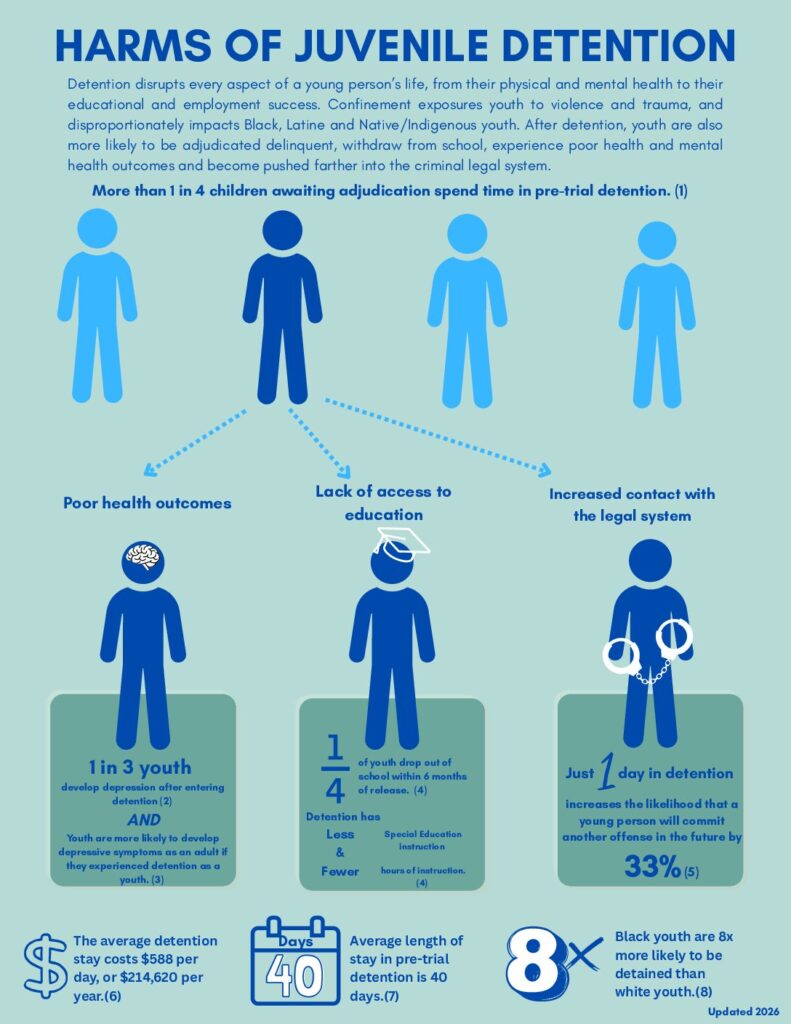
Youth in detention are removed from settings that matter: their homes, schools, and communities. Without those supports, children develop higher rates of depression, anxiety, and other mental health conditions, and they lose access to educational opportunities. Once released, youth who spent time behind bars are more likely to disengage from school and become system-involved in…