
Detention


From the introduction: “Youth justice advocates, including lawyers, organizers, and other youth and adult movement builders, want to replace the current damaging, discriminatory, and ineffective juvenile and criminal legal systems1 with better approaches. We envision approaches that support children, help them f lourish, and contribute to a safe, equitable, and healthy community. How do we…

From the abstract: “People who require gynecological and obstetric care and who are detained by U.S. federal immigration authorities face unique challenges. This article examines how the current legal and administrative landscape fails to hold those responsible for providing healthcare accountable, effectively blocking access to gynecological care, and, assuming no immediate abolition of immigrant detention…


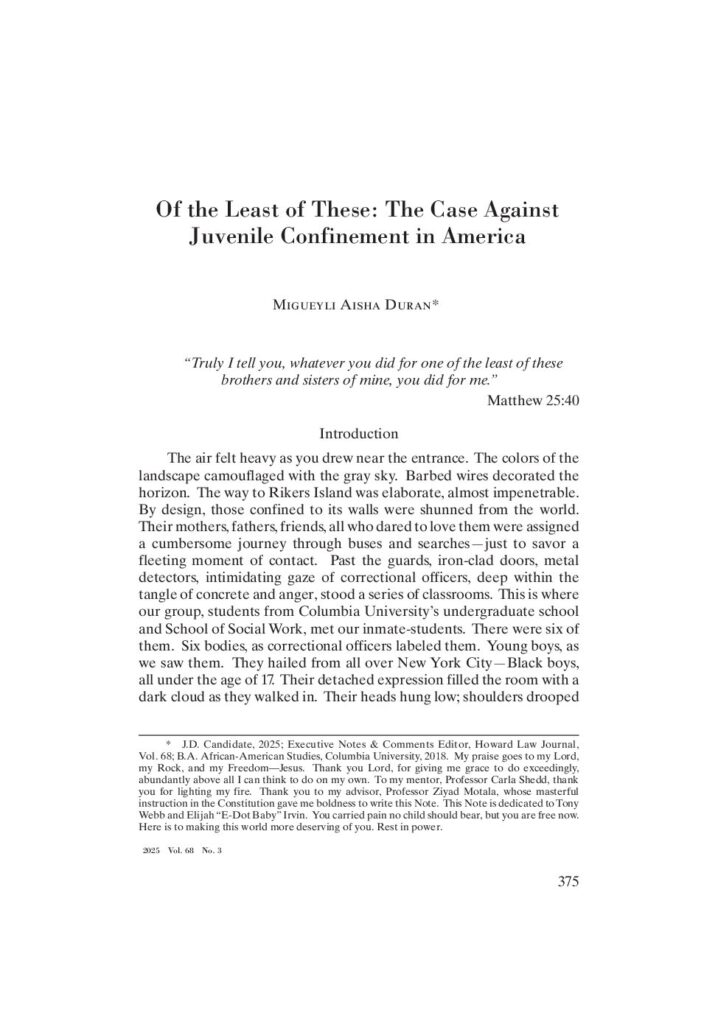
From the introduction: This Note proposes a new standard for resolving condition of youth confinement claims; one that seeks to circumvent courts’ tendency to grant state officials undue deference in conditions of youth confinement claims and protect the futures of incarcerated children. The new standard proposed is found in another provision of the Fourteenth Amendment—the…


From the introduction: “This advisory takes you through the various stages of removal proceedings to provide an overview of the process. It also explains key terms that may be relevant to your noncitizen clients.”

This letter was prepared by a group of organizations in California to the Los Angeles County Probation Department and County Board of Supervisors stating “In light of recent federal developments including an alarming increase in immigration enforcement actions, we, the undersigned organizations, write to urge you to review your protocols and ensure they are consistent…
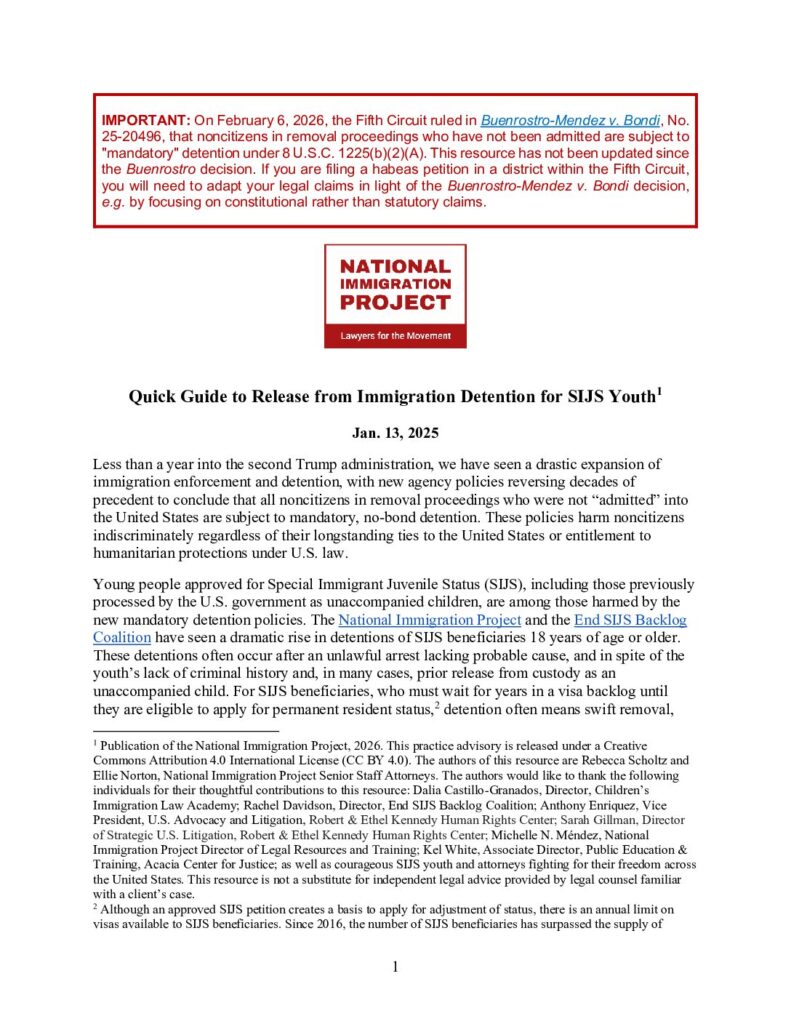
“IMPORTANT: On February 6, 2026, the Fifth Circuit ruled in Buenrostro-Mendez v. Bondi, No. 25-20496, that noncitizens in removal proceedings who have not been admitted are subject to “mandatory” detention under 8 U.S.C. 1225(b)(2)(A). This resource has not been updated since the Buenrostro decision. If you are filing a habeas petition in a district within…

This report is the latest in a series of Juvenile Justice Initiative (JJI) reports on juvenile detention, building on prior research in concluding the time is ripe for a complete overhaul of the juvenile detention system in Illinois.


This report from National Institute for Criminal Justice Reform offers six principles of a positive youth justice system (‘PYJS’) including: 1) Minimize contact with the juvenile justice system, 2) partner with youth and families to develop and share ownership of case plans, 3) community-based organizations should take the lead, 4) build on youth assets and…

The Office of Juvenile Justice and Delinquency Prevention and the National Institute of Justice released a fact sheet highlighting key delinquency caseload trends from 2021. There were 437,300 delinquency cases in the United States, down by 39% from 2020, contributing to an overall decline in delinquency cases since its peak in 1997. In 2021, 44%…


On October 24, 2024, the U.S. Department of Justice filed a Statement of Interest in a federal class action lawsuit challenging conditions of confinement at the Mary Davis Detention Home in Galesburg, Illinois. The DOJ asserted, “The federal government, too, has repeatedly recognized that children are developmentally and constitutionally different than adults and that excessive…

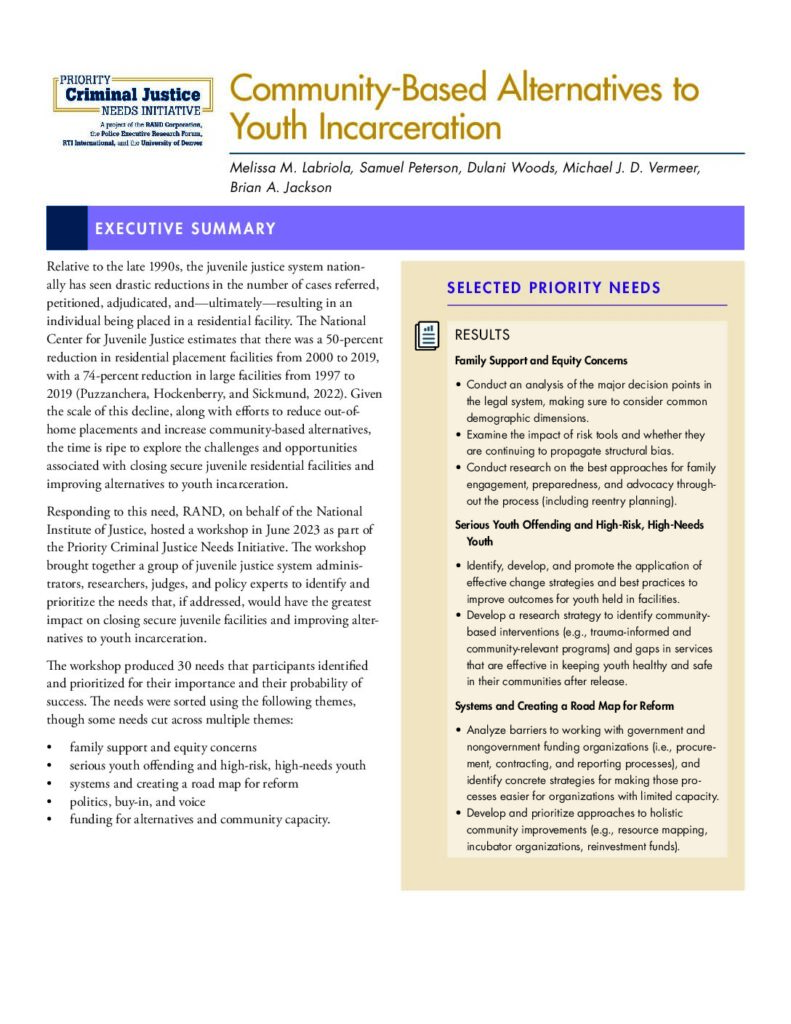
This report from the RAND Corporation highlights needs that various delinquency system practitioners and policy experts identified to support the closure of juvenile facilities and improvement of alternatives to incarceration. From the Executive Summary: Relative to the late 1990s, the juvenile justice system nation ally has seen drastic reductions in the number of cases referred,…
