
Health and Mental Health
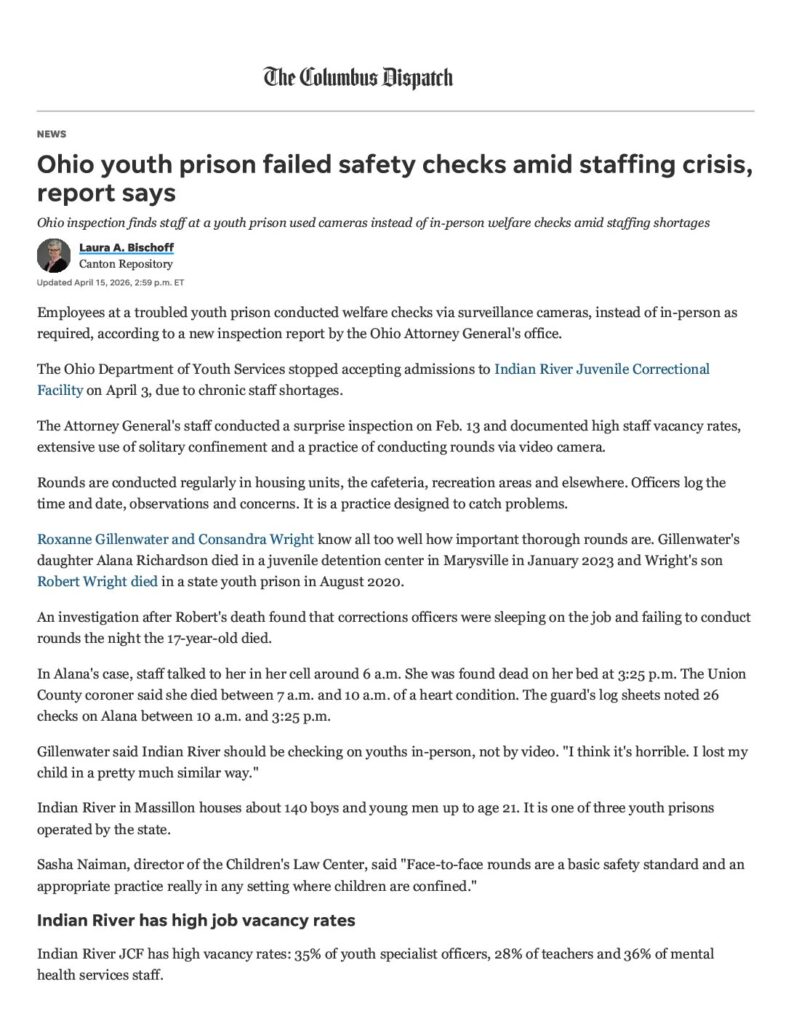
Executive Director Mary Ann Scali was interviewed by USA Today regarding conditions of confinement concerns at Ohio’s Indian River Juvenile Correctional Facility. Staffing shortages, extensive use of solitary confinement, and staff conducting rounds via video instead of in person are a just a few of the issues that have been reported by young people and…
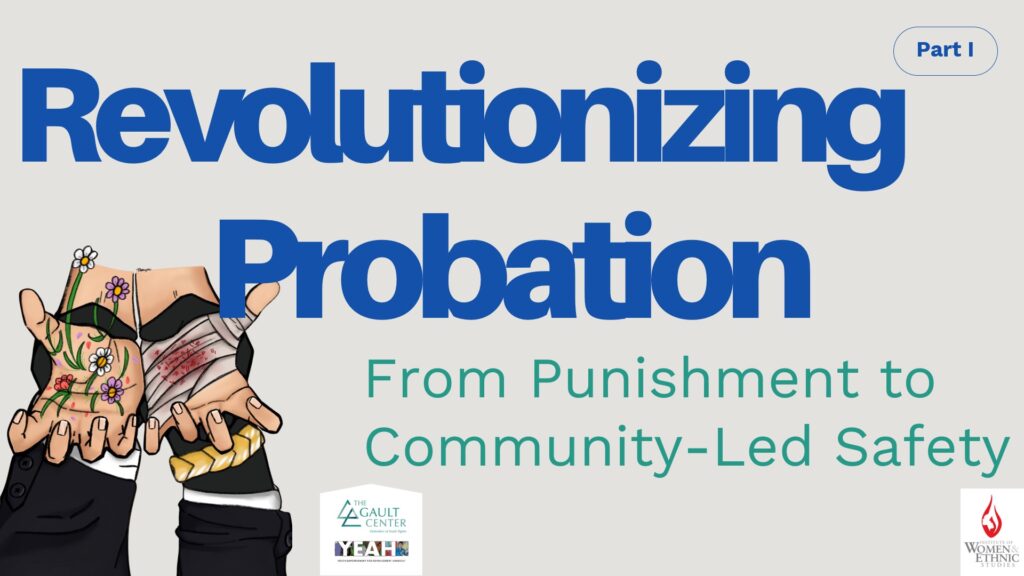
On March 26, 2026, the Gault Center & Youth Empowerment for Advancement Hangout (YEAH Philly) hosted a webinar on Revolutionizing Probation from Punishment to Community-Led Safety. This webinar focused on shifting narratives around juvenile probation—to challenge the dominant rhetoric that probation is an act of benevolence that keeps youth and communities safe and to bring…

On March 26, 2026, the Gault and Youth Empowerment for Advancement Hangout (YEAH Philly) co-hosted a webinar on Revolutionizing Probation from Punishment to Community-Led Safety. This resource includes PowerPoint presentations from the Gault Center covering the history and youth experiences on juvenile probation, YEAH Philly highlighting meaningful community-based alternatives, and the Institute of Women & Ethnic…
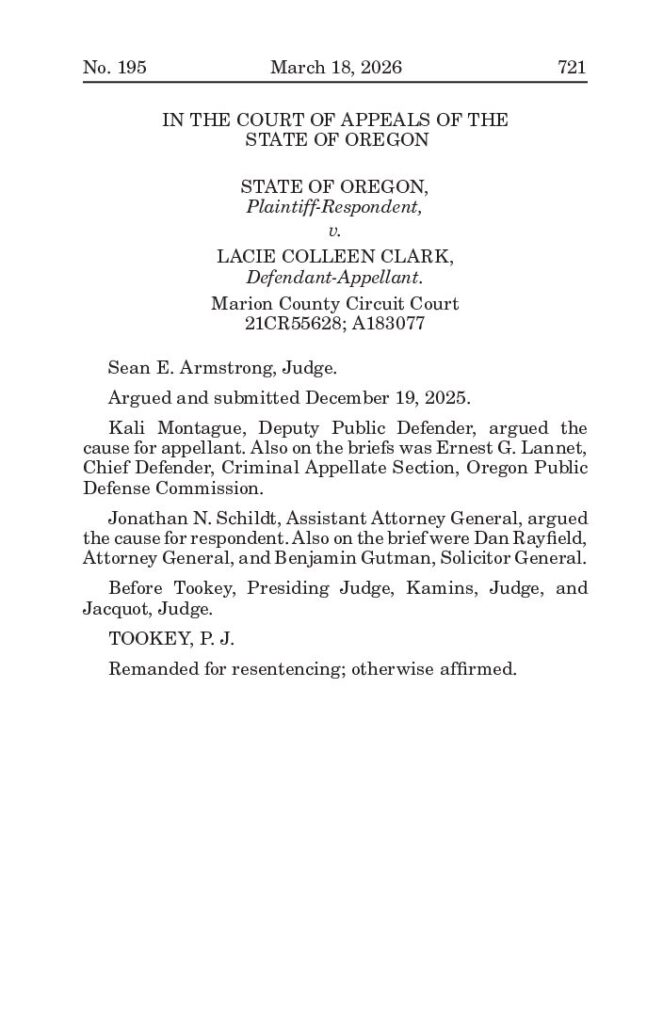
The Oregon Court of Appeals held that a trial court must consider mental health attributes at sentencing pursuant to the Eighth Amendment and the Oregon state constitution’s prohibition against cruel and unusual punishment. The court stated in relevant part: “We agree with defendant that ORS 131.295 and ORS 131.300 provide that objective societal standard. Through…

“The modern American criminal justice system emerged not simply from Progressive-Era reform, but from the intertwined projects of eugenics, psychiatry, and legal modernism. Drawing upon archival, historical, and doctrinal sources, this Article reveals how early twentieth-century reformers—including judges, criminologists, and social scientists—recast criminal law as a mechanism for identifying and controlling hereditary “defect.” Under the…
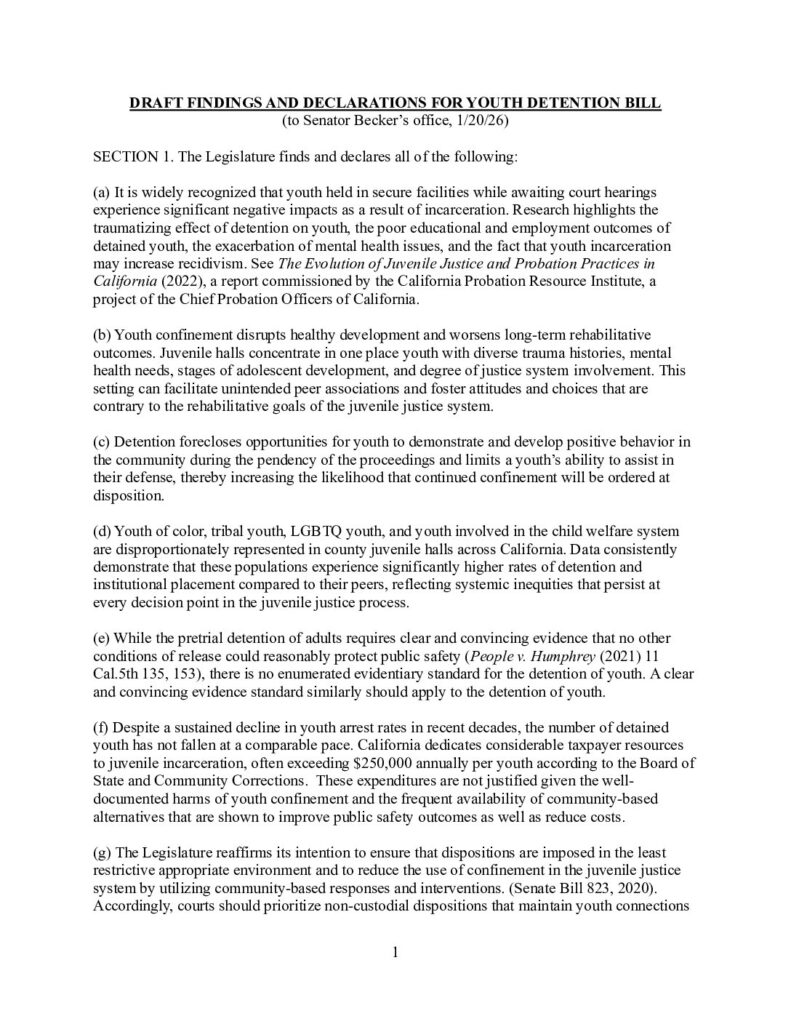
This proposed draft of a legislative “findings and declarations” document for a youth detention and disposition reform bill in California affirms the legislature’s commitment to make placement in juvenile detention “the exception, not the rule.” The draft findings rely on research regarding the impact of detention on young people, racial justice, developmental science, and California…
From the Abstract: “Interrogation techniques are influenced by the interrogator’s style and the individual being interviewed. Most law enforcement agencies use adult-centered interrogation methods, leading to suboptimal results when working with youth. The research has focused on youth offenders in the interrogation room and the choices they make, often leading to false confessions when an…


This report, written by the Sentencing Project, highlights the harmful practice of direct file, or “auto-charging” youth in adult court. This national analysis looks at the practice of direct file and the pervasive harms that it has on the wellbeing and future thriving of young people and makes recommendations for states to limit pathways for…

This memorandum proposes language for a detention and disposition reform bill in California. The memorandum proposes four areas the detention reform bill aims to change including: 1) clarifying the legal standard for pre-adjudication detention of youth, 2) clarifying the juvenile court’s authority to determine whether pre-adjudication detention is still necessary, 3) clarifying the standard at…

From the abstract: “Juvenile correctional programs that focus solely on safety, education, and structure yield suboptimal outcomes. Youth in these facilities often have learning disorders, and adaptive challenges, have been exposed to severe trauma, and have mental disorders, including autism spectrum disorder. Consequently, rehabilitation programs must be comprehensive, individualized, developmentally informed, and trauma informed to…

In October 2025, the Gault Center convened over three hundred youth defense lawyers and advocates at our annual Youth Defender Leadership Summit. Together, we practiced the cultivation of community in service of building a more just, more liberated, and more human humanity for all children and for us all. This resource captures the shared learnings…
This article focuses on the policies and practices of community supervision programs, and the impact they have on individuals with disabilities, including discriminatory practices that prevent disabled individuals from successfully completing probation or parole. From the introduction: ” This Article addresses disability discrimination in community supervision programs, a large—but frequently overlooked—component of the criminal legal…

This “Fast Facts” Publication from UCLA’s Center for the Developing Adolescent provides insight on how to support young people five years after the COVID-19 pandemic. From the publication: “In 2020, COVID disrupted nearly every aspect of education, work, and social connections. Students who were in the earliest years of their education when schools first closed…
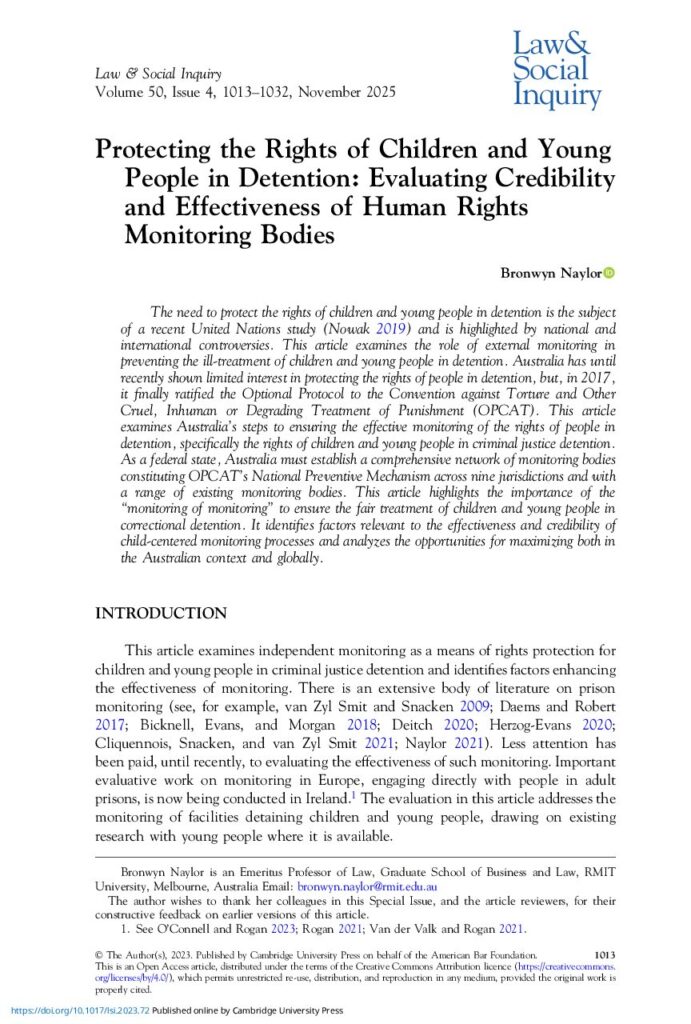
“The need to protect the rights of children and young people in detention is the subject of a recent United Nations study (Nowak 2019) and is highlighted by national and international controversies. This article examines the role of external monitoring in preventing the ill-treatment of children and young people in detention. Australia has until recently…

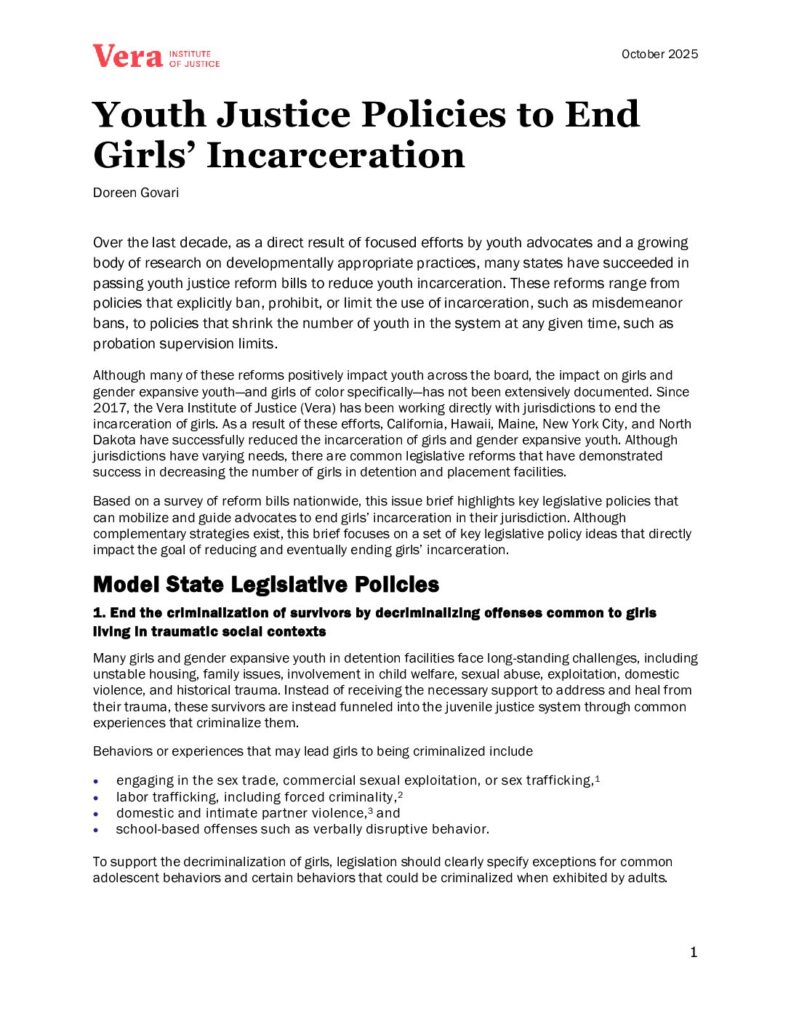
This report from Vera Institute for Justice provides examples of reforms from various states that are working to reduce the incarceration of girls in detention and long-term placement. “Over the last decade, as a direct result of focused efforts by youth advocates and a growing body of research on developmentally appropriate practices, many states have…

This resource from Lambda Legal and the American Bar Association Children’s Rights Litigation Committee gives attorneys an overview on how to approach client interviewing and relationship building in a respectful and trauma-informed way. The page discusses the importance of identity for young people’s well being and on their legal cases. It also reviews basic interview…

“Do criminal courts meaningfully accommodate psychiatric disability? A review of competency proceedings across the United States suggests not. In competency to stand trial (CST) proceedings, criminal courts offer a narrow vision of psychiatric disability that excludes many defendants. Ultimately, the institutional context of criminal court under-mines even the meager accommodations that the competency framework provides.…
This amicus brief from over 26 juvenile justice amici, including the Gault Center, , argues 1) the spirit and text of New York’s passage of landmark Raise the Age Law rejects the attitudes that underlay the Juvenile Offender Act of 1978, 2) New York’s Raise the Age Law and its legislative history demands a youth subject to adult prosecution only in “extremely rare and exceptional cases”, 3) before courts…

From the abstract: “Attorneys who can recognize and respond to trauma and stress, in both their clients and in themselves, are better positioned to provide effective advocacy and help shape a more restorative legal practice. As clients and communities face mounting pressure amid growing social, economic, climate, and systemic challenges, legal education must evolve to…

“For decades, in the summertime, America has confined certain of its youth in what are essentially open-air heat camps. In city after city, camp-form is established through the enactment of warm-weather juvenile curfews which keep the youth at home or in state-sponsored centers during summer nights and, increasingly, during days as well. Local governments justify…

This resource offers a brief overview of how children are transferred or bound over to adult court in Ohio and discusses what is at stake in the case of State v. D.T., 2024-Ohio-4482 (Ohio Ct. App. 2024) pending before the Ohio Supreme Court. The Gault Center filed an amicus in this case here. Oral arguments were…
