
Sensation Seeking
This amicus brief from over 26 juvenile justice amici, including the Gault Center, , argues 1) the spirit and text of New York’s passage of landmark Raise the Age Law rejects the attitudes that underlay the Juvenile Offender Act of 1978, 2) New York’s Raise the Age Law and its legislative history demands a youth subject to adult prosecution only in “extremely rare and exceptional cases”, 3) before courts…


From the abstract: “All countries distinguish between minors and adults for various legal purposes. Recent U.S. Supreme Court cases concerning the legal status of juveniles have consulted psychological science to decide where to draw these boundaries. However, little is known about the robustness of the relevant research, because it has been conducted largely in the…

This amici brief by Juvenile Law Center, Loyola Civitas Childlaw Clinic, and others argues automatic prosecution and mandatory sentencing of young people charged with felony murder is unconstitutional in light of recent Supreme Court case law as Illinois law does not allow for individual sentencing based on maturity and culpability. Furthemore, the brief argues the…

This amicus brief by The Gault Center, Juvenile Law Center, and National Center for Lesbian Rights argue that strict liability statutes run counter to the principles of adolescent development. Here, amici argue that a 12-year old child who engaged in non-forcible sexual conduct with his peer, who was then prosecuted under a strict liability sex…
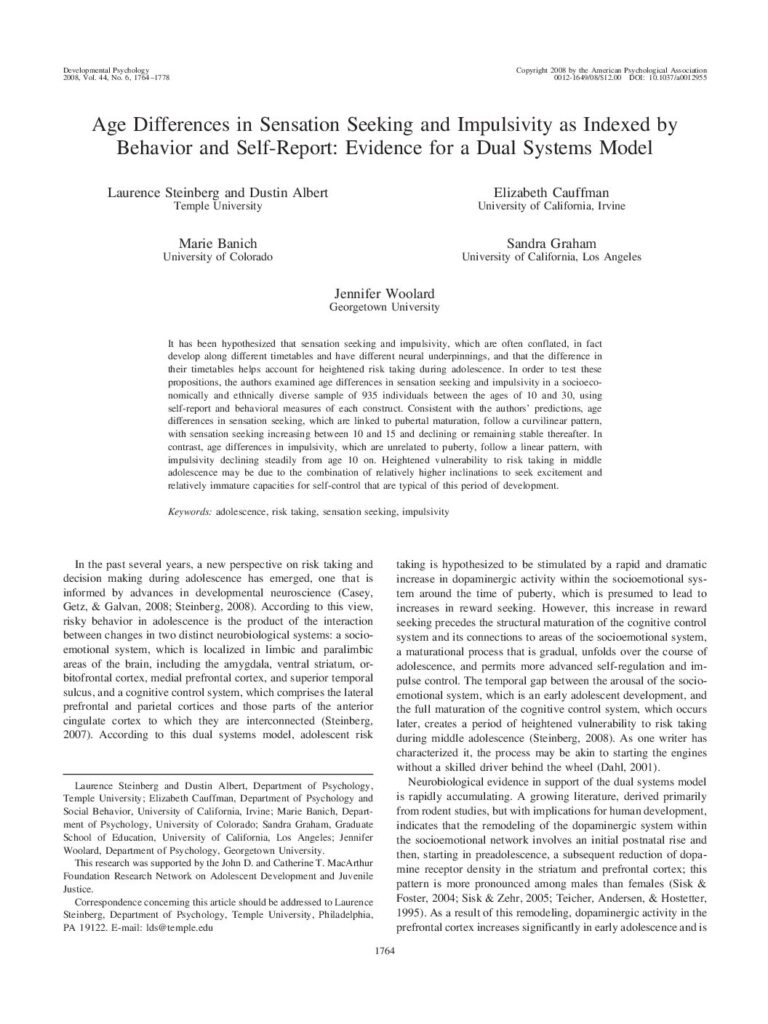
It has been hypothesized that sensation seeking and impulsivity, which are often conflated, in fact develop along different timetables and have different neural underpinnings, and that the difference in their timetables helps account for heightened risk taking during adolescence. In order to test these propositions, the authors examined age differences in sensation seeking and impulsivity…
