
Sex Offenses & Registration

From the introduction: “This project, which started in fall 2020, was initially intended to be significantly smaller than it turned out to be. Our coalition of authors intended to outline ways juvenile defenders could streamline their representation of youth charged with sex offenses. As the project gained momentum, this team of trial attorneys, social workers,…


Heavy workloads and the culture in many courts can make it difficult for juvenile defenders to stay connected to clients post-disposition. Even after disposition in juvenile court, young people face legal issues that affect — and often threaten — their liberty, their safety, their due process and civil rights, and their access to future opportunities.…

A sample motion arguing child pornography laws are unconstitutional as applied to a children engaging in sexting. The motion argues the statute is void-for-vagueness since it fails to provide fair notice regarding prohibited conduct for children under 18 and it encourages arbitrary and discriminatory enforcement because the distinction between offender and victim is blurred. Furthermore,…

This resource offers a summary of key research on sex offender registration and notification for youth. This resource includes research on recidivism, residency restrictions, collateral consequences, stresses of registration, and perceptions by the public, criminal legal systems, and individuals.

This article, written by Mae C. Quinn and published in the N.Y.U. Review of Law and Social Change, examines the “various ways in which youthful online actions and interactions, like pubescent urban activities from decades before, are being prohibited by emerging laws and orders.” Further the article looks at our country’s “obsession of policing puberty”,…

In the case of C.P, the Ohio Supreme Court ruled that R.C. 2152.86, which created a new class of youth adjudicated of sex offenses who would automatically be subject to mandatory, lifetime sex-offender registration and notification requirements, violated the U.S. and Ohio Constitutions. In its ruling, the Court offered the following language in support: “In…
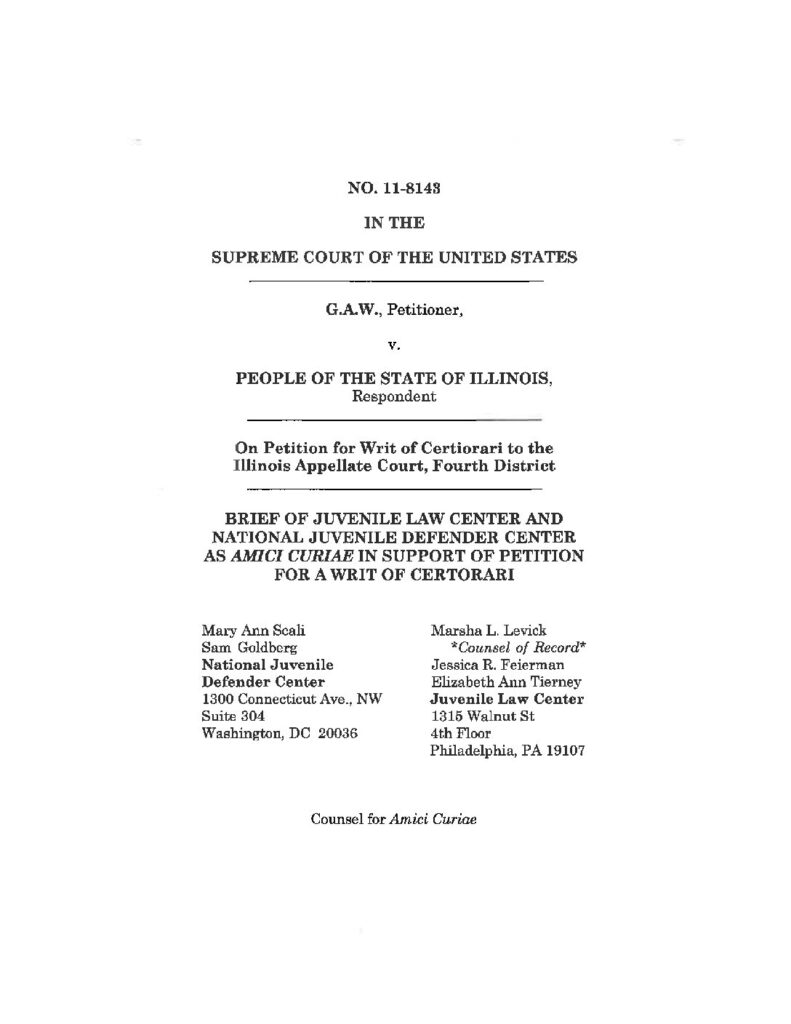
This amicus brief by The Juvenile Law Center and The Gault Center argues that young people have a constitutional right to a jury trial pursuant to the 6th and 14th Amendment, in cases with serious consequences, such as sex offenses with numerous collateral consequences, in juvenile court, without “comparable adult procedural protections”. Further, the brief…

This amicus brief by The Gault Center, Children’s Law Center, Inc., and the American Civil Liberties Union of Ohio Foundation, Inc. argues mandating young people to register on sex offender registries is improper since youth adjudicated of sex offenses are vastly different from adults convicted of sex offenses, registries frustrate the purpose of juvenile court,…

This amicus brief by The Gault Center, Juvenile Law Center, and National Center for Lesbian Rights argue that strict liability statutes run counter to the principles of adolescent development. Here, amici argue that a 12-year old child who engaged in non-forcible sexual conduct with his peer, who was then prosecuted under a strict liability sex…

An expert affidavit from Professor Franklin Zimring outlining relevant data, studies and research supporting that youth who are charged with sex offenses in juvenile court should not be subject to sex offender registry requirements or stigmatization that comes with sex offense adjudications. The affidavit analyzes recent studies highlighting that “the empirical research to date supports…
- « Previous
- 1
- 2
