In re Huerta, 2026 Cal. App. Unpub. LEXIS 116 (Cal. App. Ct. 2026)

The Fifth District Court of Appeal held that gang enhancements may form the basis of a petition for habeas relief and appointment of counsel under the state’s Racial Justice Act. The court stated in relevant part: “The present petition alleges racially disparate treatment, and it identifies the statutory subsections implicated as the basis for the…
Read MoreAnnotated Bibliography: Race and Adolescent Development
Firearm Data Report CY2024

The Ohio Department of Youth Services released a report capturing data on youth who were charged with firearm-related offenses as part of the Juvenile Detention Alternatives Initiative (JDAI). “According to 2024 data submitted by Ohio JDAI sites, there were a total of 866 admissions to detention for a firearm-related charge. The majority of admissions to…
Read MoreA Decade After Montgomery v. Louisiana: Progress, Gaps, and the Promise of Meaningful Review for Children Serving Extreme Sentences

This report from the Campaign for the Fair Sentencing of Youth provides a national overview of the progress states have made post-Montgomery in changing sentencing laws for young people in adult court facing life without parole and other lengthy sentences, and opportunities for continued legislative, legal and policy change. From the resource: Ten years ago, the…
Read MoreThe Irrationality of Punishing Homelessness
“The Supreme Court upheld the criminalization of public survival by unhoused people in City of Grants Pass v. Johnson in June 2024. This article examines that decision and considers why Grants Pass had not enforced its camping ban against unhoused people when the author visited the city one year later. One important reason is that…
Read MoreWhat to Expect When Attending Juvenile Court: Practical Guidance for Immigrant Youth and Families Interacting with the Juvenile Justice System
This resource from Citizens for Juvenile Justice offers practical guidance for immigrant youth and families interacting with the juvenile legal system. From the resource: “A young person learning that they are being summoned to appear in juvenile court can be stressful. This is especially the case when a young person is from an immigrant background,…
Read MoreAbolishing Carceral Data

“ American prisons are a black box: remote, austere, and cruel. Although basic demographic data about the people confined in prisons are common—that is, data on the number of people incarcerated, their age, or their race—there is little information available to the public regarding conditions of confinement. A natural response to this data deficit is…
Read MorePeople v. Hill, 2025 IL App (1st) 230604 (Ill. Ct. App. 2025)
The 1st District Court of Appeals of Illinois held that an individual is entitled to a new trial due to ineffective assistance of counsel where defense counsel failed to communicate sufficiently with their client and investigate a witness that was flagged by the client. The court stated in relevant part: An attorney’s failure to communicate…
Read MorePeople v. Kopp, 19 Cal. 5th 1 (Cal. 2025)
The California Supreme Court held that the imposition of punitive fines and ancillary costs ordered as part of a criminal sentencing raises equal protection issues that require courts to consider ability to pay before imposing fines and costs. The Court stated in relevant part: “In sum, in light of the Legislature’s provision of fee waivers…
Read MoreIn re K.A.A., 2025 Minn. App. Unpub. LEXIS 995 (Minn. Ct. App. 2025)
The Minnesota Court of Appeals reversed a restitution order on a juvenile delinquency case based on a finding that the youth was deprived of their right to effective assistance of counsel. The Court stated in relevant part: “Finally, K.A.A. contends that her right to effective assistance of counsel was violated in the restitution proceeding. Juvenile-delinquency…
Read MorePeople v. Michael J., 2025 IL App (5th) 250546-U (Ill. Ct. App. 2025)

The Illinois 5th District Court of Appeals found that the juvenile court lacked statutory authority to proceed on a transfer determination once a young person turned 22 years old. This case involved an initial transfer determination followed by a reconsideration request by the defense based on lack of probable cause to justify the initial transfer…
Read MorePeople v. Camp, 2025 Co. 64 (Colo. 2025)
The Colorado Supreme Court held that “when a municipal ordinance and a state statute prohibit identical conduct, the municipal penalties for such conduct may not exceed the corresponding state penalties for that conduct.”
Read MorePeople v. Lopez, 2025 Cal. App. Unpub. LEXIS 8185 (Cal. Ct. App. 2025)

The 6th District Court of Appeal in California reversed an order denying a resentencing petition based on trial counsel’s failure to raise the implications of youthfulness and adolescent development in disputing implied malice in a felony murder case. The court stated in relevant part: “Lopez, 20, participated in the attack on Sandoval with two peers.…
Read MorePeople v. Reyes, 2025 IL App. (2d) 210423-B (Ill. Ct. App. 2025)
The Second District Court of Appeals in Illinois vacated a 66-year sentence finding that the trial court misinterpreted youth-related statutory factors as aggravating instead of mitigating factors. The court stated in relevant part: “Defendant also argues that the trial court incorrectly interpreted the statutory factor of his ability to consider the risks and consequences of…
Read MorePoynter v. Bennett, 2025 FED. App. 0345P (6th Cir. 2025)
The 6th Circuit Court of Appeals reversed the district court’s summary judgment order, finding sufficient evidence for constitutional harm where a jail fails to classify or reclassify individuals who are detained based on their histories, leading to multiple assault incidents in the jail. The court stated in relevant part: “A municipality can be held liable…
Read MoreState v. Gardner-Rolph, 345 Ore. App. 681 (Or. Ct. App. 2025)

The Oregon Court of Appeals examined a state sentencing statute that prohibits juvenile life without parole sentences (ORS 161.740) and held that it applies when an individual is convicted in adult court and sentenced for an offense committed when they were under the age of 18 if the sentence was imposed on or after January…
Read MorePeople v. Campbell, 2025 Mich. App. LEXIS 10103 (Mich. Ct. App. 2025)
The Michigan 1st District Court of Appeals vacated second-degree murder and assault with the intent to commit murder sentences for an individual who was 18 years old at the time of the incident and remanded with instructions for the trial court to consider youthfulness and its attendant characteristics as mitigating factors. The court stated in…
Read MoreThe Non-Punishment Principle and Restorative Justice
“The non-punishment principle is a legal norm that has increasingly gained legitimacy over the past quarter-century within international, regional, and domestic law on human trafficking. At its core, this principle opposes the punishment of human trafficking victims for unlawful conduct they engage in as a consequence of their trafficking victimization. Little is known about the…
Read MoreJ.N.S. v. State, 2025 Fla. App. LEXIS 9475 (Fla. Dist. Ct. App. 2025)

The Florida 6th District Court of Appeal reversed a youth’s adjudication of grand theft of a motor vehicle based on the State’s failure to prove ownership of the car involved. The Court stated in relevant part: “The delinquency petition charged J.N.S. with stealing Redenti’s “Nissan automobile.” But neither J.N.S.’s confession, witness testimony, nor other evidence established…
Read MoreAutomatically Charging Youth as Adults
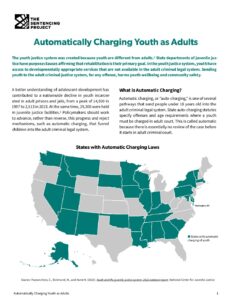
This report, written by the Sentencing Project, highlights the harmful practice of direct file, or “auto-charging” youth in adult court. This national analysis looks at the practice of direct file and the pervasive harms that it has on the wellbeing and future thriving of young people and makes recommendations for states to limit pathways for…
Read More