
HR² Effective Services and Supports for Youth Who are High Risk and Hard to Reach
The National Institute for Criminal Justice Reform released a report spotlighting promising examples of credible messenger and intensive life-coaching programs to reach youth charged with serious offenses. “This brief argues that the next phase of youth justice reform must focus on intentionally and effectively serving HR2 youth. Doing so will require moving beyond strict replication…
Read MoreReforming Juvenile Restitution
“Restitution laws, for the most part, have barely changed since their tough on-crime inception; juveniles therefore remain subject to lasting involvement in the criminal justice system—a burden that amounts to a financial death penalty. This article explains why juvenile restitution should now change too. The time has come for restitution that achieves its rehabilitative goals…
Read MoreEugenic Criminology and the Birth of Predictive Algorithms in Criminal Justice
This law review article written by Professors Megan T. Stevenson and Robynn J.A. Cox uncovers the eugenic origins of risk assessment tools and highlights how modern-day uses of risk assessments for preventive detention still perpetuate eugenic criminology, albeit with new terminology. This article challenges the ongoing influence of eugenics in identifying who is “high risk”…
Read MoreSellers v. Superior Court, 2026 Cal. LEXIS 269 (Cal. 2026)

The California Supreme Court found that a small amount of loose marijuana scattered on the rear floor of a car does not violate a state statute prohibiting driving while under the impairment of marijuana. The court further held that these circumstances did not create probable cause to conduct a search of the vehicle. The court…
Read MoreIn re J.G., 2026 Cal. LEXIS 525, (Cal. 2026)

The California Court of Appeals, First District held the courts imposition of an electronics search probation condition invalid, finding under the first and third prongs of the Lent test that the condition “1)has no relationship to the crime which the offender was convicted, and 3) requires or forbids conduct which is not reasonably related to…
Read MoreAB 1647 – Transfer Bill Proposed in California to Change Standard of Proof for Amenability Finding
This proposed legislation from California amends the transfer law (CA WIC § 707(a)) to require a judicial finding of proof beyond a reasonable doubt, instead of the lesser standard of clear and convincing evidence, that a minor is not amendable to rehabilitation while in juvenile court.
Read MoreSample Motion to Dismiss and/or Suppress Evidence Based on Selective Prosecution
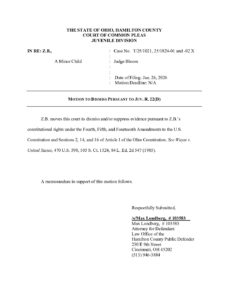
This sample motion argues for special discovery and dismissal and/or suppression based on a claim of selective prosecution in a jaywalking case. Highlighting local police data on racial disparities in jaywalking-related stops, this motion argues that police conduct had a discriminatory effect on Black youth in Cincinnati, in violation of their state and federal equal…
Read MoreSample Motion to Dismiss and/or Suppress Evidence Based on Selective Prosecution – Supplemental Memorandum
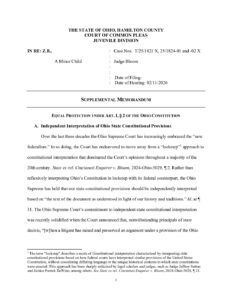
This supplemental memorandum is related to the sample motion to dismiss and/or suppress evidence based on selective prosecution, which argues for special discovery and dismissal and/or suppression based on a claim of selective prosecution in a jaywalking case. This supplemental memorandum outlines Ohio’s Equal Protection guarantee in the context of the impact of implicit racial…
Read MoreIn re A.W., 2026 Nev. Unpub. LEXIS 59 (Nev. 2026)
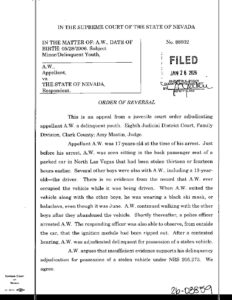
The Nevada Supreme Court reversed an adjudication finding insufficient evidence for possession of a stolen vehicle. The court stated in relevant part: “Viewing the evidence in the light most favorable to the State, we conclude that the evidence presented at the adjudicatory hearing by the State was insufficient to demonstrate that A.W. had possession of…
Read MoreIn re of E.S.S., 2026 Minn. LEXIS (Minn. 2026)
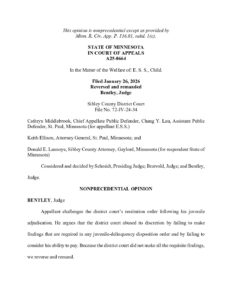
The Minnesota Court of Appeals held that the district court failed to make findings of fact required by statute when ordering restitution and remanded the case for the trial court to make the requisite findings. The court held in relevant part: “Juvenile-delinquency orders require written findings “to show that the district court considered vital standards…
Read MorePeople v. Campbell, 2026 Ill. LEXIS 11 (Ill. 2026)
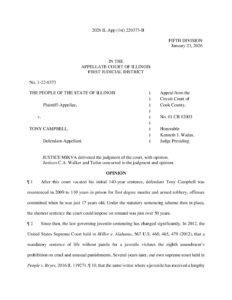
The Illinois Court of Appeals held that where a minimum sentence available by statute was a de facto life sentence, the sentencing scheme violates the Eighth Amendment under Miller and remanded the case for a new sentencing hearing. The court reasoned in relevant part: “The holding in Miller is rooted in society’s growing awareness that even brutal…
Read MorePeople v. Campbell, 2026 Il. App. (1st) 220373-B (Ill. Ct. App. 2026)

The Illinois 1st District Court of Appeals vacated a 110-year sentence, finding an Eighth Amendment violation. The court stated in relevant part: “One factor that Miller requires a court to consider before it imposes a life sentence is “the juvenile defendant’s degree of participation in the homicide and any evidence of familial or peer pressures that…
Read MoreIn the Matter of Malachi D., 2026 N.M. LEXIS 24 (N.M. 2026)
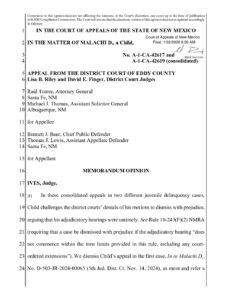
The New Mexico Court of Appeals held that Malachi D. was reserved his right to appeal despite his plea, and the trial court erred in granting counsel’s request to dismiss the cause as the adjudication hearing was not heard in a timely manner. The court reasoned in part: “We believe that the judgment and disposition…
Read MoreVelasquez v. State, 2026 Wy. 11 (Wy. 2026)
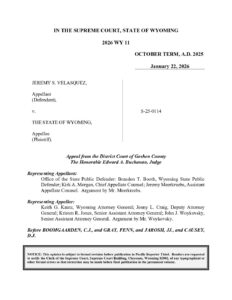
The Supreme Court of Wyoming held that a trial court must hold a separate disposition hearing in probation revocation proceeding. The court stated in relevant part: “Although Wyoming law does not require separate hearings for the adjudication and disposition phases of a probation revocation, each phase must be conducted in accordance with such law. The…
Read MoreIn re A.B.T., 2026 N.C. App. LEXIS 36 (N.C. Ct. App. 2026)
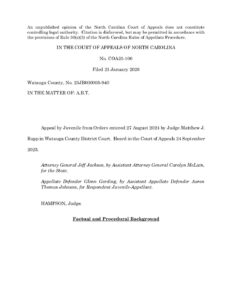
The North Carolina Court of Appeals reversed an adjudication of disorderly conduct based on insufficient evidence. The court stated in relevant part: “Considering the evidence in the light most favorable to the State and giving the State the benefit of every reasonable inference, Rose, 339 N.C. at 192, 451 S.E.2d at 223 (citation omitted), the evidence is insufficient to…
Read MoreIn re J.D., 2026 Md. App. LEXIS 57 (Md. App. Ct. 2026)
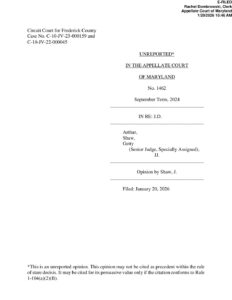
In re J.D., the Appellate Court of Maryland vacated the circuit court’s imposition of a suspended commitment to the Department of Juvenile Services because this dispositional option is not authorized by the Maryland Rules or the Juvenile Causes Act. The court offered the following language in support: “In our review of the Juvenile Causes Act, we found the statute to be clear and unambiguous. It plainly provides for three types of disposition: probation, commitment…
Read MorePeople v. Abbatoy, 2026 Mich. App. LEXIS 538 (Mich. Ct. App. 2026)

The 1st District Court of Appeals vacated a sentence involving, finding that the trial court failed to properly consider youthfulness at the time of offense as a mitigating factor. The court stated in relevant part: “Defendant argues that the trial court again failed to properly consider his youth at the time of the offense as…
Read MoreSample Draft Findings and Declarations for California Youth Detention Bill
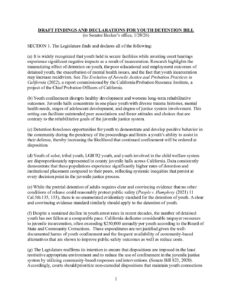
This proposed draft of a legislative “findings and declarations” document for a youth detention and disposition reform bill in California affirms the legislature’s commitment to make placement in juvenile detention “the exception, not the rule.” The draft findings rely on research regarding the impact of detention on young people, racial justice, developmental science, and California…
Read MoreReducing Youth False Confessions with Attorney Presence
From the Abstract: “Interrogation techniques are influenced by the interrogator’s style and the individual being interviewed. Most law enforcement agencies use adult-centered interrogation methods, leading to suboptimal results when working with youth. The research has focused on youth offenders in the interrogation room and the choices they make, often leading to false confessions when an…
Read MoreState v. Magana-Arevalo, 2026 Wash. LEXIS 59 (Wash. 2026)
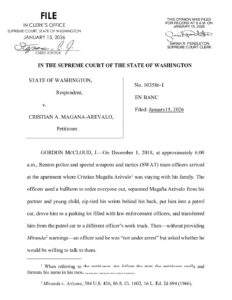
The Supreme Court of Washington found a Miranda violation based on a totality of the circumstances analysis, which the Court noted must include consideration of race and age. The Court stated in relevant part: “The United States Supreme Court has established that in determining whether a suspect is in custody under Miranda, we must “‘examine…
Read MoreHow the Administration’s Enforcement Policies Are Separating Families and Harming Unaccompanied Children
From the resource by Kids in Need of Defense: “This policy brief provides an overview of the expanding ways that the Administration’s policies and actions are tearing families apart and illustrates how the Administration is using government agencies, resources, and staffing to exploit, rather than mitigate, children’s vulnerabilities. It documents how efforts prioritizing the removal…
Read MorePrevention Beyond Deterrence
“This Article reconceptualizes preventive justice—the public safety paradigm that seeks to prevent harm before it occurs. Scholars have long documented how cities have advanced this paradigm through largely punitive measures, notably variants of broken windows policing, which posit that aggressive misdemeanor enforcement deters more serious crime. Yet in the aftermath of the 2020 George Floyd…
Read MoreIn re D.L., 2026 Cal. App. Unpub. LEXIS 132 (Cal. Ct. App. 2026)
The California Second District Court of Appeal reversed the juvenile court’s adjudication and disposition orders related to a felony murder charge, finding that the record lacked substantial evidence that the youth acted with reckless indifference to human life. The court stated in relevant part: “Considering the totality of the circumstances, and measured against Emanuel‘s guidance, the…
Read MoreCommonwealth v. Freeman, 2026 Pa. Super. LEXIS 9 (Pa. Super Ct. 2026)
The Pennsylvania Superior Court vacated a sentence based on an objective appearance of bias where a former prosecutor against the co-defendant is now presiding as a judge over a related post conviction relief petition. The court stated in relevant part: “In reaching our conclusion, we emphasize that our standard of review is not whether Judge Reichley is…
Read MoreIn re R.R., 2026 Ariz. App. Unpub. LEXIS 15

An Arizona appellate court reversed a youth’s delinquency adjudication, finding that the youth’s statements that he “thinks” or “fantasizes” “about shooting up the school” did not constitute a true threat. The court stated in relevant part: “R.R. argues that his statement was not a true threat because he “specifically said that he would not do…
Read More