
Executive Summary – Revolutionizing Probation from Punishment to Community-Led Safety, Part I
Summarizes what young people are saying about juvenile probation and offers a visual timeline highlighting the historical lineage of probation as a form of racialized social control.
Read MoreRevolutionizing Probation from Punishment to Community-Led Safety, Part I
Examines young people’s experiences on juvenile probation and the racialized history of juvenile probation in our country.
Read MoreComplaint for Declaratory and Injunctive Relief, Issac N. v. Jared Polis
This complaint filed in the U.S. District Court for the District of Colorado challenges Colorado’s practice of keeping dually involved youth detained on a delinquency case due to a lack of placement options in the state’s foster care system. The complaint raises substantive and procedural due process violations and seeks declaratory and injunctive relief. “The…
Read MoreState v. Clark, 2026 Ore. App. LEXIS 356 (Or. Ct. App. 2026)
The Oregon Court of Appeals held that a trial court must consider mental health attributes at sentencing pursuant to the Eighth Amendment and the Oregon state constitution’s prohibition against cruel and unusual punishment. The court stated in relevant part: “We agree with defendant that ORS 131.295 and ORS 131.300 provide that objective societal standard. Through…
Read MoreStep by Step Family Preparedness Plan

State v. Vy Thang, 2026 Wash. App. LEXIS 445 (Wash. Ct. App. 2026)

The Court of Appeals of Washington remanded a case for resentencing finding that the trial court abused its discretion by “failing to place greater emphasis on Thang’s mitigating qualities of youth during resentencing,” pursuant to the Miller decision. The court stated in relevant part: “We agree with Thang that this analysis shows that the sentencing…
Read MorePromoting the Rights of Immigrant Children Through State and Local Action
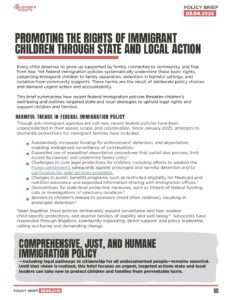
From the resource by Children’s Rights: “Every child deserves to grow up supported by family, connected to community, and free from fear. Yet federal immigration policies systematically undermine these basic rights, subjecting immigrant children to family separation, detention in harmful settings, and isolation from community supports. These harms are the result of deliberate policy choices…
Read MoreYouth Transfer
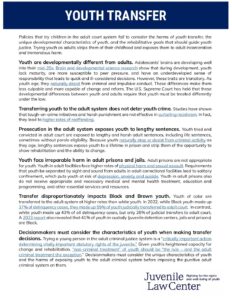
This one-pager from the Juvenile Law Center can be used as an educational tool for judges, policy makers, community members and other decision makers when talking about transfer to adult court. From the one-pager: “Policies that try children in the adult court system fail to consider the harms of youth transfer, the unique developmental characteristics…
Read MoreEugenics and the Carceral State: Progressive-Era Reform and the Creation of the Modern Criminal Justice System
“The modern American criminal justice system emerged not simply from Progressive-Era reform, but from the intertwined projects of eugenics, psychiatry, and legal modernism. Drawing upon archival, historical, and doctrinal sources, this Article reveals how early twentieth-century reformers—including judges, criminologists, and social scientists—recast criminal law as a mechanism for identifying and controlling hereditary “defect.” Under the…
Read MoreTime Out for Transfer: Youth Transfer as Punishment
This law review article written by Professor Kristina Kersey explores transfer as a form of punishment and calls for jurisdictions to enact a moratorium on transfer, drawing lessons from the movement to end the death penalty. Noting similarities between transfer and the death penalty, this article analogizes the two and argues that transfer mechanisms operate…
Read MoreThe Innocence Trap
“What makes a conviction wrongful? Developments in DNA science have led to a wave of exonerations over the past thirty years, revealing sources of error in the criminal legal process. Innocence organizations proliferated to represent people whose convictions could be overturned by newly discovered evidence. This is vital work for the individuals who are released…
Read MoreIn re K.G.-B, 2026 Pa. Super. LEXIS 98 (Pa. Super. Ct. 2026)
The Pennsylvania Superior Court reversed a young person’s probation revocation, finding that the state’s failure to provide defense counsel with notice and discovery violated the young person’s due process rights. The court stated in relevant part: We recognize that “[d]ue process is a flexible concept which ‘varies with the particular situation.’” Bundy v. Wetzel, 646 Pa.…
Read MoreA Good Reason to Be Suspicious: The U.S. Legal History of Transgender Discrimination
“In the Supreme Court’s recent United States v. Skrmetti (2025) decision, Justice Amy Coney Barrett raised the novel question: Does the United States have a long-standing history of de jure discrimination against transgender people, perpetrated by state actors through the force of law? This Essay provides the beginnings of an answer to Justice Barrett’s inquiry, demonstrating that throughout the…
Read MoreState v Millner, 2026 N.J. Super. LEXIS 30 (N.J. Ct. App. 2026)
The New Jersey Superior Court Appellate Division held that when individuals convicted of sex offenses in other states relocate to New Jersey, they are entitled to a hearing assessing whether their out-of-state conviction is “similar to” New Jersey Megan’s Law offenses before indicting individuals for failure to register, pursuant to their due process rights. The…
Read More[Missouri] Special School District of St. Louis County: Investigation
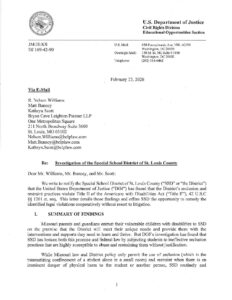
On February 23, 2026, the U.S. Department of Justice released its investigation findings of the Special School District of St. Louis County, highlighting that the District’s seclusion and restraint practices violate Title II of the Americans with Disabilities Act. From the investigation: “Missouri parents and guardians entrust their vulnerable children with disabilities to SSD on…
Read MoreT.S. v. State, 2026 Fla. LEXIS 1311 (Fla. 2026)
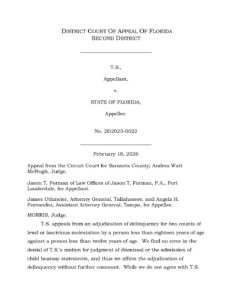
The Florida Court of Appeals, Second District, found the trial court erred when it decided to make an upward departure from the recommendation of the Department of Juvenile Justice’s recommendation and failed to explain why the departure was most appropriate for T.S.’s individual rehabilitative needs. The court reasoned in part: “Simply listing ‘reasons’ that are…
Read MoreThe Young and the Armed: History for Litigating Firearms Age Restrictions in a Post-Bruen World

“The Supreme Court’s 2022 ruling in New York State Rifle and Pistol Ass’n v. Bruen has dramatically reshaped Second Amendment jurisprudence. That decision, bucking precedent, created an entirely new, history-based standard for adjudicating the constitutionality of firearms restrictions and has led to a flurry of challenges to long-standing local, state, and federal gun laws. Among these…
Read MoreDigitally Branded: The Developmental Catastrophe of Juvenile Sex Offender Registries
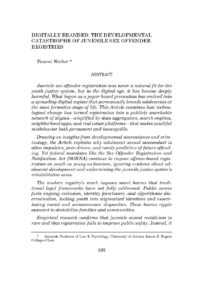
“Juvenile sex offender registration was never a natural fit for the youth justice system, but in the digital age, it has become deeply harmful. What began as a paper-based precaution has evolved into a sprawling digital regime that permanently brands adolescents at the most formative stage of life. This Article examines how technological change has…
Read MoreState v. Conkey, 2026 Ohio LEXIS 594 (Ohio 2026)
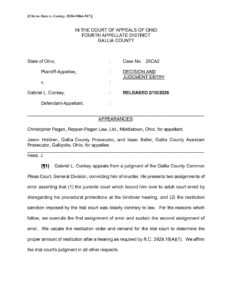
The Ohio Court of Appeals, Fourth District, vacated and remanded the trial court’s restitution order, where the trial court allowed unsworn testimony from the victim about restitution and a failed to hold a contested restitution hearing pursuant to state statute. The court reasoned in part: ““‘“[T]he amount of the restitution must be supported by competent,…
Read MoreState v. J.W., 2026 Wash. App. LEXIS 283 (Wash. Ct. App. 2026)

The Washington Appeals Division 2 reversed a conviction involving allegations of an 11-year-old child charged with attempted rape of a child, finding that the state failed to produce clear and convincing evidence that the child was capable of committing a criminal sexual act. The court stated in relevant part: “A child of at least 8…
Read MoreM.C. v. State, 2026 Ala. Crim. App. LEXIS 2 (Ala. Crim. App. 2026)
The Alabama Criminal Appeals Court reversed an adjudication of making a terrorist threat in the second degree based on insufficient evidence. The court stated in relevant part: “The definition of “threaten” in § 13A-10-242(2) specifically refers to three people. Subsection a. refers to the person who “makes [the] statement.” Subsection b. refers to the person to…
Read MoreIn the Matter of V.B., 2026 Ind. App. Unpub. LEXIS 190 (Ind. Ct. App. 2026)
The Indiana Court of Appeals reversed a probation violation related to a condition that youth must “obey all laws” based on insufficient evidence. The court stated in relevant part: “V.B. contends the State did not prove he violated the condition of his probation requiring him to obey the law because he had only been arrested…
Read MoreState v. Mann-Tate, 2026 WI App 17 (Wis. Ct. App. 2026)
The Court of Appeals of Wisconsin held that the state’s reverse waiver statute was unconstitutional “to the extent it does not require circuit courts to consider the unique attributes of youth identified by the United States Supreme Court.” In Wisconsin, a youth’s case that is directly filed in adult criminal court may be sent to…
Read MoreThe Gault Center Letter in Favor of Maryland Senate Bill No. 323 Jurisdiction (Youth Charging Reform Act)
This letter written and submitted to the Maryland Senate Judicial Proceedings Committee on behalf of the Gault Center, outlines its reasons for supporting Maryland Bill No. 323 (named the Youth Charging Reform Act), which would limit the types of cases eligible for automatic transfer to adult court. From the letter: “The Gault Center: Defenders of…
Read MoreReforming Juvenile Restitution
“Restitution laws, for the most part, have barely changed since their tough on-crime inception; juveniles therefore remain subject to lasting involvement in the criminal justice system—a burden that amounts to a financial death penalty. This article explains why juvenile restitution should now change too. The time has come for restitution that achieves its rehabilitative goals…
Read More