
Education as a Right, Homelessness as a Crisis: The Displaced Futures of American Homeless Youth

“Homelessness in the United States has been a humanitarian crisis affecting youth as one of its most vulnerable populations. Education is one of the few opportunities to break through this cycle of poverty. Recognizing the gap in education for homeless students and other students, Congress enacted the McKinney-Vento Act, which guarantees homeless youth educational rights…
Read MoreImportant Immigration Protections for System Involved Young People in California
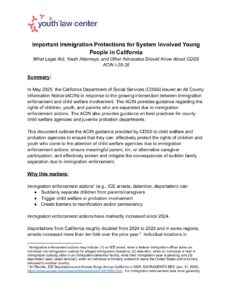
From the Summary of this practice guide by Youth Law Center: “In May 2025, the California Department of Social Services (CDSS) issued an All County Information Notice (ACIN) in response to the growing intersection between immigration enforcement and child welfare involvement. The ACIN provides guidance regarding the rights of children, youth, and parents who are…
Read MoreStrategies for Deepening Engagement with Moveable Audiences: Move Them or Lose Them

This report was written by Define American, an organization dedicated to “helping audiences see all immigrants with their full humanity” through diverse and nuanced storytelling about immigrant experiences across diverse media and industries. From the Overview: “Define American set out to better understand the “Moveable Middle”—people in the U.S. who, with the right approach, could…
Read MoreRevocation Reconsidered: Probation Advocacy Through a Litigation Lens
“Being found in violation of probation has dire consequences. The person found in violation can be imprisoned, upending them from their job, family, and community. Unlike incarceration after a criminal trial, a sentence after a violation of probation is not the result of a legal process characterized by robust due process protections. It is also…
Read MoreThe Right to Seek Joy
From the abstract: “Within the past three years, roughly half of American states have restricted access to gender-affirming medical treatment for children. In this article, I argue that these bans violate transgender children’s right to liberty guaranteed by the Fourteenth Amendment’s Due Process Clause. I do so by excavating the Framers’ understanding of liberty as…
Read MoreCoercion and Manipulation: Abusive Practices in the Recruitment and Use of America’s Youth as Confidential Informants

From the abstract: “Over the past several decades, there have been an alarming number of instances where young Americans have had their lives ruined due to their involvement as confidential informants in law enforcement narcotics investigations. These tragedies have garnered national attention and inspired attempts at reform several times. Yet, the reckless use of the…
Read MoreShanks v. State, 2026 Ind. App. LEXIS 141 (Ind. Ct. App. 2026)

The Indiana Court of Appeals reversed a murder and armed robbery conviction based on double jeopardy violation. The court stated in relevant part: [H]ere the charging information for murder simply tracks the statutory language, while the robbery charge alleges a threat or the use of force by shooting at Martin. Because of the way the…
Read MoreIn re E.E.C., 2026 Ore. App. LEXIS 607 (Or. Ct. App. 2026)
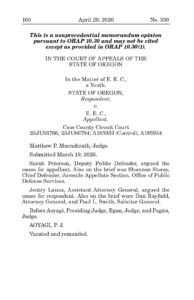
The Oregon Court of Appeals vacated and remanded a placement order, finding that the order lacked written findings justifying placement based on the best interests of the youth, as required under state statute. The court stated in relevant part: Under ORS 419C.478(1), a juvenile court placing a youth in OYA custody must include in its order…
Read MoreState v. Flores, 2026 Minn. App. Unpub. LEXIS 447 (Minn. Ct. App. 2026)
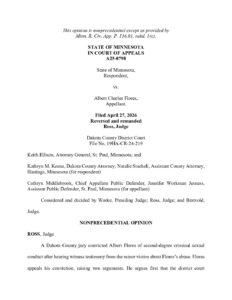
The Minnesota Court of Appeals held that statements made to a child welfare investigator after invoking the right to counsel are inadmissible under Miranda, finding that the investigator was acting as an arm of the state. The court reasoned: The central issue on appeal therefore narrows to whether Flores’s invocation of his Miranda rights bars not…
Read MoreWhat is Happening with Deferred Action for Special Immigrant Juveniles (SIJs)?
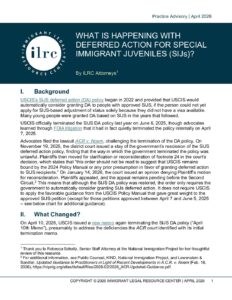
“USCIS’s SIJS deferred action (DA) policy began in 2022 and provided that USCIS would automatically consider granting DA to people with approved SIJS, if the person could not yet apply for SIJS-based adjustment of status solely because they did not have a visa available. Many young people were granted DA based on SIJS in the…
Read MoreCameras Replaced In-Person Checks at Ohio Youth Prison- The Columbus Dispatch

Executive Director Mary Ann Scali was interviewed by USA Today regarding conditions of confinement concerns at Ohio’s Indian River Juvenile Correctional Facility. Staffing shortages, extensive use of solitary confinement, and staff conducting rounds via video instead of in person are a just a few of the issues that have been reported by young people and…
Read MorePractice Alert: Arguments for Using the SIJS-based Adjustment Provision to Adjust Based on a Different Petition
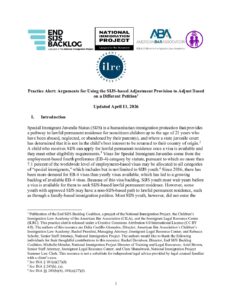
From the Introduction: “Special Immigrant Juvenile Status (SIJS) is a humanitarian immigration protection that provides a pathway to lawful permanent residence for noncitizen children up to the age of 21 years who have been abused, neglected, or abandoned by their parent(s), and where a state juvenile court has determined that it is not in the…
Read MoreCare and Control in Collaborative Courts: Ethnographic Insights into Therapeutic Justice
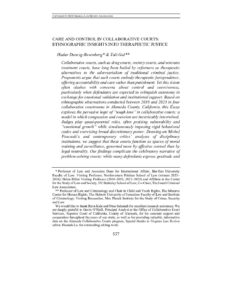
“Collaborative courts, such as drug courts, reentry courts, and veterans treatment courts, have long been hailed by reformers as therapeutic alternatives to the adversarialism of traditional criminal justice. Proponents argue that such courts embody therapeutic jurisprudence, offering accountability and care rather than punishment. Yet this vision often clashes with concerns about control and coerciveness, particularly…
Read MoreState v. Reynoso, 2026 N.J. Super. LEXIS 41 (N.J. Ct. App. 2026)
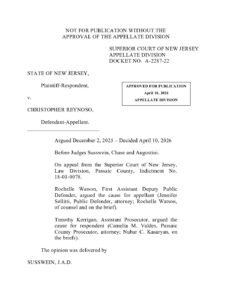
The New Jersey Superior Court Appellate Division held that the State failed to meet its burden of proving voluntariness of a youth’s Miranda waiver and reversed the trial court’s denial of defense’s suppression motion. Based on a totality-of-circumstances analysis, the court considered the following factors in making its decision: the youth’s Spanish-speaking mother was present…
Read MoreIn the Matter of K.R.C., 2026 Ore. App. LEXIS 484 (Or. Ct. App. 2026)
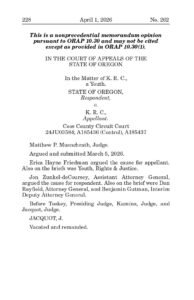
The Oregon Court of Appeals vacated and remanded an adjudication finding that the trial court erred in failing to provide written findings and consider the youth’s best interest. The court stated in relevant part: Assessment of a youth’s best interest is “a child-focused consideration” and “must be child-centered.” Dept. of Human Services v. T. M. D.,…
Read MoreMinimal Success: The Consequences of Mandatory Minimums in Youth Sentencing
“In New York State, children as young as thirteen can be processed as adults and sentenced to mandatory minimum sentences. Mandatory minimum sentences require judges to sentence the defendant to a statutorily set minimum term of imprisonment. Practitioners, judges, and researchers question the efficacy of mandatory minimum sentences, finding that they are ineffective at deterring…
Read MoreICE Out: Mapping and Resisting Local Law Enforcement Collusion with ICE in Massachusetts

From the Executive Summary, developed by Citizens for Juvenile Justice: “In the context of aggressive federal immigration enforcement that has shifted away from the border and into our communities, this report examines the role that Massachusetts local law enforcement and justice actors play in federal Immigration and Customs Enforcement (ICE) operations. State law prohibits local…
Read MoreCommonwealth v. Donovan, 497 Mass. 355 (Mass. 2026)
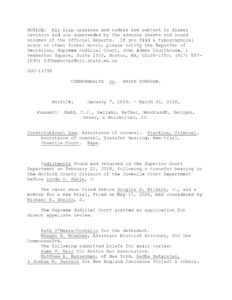
The Supreme Court of Massachusetts held that a transfer hearing is a “critical stage of the criminal process” that requires effective assistance of counsel under the 6th Amendment of the U.S. Constitution. The Court held that defense counsel’s failure to present evidence on youthfulness, developmental maturity, and rehabilitation prevented the judge from considering factors critical…
Read MoreNarrative Change Self-Assessment Form

The Institute of Women and Ethnic Studies developed a Narrative Change Self-Assessment Form to think through narrative change work. This resource was shared as part of the Gault Center & Youth Empowerment for Advancement Hangout (YEAH Philly)’s webinar on Revolutionizing Probation from Punishment to Community-led Safety, Part I, held on March 26, 2026. “This document…
Read MoreIn re A.M., 2026 Tex. App. LEXIS 2882 (Tex. Ct. App. 2026)
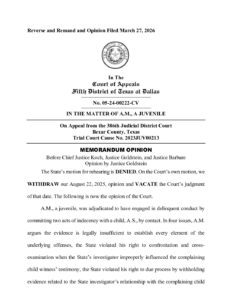
The Fifth Court of Appeals of Texas reversed a sex offense adjudication finding a violation of due process and the right to confrontation when a state investigator signaled to a child witness during their testimony at trial. The court stated in relevant part: “Rather than being a permissible support person, Dear, looking like Santa, interjected…
Read MoreIn re I.H., 2026 Kan. App. LEXIS 10 (Kan. 2026)

The Kansas Court of Appeals held that a youth may not be prosecuted as an adult if they were under the age of 13 at the time of the offense based on the court’s statutory interpretation of K.S.A. 38-2347. The court stated in relevant part: “From this review, we do not find that the Legislature…
Read MoreD.D.B. v. State, 2026 Ala. Crim. App. LEXIS 11 (Ala. Ct. App. 2026)
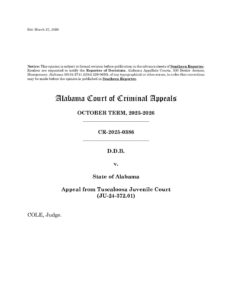
The Alabama Criminal Appeals Court reversed a delinquency adjudication involving possession of a firearm, finding that evidence of the firearm should have been suppressed in light of the illegal stop that took place when the police turned on his vehicle’s emergency lights without reasonable suspicion. The court stated in relevant part: “We hold that Cpl. Seibert lacked…
Read MoreRevolutionizing Probation: From Punishment to Community-Led Safety, Part I, Webinar Slides
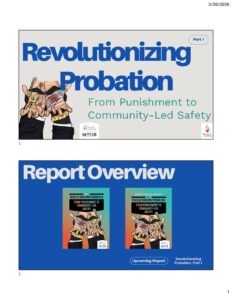
On March 26, 2026, the Gault and Youth Empowerment for Advancement Hangout (YEAH Philly) co-hosted a webinar on Revolutionizing Probation from Punishment to Community-Led Safety. This resource includes PowerPoint presentations from the Gault Center covering the history and youth experiences on juvenile probation, YEAH Philly highlighting meaningful community-based alternatives, and the Institute of Women & Ethnic…
Read MoreCommonwealth v. Lee, 2026 Pa. LEXIS 553 (Pa. 2026)
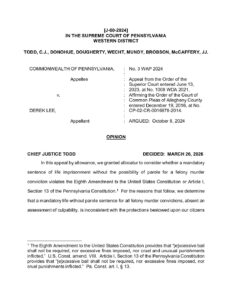
The Supreme Court of Pennsylvania ended the use of mandatory life without parole for felony murder cases based on the state constitution’s prohibition against cruel punishment. Finding that Pennsylvania’s constitutional safeguards against cruel punishment offers greater protections than the 8th Amendment of the U.S. Constitution, the Court reasoned that the blanket imposition of mandatory life…
Read MoreRestorative Justice Diversion: A Better Way to Provide Meaningful Accountability for Youth
This report from the Sentencing Project provides an overview of restorative justice (‘RJ’) diversion programs including research on the results of these programs, the advantages of RJ diversion programming over court involvement, benefits to victims, and recommendations for implementing RJ programs. From the Executive Summary: “Restorative justice (RJ) diversion programs address adolescent lawbreaking outside the court system using a process designed to address victims’ needs and repair the harm caused by youth misconduct.…
Read More