
Supporting Immigrant Children: Resources for Ohio Child Providers and Practitioners
From the resource by Case Western Reserve University Schubert Center for Child Studies: “This document offers an overview of the most current and reliable national and Ohio-specific guidance and resources to support practitioners and providers working with immigrant children. It is organized in the following child and youth-specific settings: Each section provides practical tools, current…
Read MoreYouth Defender Immigration Tip Sheet: Special Immigrant Juvenile Status
Guides youth defenders on how to screen for SIJS eligibility and obtain a SIJS predicate order in juvenile court to support a young person’s application for immigration relief.
Read MoreIn re R.G., 2026 Cal. App. Unpub. LEXIS 3840 (Cal. Ct. App. 2026)

The California 4th District Court of Appeal struck down a probation condition that prohibited a youth from associating with any known gang members because the condition was not reasonably related to the underlying offense. The court stated in relevant part: When a gang condition imposed by the juvenile court involves non-criminal conduct and prohibits a…
Read MorePeople v. Conwell, 2026 IL App (1st) 240714 (Ill. Ct. App. 2026)

The Illinois 1st District Court of Appeals granted an individual to proceed on a postconviction hearing to challenge his life sentence based on the state’s proportionate penalties clause. The court held that the individual who 18 at the time of the offense was entitled to present mitigating evidence about his age and youthfulness. The court…
Read MoreStrategies for Dealing with Disruptive Behavior Chart [Completed]
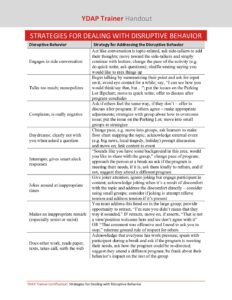
This disruptive behavior strategy chart provides examples of disruptive behaviors that that may arise during a training session, and a corresponding section to highlight strategies to respond to and address those behaviors.
Read MoreIn re Mark B., 2026 Cal. App. Unpub. LEXIS 3743 (Cal. Ct. App. 2026)

The California 4th District Court of Appeal found struck down a probation condition requiring a youth to “participate in counseling and/or an education program…as directed by your probation officer,” finding that the condition is too indefinite. The court stated in relevant part: We believe this condition leaves too much to the probation officer’s discretion because…
Read MoreCastro v. Superior Court of Kern, 2026 Cal. App. Unpub. LEXIS 2761 (Cal. Ct. App. 2026)
The California 5th District Court of Appeal held that the defense was entitled to discovery related to racial disparities in plea deals to voluntary manslaughter, finding that defense’s statistical evidence showing that Latine individuals in Kern County were more likely to be charged with murder and receive longer sentences than white individuals satisfied the “plausible…
Read MoreWorking Toward a Horizon of Interdependence: An Abolitionist Ethos for Youth Defenders
This Essay, written by HyeJi Kim at the Gault Center, details the role of youth defenders in abolition. The Essay offers five entry points for youth defenders to embrace an abolitionist ethos to build toward a horizon of interdependence: Embrace a shared vision that points toward a horizon of interdependent thriving where all children are…
Read MoreThe Second Look Movement and Reducing Mass Incarceration
From the abstract: “Mass incarceration in the United States has been driven largely by increasingly long sentences, particularly for individuals convicted of violent offenses. A major obstacle to reversing this trend is the widespread belief that these sentences cannot be revisited. While there has been a growing recognition across political and ideological lines that far…
Read MoreArt and Evidence: Judicial Tools for Determining the Admissibility of Rap Lyrics in Criminal Trials

From the abstract: “When rap lyrics or videos are offered as evidence in a criminal proceeding, trial judges must determine whether the material is admissible. This decision-making process may be complex and/or nuanced, since it involves principles of substantive law, evidentiary rules, trial procedure, societal norms, and biases all at once. With this Article, the…
Read MoreEducation as a Right, Homelessness as a Crisis: The Displaced Futures of American Homeless Youth
From the abstract: “Homelessness in the United States has been a humanitarian crisis affecting youth as one of its most vulnerable populations. Education is one of the few opportunities to break through this cycle of poverty. Recognizing the gap in education for homeless students and other students, Congress enacted the McKinney-Vento Act, which guarantees homeless…
Read MoreCreative Exercises for Training Youth Defenders

This resource provides a wide variety of exercises sourced from a variety of organizations and individuals who provide training for youth defenders.
Read MoreYDAP Logistics Checklist
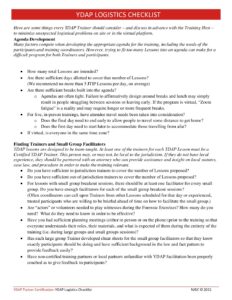
A checklist of logistical details to consider when planning any YDAP training.
Read MoreTrainer’s Zoom and Virtual Tech Checklist
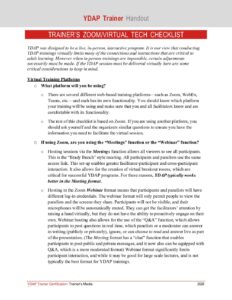
A checklist of logistical details to consider when planning a virtual and Zoom YDAP training.
Read MoreGeneral Interventions
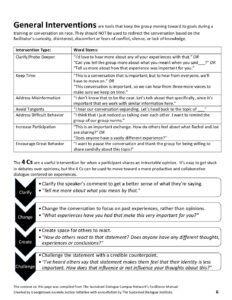
The Georgetown Juvenile Justice Initiative created this handout in consultation with the Sustained Dialogue Institute, providing examples of intervention tools and responses with the goal of having productive and collaborative conversations during training sessions or conversations that are focused on race. From the handout: “General Interventions are tools that keep the group moving toward its…
Read MoreSystemic Awareness
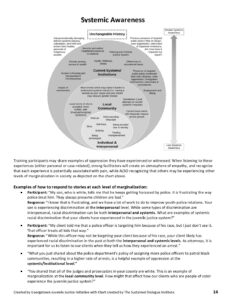
The Georgetown Juvenile Justice Initiative created this handout in consultation with the Sustained Dialogue Institute, highlighting that Youth defenders, their clients, and communities regularly experience and witness oppression and trauma when interacting with the juvenile legal and adult legal systems. This document provides tips for responding to examples of interpersonal, systemic and institutional oppression that…
Read MoreIn the Interest of K.W.-D., 2026 Pa. Super. LEXIS 272 (Pa. Super. Ct. 2026)

The Pennsylvania Superior Court vacated a probation revocation order, finding that the youth was deprived of their constitutional right to notice of the specific allegations and supporting evidence pertaining to the revocation. The court stated in relevant part: Based on our review, and in light of this Court’s ruling in K.G.-B., we conclude that K.W.-D. was…
Read MoreDobie v. United States, 2026 D.C. App. LEXIS 190 (D.C. 2026)
The D.C. Court of Appeals held that age and youthfulness should be considered as mitigating evidence in sentencing reconsiderations pursuant to D.C.’s Incarceration Reduction Amendment Act. The court stated in relevant part: As our prior decisions have made clear, the “[District of Columbia] Council initially passed the IRAA in response to several ‘constitutional imperatives’ declared…
Read MoreYouth Courts vs. Adult Courts: Why the Juvenile Justice System Works Better

From the Sentencing Project: “Despite their many flaws, juvenile courts are better for youth who break the law than are adult courts. Contrary to critics’ beliefs, juvenile courts regularly address serious and violent crimes. Juvenile courts do not offer a “slap on the wrist;” they often issue harsh punishments. The frequent alternative, sending youth to…
Read MorePeople v. Cardenas, 2026 Cal. App. LEXIS 324 (Cal. Ct. App. 2026)

The California 2nd District Court of Appeal vacated a sentence enhancement, finding that the trial court erred in denying defense counsel the opportunity to present a closing argument. The court stated in relevant part: Under the determinate sentencing scheme, the court may not impose an upper term sentence unless an aggravating circumstance applies. (§ 1170,…
Read MoreIn re J.K.B., 2026 N.C. App. LEXIS 399 (N.C. Ct. App. 2026)
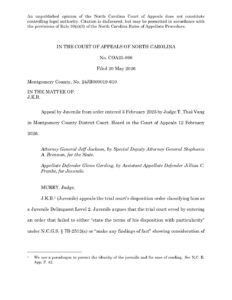
The North Carolina Court of Appeals vacated a disposition order, finding that the failure to specify the length of probation violated state statute. The court stated in relevant part: In juvenile-delinquency proceedings, the trial court’s dispositional order must “be in writing” and “contain appropriate findings of fact and conclusions of law.” N.C.G.S. § 7B-2512(a). Additionally, the…
Read MoreState v. Villalobos, 2026 N.M. LEXIS 83 (N.M. 2026)
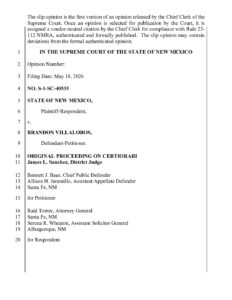
The Supreme Court of New Mexico held that a young person’s age and intellectual disability are relevant considerations in determining whether the constitutional right to a speedy trial was violated. In State v. Villalobos, the Court held that an individual who had an intellectual disability and was 15 years old at the time of the…
Read MorePeople v. Oslund, 2024 Mich. LEXIS 2447 (Mich. 2024)
In People v. Oslund, the Michigan Supreme Court reversed the circuit court’s decision to transfer Evan Oslund to adult court in an assault case pursuant to an “aiding and abetting” theory. In doing so, the Michigan Supreme Court ruled that only the actions of the youth can be considered when determining whether the “juvenile is armed with a dangerous weapon” for purposes of the ‘automatic’ waiver statute in Michigan (MCLS 764.1f(2)(b)). Since there was no evidence that Evan was armed with a dangerous weapon during…
Read MoreWebinar Tip Sheet: Revolutionizing Probation from Punishment to Community-Led Safety, Part I

Compiles key takeaways and resources on building narrative strategies to transform juvenile probation, offered during a webinar on Revolutionizing Probation from Punishment to Community-Led Safety, Part I.
Read MorePeople v. Snell, 2026 Mich. App. LEXIS 3913 (Mich. Ct. App. 2026)

The 1st District Court of Appeals of Michigan vacated a life without parole sentence following a felony murder conviction, finding that trial counsel was ineffective by failing to raise mitigating evidence on adolescent brain development and childhood trauma and abuse. The court stated in relevant part: Appellate counsel obtained a mitigation expert, Mary Cuddehe, to…
Read More