
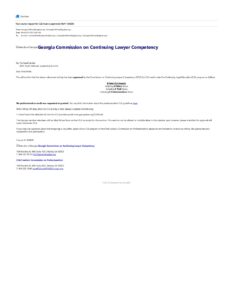
Georgia CLE Accreditation Letter
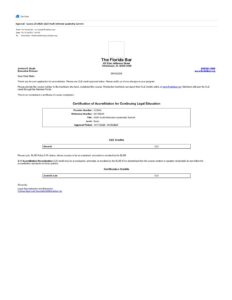
Florida CLE Accreditation Letter
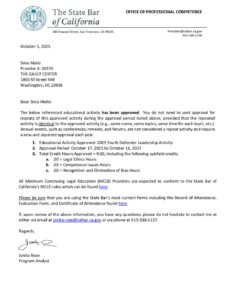
California CLE Accreditation Letter
In the Interest of W.M.H., 2025 Mo. App. LEXIS 841 (Mo. Ct. App. 2025)
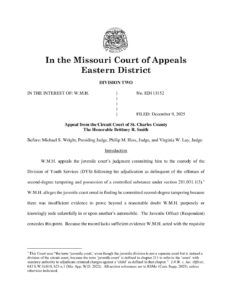
The Missouri Eastern District Court of Appeals reversed a juvenile court adjudication of second-degree tampering based on insufficient evidence regarding the youth’s requisite culpable mental state. The Court stated in relevant part: “W.M.H. argues the juvenile court erred in finding he committed second-degree tampering because there was insufficient evidence to prove beyond a reasonable doubt W.M.H.…
Read MoreSample California Detention Reform Bill-Concept Paper with Proposed Language
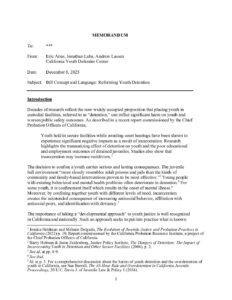
This memorandum proposes language for a detention and disposition reform bill in California. The memorandum proposes four areas the detention reform bill aims to change including: 1) clarifying the legal standard for pre-adjudication detention of youth, 2) clarifying the juvenile court’s authority to determine whether pre-adjudication detention is still necessary, 3) clarifying the standard at…
Read MorePeople v. Lampkin, 2025 Cal. App. Unpub. LEXIS 7786 (Cal. Ct. App. 2025)

The Third District Court of Appeal in California vacated a felony murder conviction based on insufficient evidence to support the state’s required “reckless indifference” finding, which must also take into consideration youthfulness at the time of the incident. The court stated in relevant part: “Finally, defendant’s youth also cuts against a finding of reckless indifference. In Moore, supra,…
Read MoreState v. Y.A., 2025 Del. Fam. Ct. LEXIS 36 (Del. Fam. Ct. 2025)

The Delaware Family Court granted a youth’s suppression motion, finding that age and race must be considered when determining whether a seizure has occurred under the Fourth Amendment. The court states in relevant part: “Children are not adults. In J.D.B. v. North Carolina, the Supreme Court decided that children should not be treated like adults for the purposes of…
Read MoreIncarcerated Women and Girls
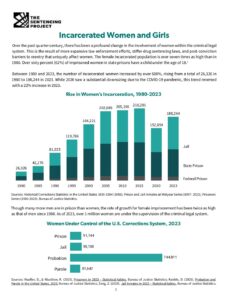
This report, by The Sentencing Project, examines the changes in involvement of women and girls in the criminal and juvenile legal system over the past quarter century. The report includes data examining the rise of women and girls’ incarceration in jails, state and federal prisons, residential placement centers, as well as women under the control of the U.S. Corrections systems through probation or parole., This…
Read MoreCommonwealth v. Peak, 2025 Pa. Super. Unpub. LEXIS 3089 (Pa. Super. Ct. 2025)

The Pennsylvania Superior Court vacated a conviction for theft by receiving stolen property finding that the evidence was insufficient to establish that the property was stolen. The court stated in relevant part: “Viewing the record, including the habeas corpus testimony about the VIN number check, and drawing all reasonable inferences from that evidence in the light most…
Read MorePlace, Power, and School Pushout: Defensive Localism and School Discipline

“Suspensions, expulsions, and school-based arrests: These exclusionary and overly punitive disciplinary responses disproportionately impact Black students and have become normalized throughout the nation. In reality, school pushout, or the disciplinary sanction of removing students from the classroom, contravenes the very purpose of public education to prepare children to engage as full citizens in our democratic…
Read MoreA Trial By Another Name: Daisey Kates and Injustice in Pretrial Revocation of Probation and Parole
“It is considered “good law” in Pennsylvania that prosecution can bring a violation of probation or parole (VOP) hearing for a direct violation of the conditions of parole even before the alleged violation’s substantive criminal trial takes place. Mrs. Kates’s name has since become synonymous with pretrial VOP hearings for direct violations. This Comment calls…
Read MoreUnregulated and Unacceptable: Facial Recognition Technology’s History, Privacy Concerns, and Impact on Society
From the abstract: “This Note provides a general review of the current state of Facial Recognition Technology (FRT), including Illinois state regulation and past federal regulation attempts. This Note asserts that even as datasets become more diverse and “fairer,” FRT may still have discriminatory impacts on minority populations, as evidenced by a few highlighted examples…
Read MoreRehabilitating Youth in Juvenile Corrections
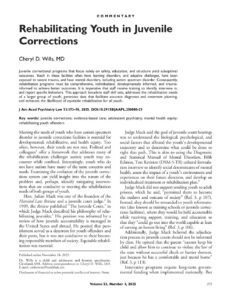
From the abstract: “Juvenile correctional programs that focus solely on safety, education, and structure yield suboptimal outcomes. Youth in these facilities often have learning disorders, and adaptive challenges, have been exposed to severe trauma, and have mental disorders, including autism spectrum disorder. Consequently, rehabilitation programs must be comprehensive, individualized, developmentally informed, and trauma informed to…
Read MoreThe Special Education Bargain
“Half a century ago, Congress “revolutionized” the way children with disabilities are educated in this country. Under the Individuals with Disabilities Education Act (“IDEA”), every year the public schools must prepare a “written statement” describing where each such child stands educationally, what educational goals she will work toward, and the special education services she will…
Read MorePeople v. Symonds, 2025 Mich. LEXIS 9515 (Mich. 2025)
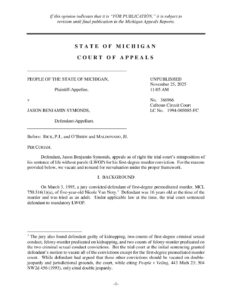
The Supreme Court of Michigan held that the trial court’s analysis of Appellant’s case pursuant to the Miller factors and resentencing to LWOP was improper and remanded the case for reconsideration under the proper framework. The court stated in relevant part: “Notably, as defendant identifies, the trial court relied on the fact that defendant has…
Read MoreBeehive Buzz: Emerging Strategies from 2025 Summit Policy Meeting
Written Testimony of Citizens for Juvenile Justice (CfJJ) to the Joint Committee on Racial Equity, Civil Rights and Inclusion
CfJJ delivered written testimony to the Massachusetts’ Joint Committee on Racial Equity, Civil Rights and Inclusion on information-sharing practices between the juvenile and criminal legal systems and federal immigration authorities. Following a review of public records requests around these practices, CfJJ found a pattern of collaboration between police, prosecutors, probation officers, and Immigration and Customs…
Read MoreBeehive Buzz: Emerging Strategies from Summit 2025

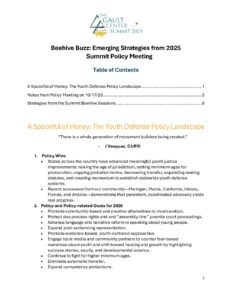
In October 2025, the Gault Center convened over three hundred youth defense lawyers and advocates at our annual Youth Defender Leadership Summit. Together, we practiced the cultivation of community in service of building a more just, more liberated, and more human humanity for all children and for us all. This resource captures the shared learnings…
Read MoreYouth Justice by the Numbers

The Sentencing Project released an updated snapshot of the numbers of youth in the juvenile legal system from 2000 to 2023, finding significant declines in youth arrests and incarceration, though racial and ethnic disparities persist. The report calls for the need to continued shrinking the juvenile legal system by increasing informal or diversionary responses to youth arrests. Introduction: “Youth arrests and incarceration increased dramatically in the closing…
Read MoreOregon v. Johnson, 2025 Or. LEXIS 1863 (Or. 2025)
The Oregon Court of Appeals held that the trial court erred where it failed to instruct the jury on the “choice-of-evils” defense. The court stated in relevant part: Regarding the first assignment of error, we review a trial court’s refusal to provide a requested jury instruction for legal error. State v. Jackson, 334 Or App…
Read MoreAccess to Counsel in Immigration Court, Revisited 111 Iowa L. Rev. 1 (2025)

This article focuses on the state of access to counsel for individuals in immigration proceedings, looking at data collected from 2013-2024. This article looks at representation inside and outside of detention, in different jurisdictions, and across different nationalities. This article also looks at the increase of young people placed in removal proceedings, as well as…
Read MoreDisability Rights on Probation and Parole, 124 MICH. L. REV. 519 (2025)

This article focuses on the policies and practices of community supervision programs, and the impact they have on individuals with disabilities, including discriminatory practices that prevent disabled individuals from successfully completing probation or parole. From the introduction: ” This Article addresses disability discrimination in community supervision programs, a large—but frequently overlooked—component of the criminal legal…
Read MorePolice Power Abolition

From the abstract: This Article employs the Law Review’s Discourse symposium on my book, Unreasonable: Black Lives, Police Power, and the Fourth Amendment, as a starting point to foreground and elaborate on an idea that I reference in that text: police power abolition. The Article begins by describing the central insight that motivates Unreasonable—namely, that…
Read MoreIn re D.C., 2025 Ohio 5147 (Ohio 2025)

The Court of Appeals of Ohio, Eighth District, held that the trial court erred when it did not permit D.C. an opportunity to speak on his own behalf during the dispositional hearing, particularly when the trial court emphasized D.C.’s purported lack of remorse. The court stated in relevant part: “While appellant’s counsel spoke on his…
Read MoreA Queer Constitutional History of Loss: Mayes v. Texas (1974), Privacy, and the Struggle for the Right to Be Trans in Public in the 1970s
“In the period of the 1960s through 2015, the U.S. Supreme Court issued a set of canonical, key decisions expanding the constitutional doctrines of sexual liberty and privacy, equality, and substantive due process for women and sexual and gender minorities. The Court interpreted these principles to protect contraceptive use, abortion, interracial marriage, the private consumption…
Read More