
5th Amendment
In New Mexico v. Antonio T., the Supreme Court of New Mexico ruled any statements elicited by a school official in the presence of a law enforcement officer may not be used against the child in a delinquency proceeding unless the child made a knowing, intelligent, and voluntary waiver of his statutory right to remain…
A proposed settlement agreement between the United States and Lauderdale County in the State of Mississippi after an investigation of the substantive and procedural due process rights of youth who appear in Lauderdale County Youth Court. The Settle Agreement proposes several remedial measures the named parties must take including creating a probation process that complies…

A practice guide for youth defenders in delinquency cases when litigating suppression issues. This guide covers all aspects of litigating a suppression motion: from drafting the motion, securing witnesses, evidentiary considerations, appellate preservation, and procedural aspects of the suppression hearing that may arise at the suppression hearing, during trial. and on appeal.

This amicus brief by Juvenile Law Center, The Gault Center, and others argues Ohio’s mandatory bindover statute violates the Due Process protections guaranteed by the 14th Amendment of the U.S. Constitution as the mandatory scheme does not allow for individualized sentencing and recognition of the unique characteristics of youth. Further, amici argue individualized transfer proceedings…

This amicus brief prepared by Children’s Law Center, Inc., the Office of the Ohio Public Defender, The Gault Center, and others argues that due process and fundamental fairness, pursuant to the 5th Amendment, the 14th Amendment and Ohio law, require the state to provide full discovery to a young person prior to a probable cause…

A sample motion from Ohio requesting suppression of statements made by a 17-year old with disabilities including a specific learning disability and expressive language disorder. The motion argues the child’s statement should be suppressed given the inherent coerciveness of police interrogations of children, the inadequate and untimely reading of the Miranda rights by the police…

This amicus brief by Center on Wrongful Convictions of Youth, The Gault Center, and others argue a 15-year-old child from South Dakota did not knowingly and intelligently waive her Miranda rights when the police failed to allow her to consult with her mother before interrogation, minimized the importance of the Miranda warnings, and did not…
This research article from Frontiers in Human Neuroscience asks, “does the brain activity underlying the production of deception differ depending on whether or not one believes their deception can be detected? To address this question, we had participants commit a mock theft in a laboratory setting, and then interrogated them while they underwent functional MRI…

This amicus brief by the Center on Wrongful Convictions of Youth, Vanderbilt Professor of Law and Medicine Terry A. Maroney, The Gault Center, and others. Amici argue a 16-year-old youth’s waiver of his Miranda rights was involuntary and his confession must be suppressed pursuant to the 5th and 14th Amendments, where he was threatened during…

On December 17, 2012, the U.S. Department of Justice entered into a settlement agreement with Shelby County and the Juvenile Court of Memphis and Shelby County in Tennessee following their investigation into the juvenile court system. The settlement agreement includes remedial measures to align the following practices with the U.S. Constitution: probable cause determinations, notice…

On October 24, 2012, the U.S. Department of Justice filed a complaint in the United States District Court, Southern District of Mississippi asserting that the City of Meridian, County of Lauderdale, and State of Mississippi are engaging in a “pattern or practice of unlawful conduct through which they routinely and systematically arrest and incarcerate children,…

On August 10, 2012, the U.S. Department of Justice released a findings report regarding their investigation of Lauderdale County Youth Court, Meridian Police Department, and Mississippi Division of Youth Services. The findings included the following violations: “(1) The City of Meridian Violates the Fourth Amendment by Arresting Children Without Assessing Probable Cause; (2) Lauderdale County…

On December 17, 2012, the U.S. Department of Justice entered into a settlement agreement with Shelby County and the Juvenile Court of Memphis and Shelby County in Tennessee following their investigation into the juvenile court system. The settlement agreement includes remedial measures to align the following practices with the U.S. Constitution: probable cause determinations, notice…

This amicus brief by Juvenile Law Center, Children’s Law Center, Inc., The Gault Center, and others argues Ohio should adopt a bright line rule requiring meaningful access to counsel for all young people at the interrogation stage of a delinquency proceeding. Amici argue counsel at interrogation is essential given the developmental and neuroscientific differences between…

This amicus brief by Juvenile Law Center and others argues young people are different for purposes of the Miranda custody analysis and the Supreme Court should afford young people Constitutional protections in light of Supreme Court jurisprudence on interrogations and recently under the 8th Amendment as well as social science research about the particular vulnerability…

This amicus brief by The Gault Center and others argues Nevada’s certification statute violates a child’s right to effective assistance of counsel as it interferes with counsel’s ability to plan and participate in the adversarial fact-finding process and it fails to measure up to essentials of due process and fair treatment. Furthermore, amici argue this…
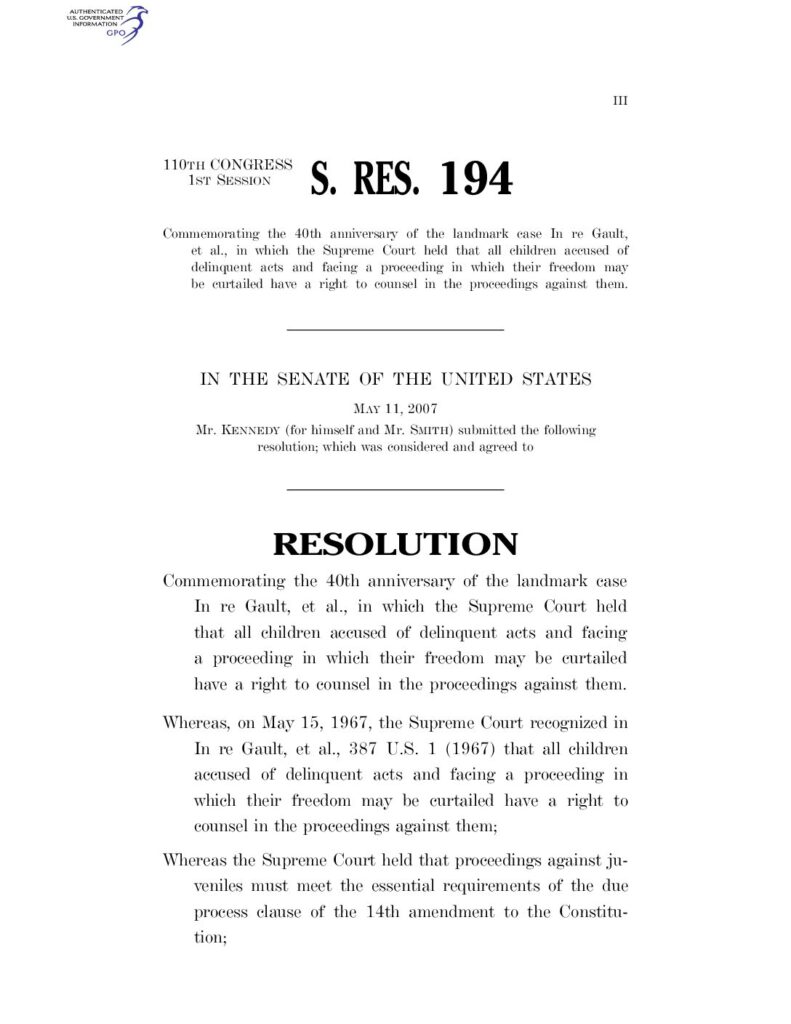
On May 11, 2007, the Senate passed a resolution commemorating the 40th anniversary of the In re Gault decision, which upheld the right to counsel for children in juvenile court. The resolution reiterates the Supreme Court’s holding that juvenile court proceedings must “meet the essential requirements of the due process clause of the 14th Amendment to the…

This research paper from the Journal of Interpretation looks at the intersection of a subset of deaf people, who are classified as semilingual (meaning they are functionally illiterate (reading level grade 2.9 or below) and lack proficient English or sign language skills.), and their involvement in the legal system. The research paper examines eleven frequently…
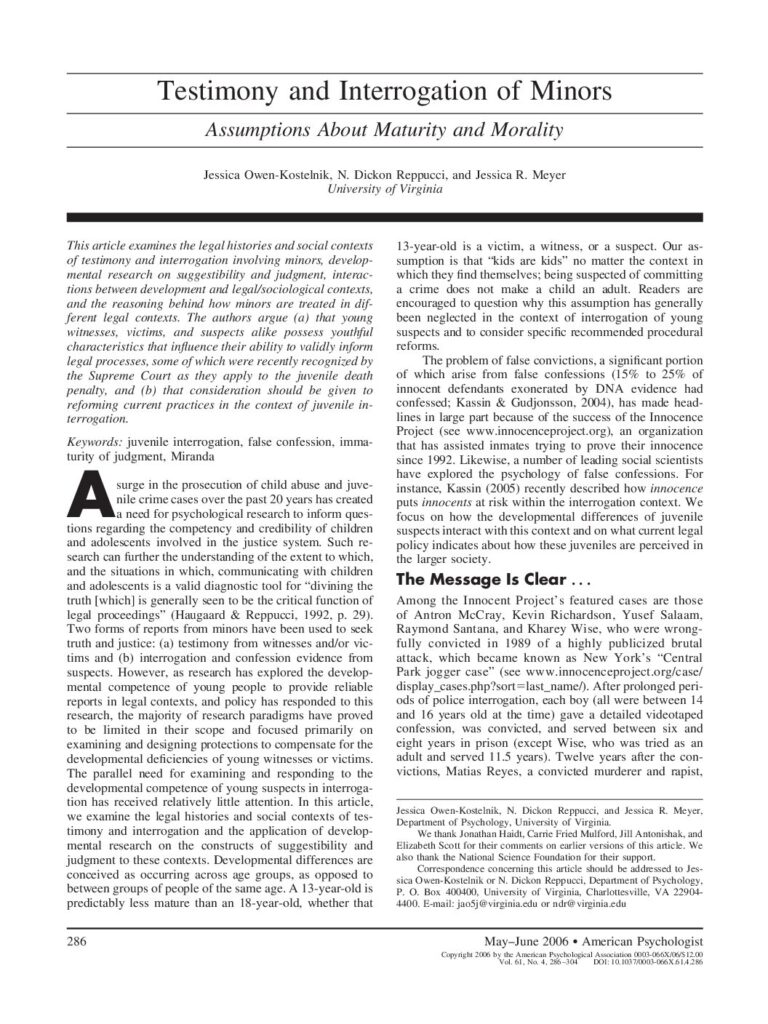
This article examines the legal history and social contexts of testimony and interrogation involving young people, developmental research on suggestibility and judgment, interactions between development and legal/sociological contexts, and the reasoning behind how young people are treated in different legal contexts. The authors argue (a) that young witnesses, victims, and suspects alike possess youthful characteristics…


- « Previous
- 1
- 2
- 3
- 4
