
Disabilities

On August 14, 2009, the DOJ released its investigation of four juvenile facilities in New York, finding that conditions violate federal and constitutional rights of youth. Specifically, the investigation highlights the facilities’ use of excessive force and inappropriate restraints and its failure to provide adequate mental health care and treatment for youth, in violation of…

On May 16, 2008, the DOJ filed a complaint against the State of Ohio in the Southern District of Ohio Eastern Division for engaging in a pattern or practice of constitutional violations in juvenile facilities. Specifically, the complaint alleges that the state has engaged in a pattern or practice of violating young people’s right to…
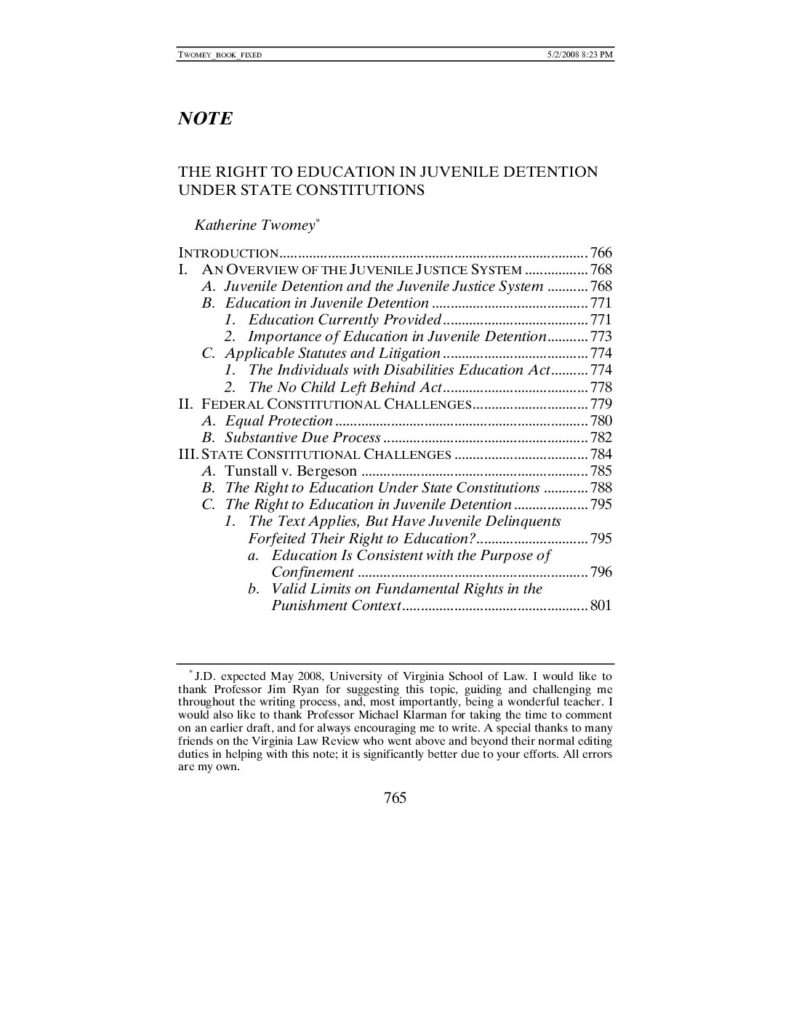
From the introduction: “This Note will argue that children in juvenile detention have a right to an adequate education based on state constitutional guarantees of education. This right can be used to challenge the inadequacy of the current educational services provided in juvenile detention facilities. The argument will proceed in three parts. Part I will…

On May 9, 2007, the DOJ released its investigation of the Marion County, Ohio Juvenile Correctional Facility, finding that the conditions violate federal and constitutional rights of youth. Specifically, the investigation highlights violations of young people’s right to reasonable safety, right to adequate mental health care, and right to special education services. Related actions: [Ohio]…

On May 9, 2007, the DOJ released its investigation of the Scioto Juvenile Correctional Facility, finding that the conditions violate federal and constitutional rights of youth. Specifically, the investigation highlights violations of young people’s right to reasonable safety, right to adequate mental health care, and right to special education services. Related actions: [Ohio] Marion Juvenile…

This research paper from the Journal of Interpretation looks at the intersection of a subset of deaf people, who are classified as semilingual (meaning they are functionally illiterate (reading level grade 2.9 or below) and lack proficient English or sign language skills.), and their involvement in the legal system. The research paper examines eleven frequently…

This study examined the relationship of legal capacities to cognitive development, legal learning opportunities, and psychological symptoms. Participants were 152 male and female [adolescents] charged in juvenile court proceedings and held in detention, aged 11–17. The youth completed Grisso’s Instruments for Assessing Understanding and Appreciation of Miranda Rights, the Fitness Interview Test (Revised Edition), the…


The delinquent act itself is often the primary basis for determining intention and competency of children under 18 in adult or juvenile court. But behaviors result from one or more of a diverse range of factors, each of which has different effects on decision-making. The capacity of juveniles to plan or to stop an action…
The intended audience for this manual is defense attorneys who represent children in delinquency matters and in status offenses; the intended audience includes also disability rights attorneys and other public interest attorneys with an interest in representing children who are enmeshed in the delinquency system. Children strive to be productive and to be accepted. Children…


- « Previous
- 1
- …
- 5
- 6
- 7
