

This expert affidavit from Dr. Donald Rosenblitt, a child psychiatrist and clinician licensed in North Carolina. Dr. Rosenblitt discusses the impact of shackling young people in juvenile court proceedings and how shackling negatively impacts a young people’s positive development, self-perception, overall health, and views of the legal system.

This resource offers a summary of key research on sex offender registration and notification for youth. This resource includes research on recidivism, residency restrictions, collateral consequences, stresses of registration, and perceptions by the public, criminal legal systems, and individuals.

On August 14, 2013, the U.S. Department of Justice filed a Statement of Interest in a federal class action lawsuit on the constructive denial of counsel in criminal proceedings within five counties in New York. The DOJ asserted, “The provision of defense services is a multifaceted and complicated task. To guide the defense function, the…

The Kentucky Court of Appeals vacated a young person’s conviction in adult court based on ineffective assistance of counsel during the transfer hearing. Noting transfer as a critical stage in the proceeding and defense counsel’s failure to present any lay or expert witnesses and effectively cross-examine the prosecution’s witnesses, the court concluded that the transfer…

The Court of Appeals of Indiana found the juvenile court abused its discretion when it denied a 12-year-old’s continuance of his waiver hearing after his attorney only had four business days to investigate and prepare for the hearing. The court reversed the child’s conviction in adult court and remanded the proceeding to juvenile court offering…

Expert Affidavit of Susan L. Burrell on Standards of Competence in the Legal Representation of Youth
Expert Affidavit of Susan L. Burrell for a young person’s case in Colorado claiming ineffective assistance of counsel. The claims included a failure to fulfill basic duties to the client, failure to investigate, failure to retain expert witnesses, and a failure to assure that a plea was voluntary, knowing and intelligent.
An introductory guide to defending an arson case including what to look for in discovery, preparation for an arson invesigation, and myths related to arson forensic science.
The American Psychological Association’s (APA’s) stance on the psychological maturity of adolescents has been criticized as inconsistent. In its Supreme Court amicus brief in Roper v. Simmons (2005), which abolished the juvenile death penalty, APA described adolescents as developmentally immature. In its amicus brief in Hodgson v. Minnesota (1990), however, which upheld adolescents’ right to…

An expert affidavit from Professor Franklin Zimring outlining relevant data, studies and research supporting that youth who are charged with sex offenses in juvenile court should not be subject to sex offender registry requirements or stigmatization that comes with sex offense adjudications. The affidavit analyzes recent studies highlighting that “the empirical research to date supports…
In this research article from Child Development, age differences in future orientation are examined in a sample of 935 individuals between 10 and 30 years using a delay discounting task as well as a new self-report measure. Younger adolescents consistently demonstrate a weaker orientation to the future than do individuals aged 16 and older, as…
It has been hypothesized that sensation seeking and impulsivity, which are often conflated, in fact develop along different timetables and have different neural underpinnings, and that the difference in their timetables helps account for heightened risk taking during adolescence. In order to test these propositions, the authors examined age differences in sensation seeking and impulsivity…
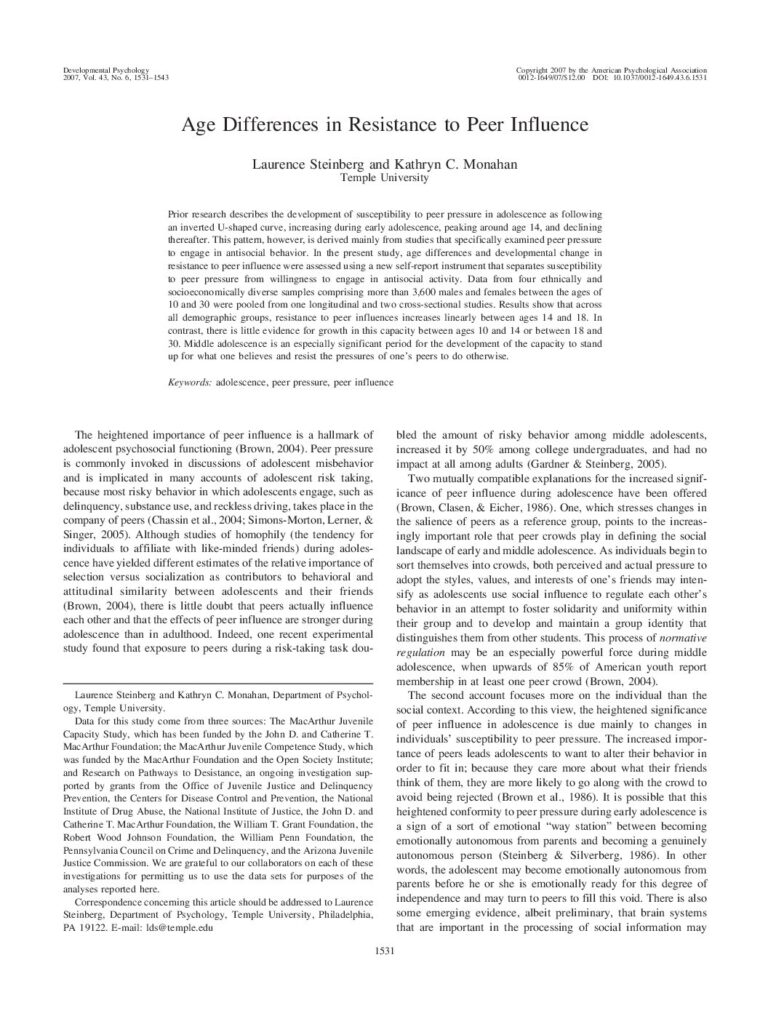
“Prior research describes the development of susceptibility to peer pressure in adolescence as following an inverted U-shaped curve, increasing during early adolescence, peaking around age 14, and declining thereafter. This pattern, however, is derived mainly from studies that specifically examined peer pressure to engage in antisocial behavior. In the present study, age differences and developmental…

The delinquent act itself is often the primary basis for determining intention and competency of children under 18 in adult or juvenile court. But behaviors result from one or more of a diverse range of factors, each of which has different effects on decision-making. The capacity of juveniles to plan or to stop an action…
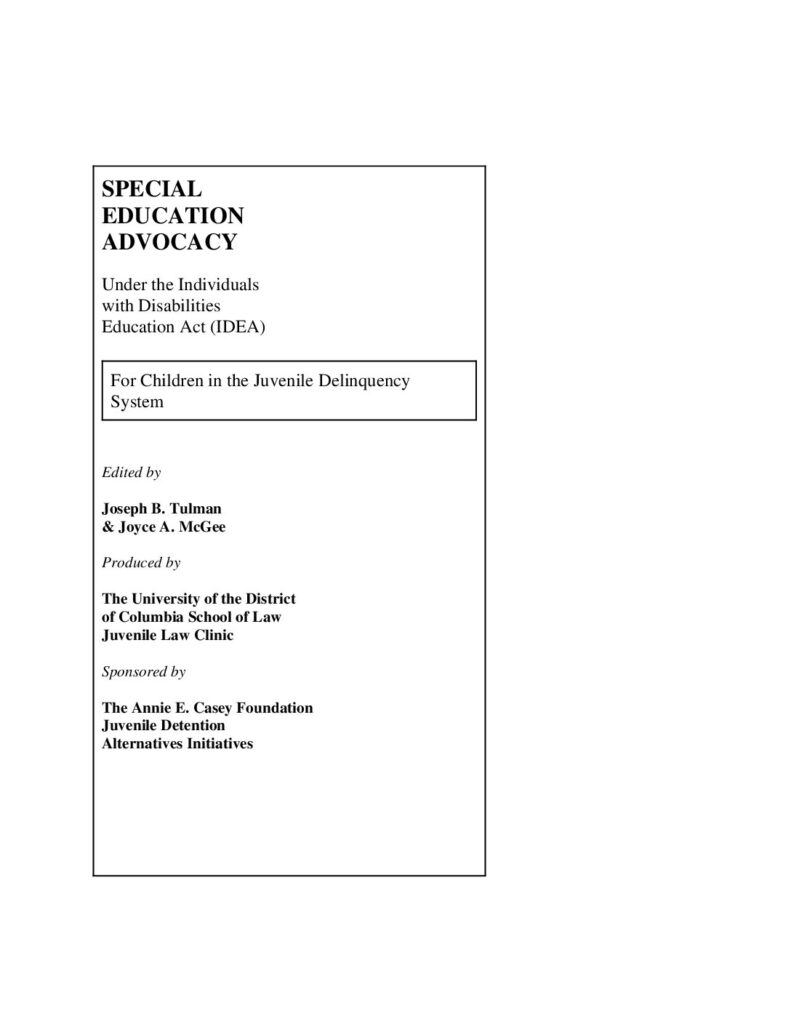
The intended audience for this manual is defense attorneys who represent children in delinquency matters and in status offenses; the intended audience includes also disability rights attorneys and other public interest attorneys with an interest in representing children who are enmeshed in the delinquency system. Children strive to be productive and to be accepted. Children…

The U.S. Supreme Court held that when mental health is a significant factor in an accused person’s defense, they must have the ability to hire an independent expert provided to the defense at the expense of the state if they cannot afford it. The Court reversed and remanded the holding of the Oklahoma Court of…
- « Previous
- 1
- 2
- 3
