
The Pennsylvania Superior Court vacated a probation revocation order, finding that the youth was deprived of their constitutional right to notice of the specific allegations and supporting evidence pertaining to the revocation. The court stated in relevant part: Based on our review, and in light of this Court’s ruling in K.G.-B., we conclude that K.W.-D. was…
The Oregon Court of Appeals vacated and remanded a placement order, finding that the order lacked written findings justifying placement based on the best interests of the youth, as required under state statute. The court stated in relevant part: Under ORS 419C.478(1), a juvenile court placing a youth in OYA custody must include in its order…
The Oregon Court of Appeals vacated and remanded an adjudication finding that the trial court erred in failing to provide written findings and consider the youth’s best interest. The court stated in relevant part: Assessment of a youth’s best interest is “a child-focused consideration” and “must be child-centered.” Dept. of Human Services v. T. M. D.,…
The Pennsylvania Superior Court reversed a young person’s probation revocation, finding that the state’s failure to provide defense counsel with notice and discovery violated the young person’s due process rights. The court stated in relevant part: We recognize that “[d]ue process is a flexible concept which ‘varies with the particular situation.’” Bundy v. Wetzel, 646 Pa.…


On April 9, 2025, the Oregon Court of Appeals found that a probation condition ordering a youth “to follow probation conditions as designated by OYA [the Oregon Youth Authority]” was legally insufficient to determine whether a young person violated a term of their probation. The Court explained, “without knowing what probation conditions OYA had actually…
The Oregon Court of Appeals held that the court must provide constitutionally adequate notice to a young person of a requirement to appear in person rather than remotely before making a finding of “failure to appear”. The court stated in relevant part: “Fundamental principles of due process require that an individual be provided with notice…

This checklist can be used to assess the presence of constitutional violations throughout the course of a client’s case. Please refer to the National Youth Defense Systems Standards and their accompanying User Guide for litigation strategies to challenge potential constitutional violations noted in this checklist.

This User Guide provides advocates with a step-by-step outline of how to actualize the vision of the National Youth Defense System Standards to equip and invest in youth defense teams to fight for the liberation of all youth.The User Guide outlines constitutional rights detailed in the System Standards, provides a checklist to assess the presence…

Outlines steps that states must take to comply with the minimum requirements of the U.S. Constitution to protect the rights of youth facing deprivations of liberty.

From the executive summary: “• Police increasingly replace stop-and-frisk practices with databases that crudely profile Black and Latinx youth based on their neighborhoods, peer groups, and clothing. • These databases ruin lives: police typecast minority youths as gang members without evidence, putting them at risk of false arrest and wrongful deportation. • Many police departments…


The Louisiana Supreme Court took up defense counsel’s writ following the trial court’s denial of a motion to quash following the State’s dismissal and refiling of charges following two adverse rulings, in effect evading all appellate review of the court’s ruling. The court found the accused, Mr. Reimonenq’s, 14th Amendment right to due process and…

On December 17, 2012, the U.S. Department of Justice entered into a settlement agreement with Shelby County and the Juvenile Court of Memphis and Shelby County in Tennessee following their investigation into the juvenile court system. The settlement agreement includes remedial measures to align the following practices with the U.S. Constitution: probable cause determinations, notice…

The Court of Appeals of Indiana found the juvenile court abused its discretion when it denied a 12-year-old’s continuance of his waiver hearing after his attorney only had four business days to investigate and prepare for the hearing. The court reversed the child’s conviction in adult court and remanded the proceeding to juvenile court offering…


On December 17, 2012, the U.S. Department of Justice entered into a settlement agreement with Shelby County and the Juvenile Court of Memphis and Shelby County in Tennessee following their investigation into the juvenile court system. The settlement agreement includes remedial measures to align the following practices with the U.S. Constitution: probable cause determinations, notice…
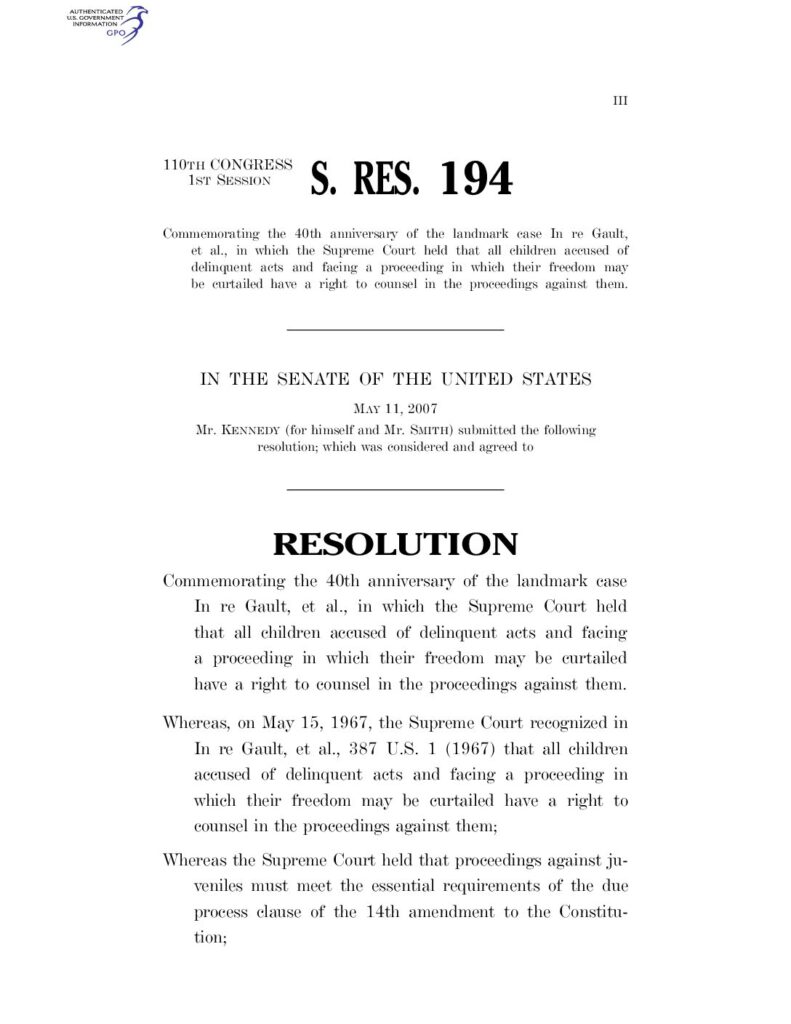
On May 11, 2007, the Senate passed a resolution commemorating the 40th anniversary of the In re Gault decision, which upheld the right to counsel for children in juvenile court. The resolution reiterates the Supreme Court’s holding that juvenile court proceedings must “meet the essential requirements of the due process clause of the 14th Amendment to the…

The U.S. Supreme Court held the Due Process Clause of the 14th Amendment did not require an accused person to give pretrial notice to the prosecution of his alibi defense and witnesses unless the accused person had reciprocal discovery rights. The conviction was reversed and remanded. To support this ruling, the Court stated: “Although the…

