
Competence

Much the impetus for the current debate about bias in psychological testing is based on well-documented, consistent, and substantive differences between IQ scores of Whites, Hispanics, and Blacks in the U.S.A. Various explanations are offered for these differences including the idea that IQ tests are inherently biased against Blacks, Hispanics, and possibly other ethnics groups,…

As part of the John D. and Catherine T. MacArthur Foundation’s Models for Change initiative, Larson and Grisso (2011) authored a document entitled Developing Statutes for Competence to Stand Trial in Juvenile Delinquency Proceedings: A Guide for Lawmakers. This guide outlines legal components and best practice recommendations that legislators might consider when creating or revising…

Juvenile competency to stand trial has historically involved the intrinsic abilities of a juvenile to understand and appreciate the nature of the proceeding against the juvenile and the juvenile’s ability to assist in his/her defense and communicate effectively with defense counsel. The literature has not addressed the recursive systemic competency process between the juvenile, defense…

The Ohio Appellate Court vacated a youth’s convictions and transfer order and offered the following language in support. “Because the juvenile court (1) did not identify all of the factors it considered, i.e., the “other information factors” referenced at the amenability hearing, (2) did not identify or discuss the factual or evidentiary basis for its…

From the Abstract: “Modern doctrine and scholarship largely take it for granted that offenders should be criminally punished for reckless acts. Yet, developments in our understanding of human behavior can shed light on how we define and attribute criminal liability, or at least force us to grapple with the categories that have existed for so…
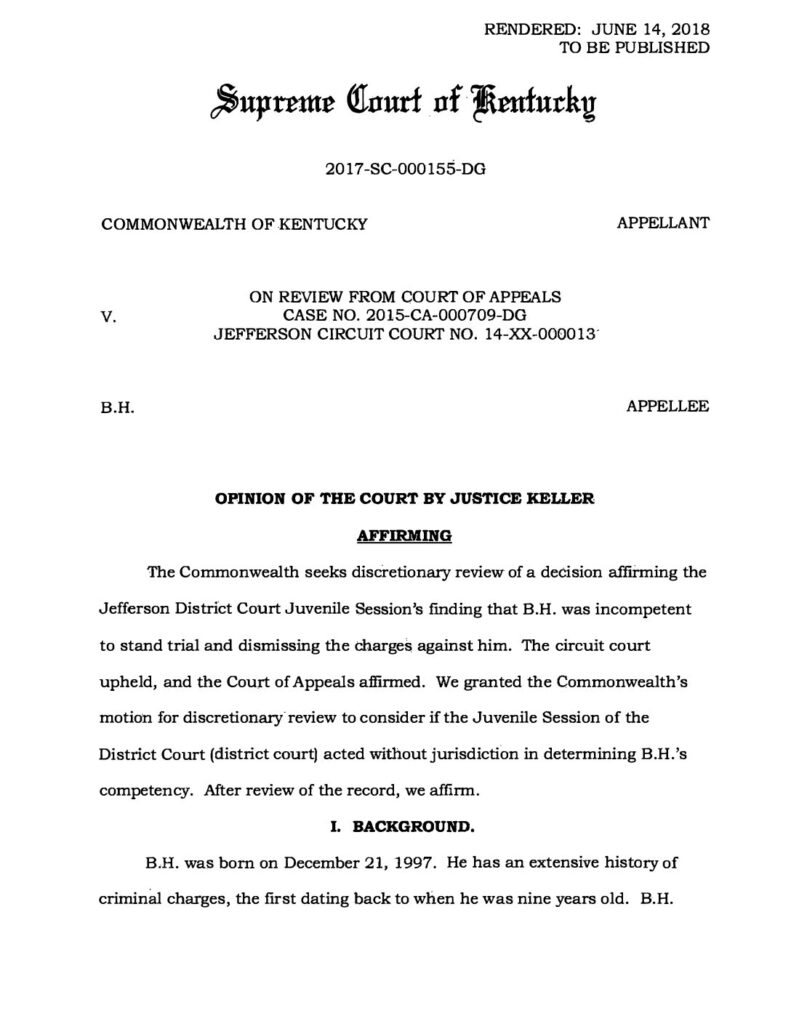
The Kentucky Supreme Court found that competency attaches for young people at transfer hearings pursuant to the 6th and 14th Amendments of the U.S. Constitution as well as Section 11 of the Kentucky Constitution. The Court reasoned that because transfer hearings are critically important proceedings as identified in Kent, competence must be established before transfer…

“In this article, we address the question left unanswered by the Court in J.D.B.: In light of the substantial research establishing that children’s understanding and appreciation of the Miranda warnings are quite limited, must the traditional test for assessing the validity of an individual’s waiver of their Miranda rights be re-calibrated to take into account…

This affidavit written by Legal Ethicist Abbe Smith outlines the ethical quandaries posed by Florida’s direct file transfer laws and calls into question the legality of such laws based on adolescent development research. The affidavit states in relevant part: “The prosecutorial practice of direct file plea-bargaining without defender/child knowledge of the case’s strengths and weaknesses…
The Campaign for the Fair Sentencing of Youth issued Trial Defense Guidelines for representing youth facing a possible life sentence. “The objective of these guidelines is to set forth a national standard of practice to ensure zealous, constitutionally effective representation for all juveniles facing a possible life sentence (“juvenile life”) consistent with the United States…


The Court of Appeals of Indiana found the juvenile court abused its discretion when it denied a 12-year-old’s continuance of his waiver hearing after his attorney only had four business days to investigate and prepare for the hearing. The court reversed the child’s conviction in adult court and remanded the proceeding to juvenile court offering…

Expert Affidavit of Susan L. Burrell on Standards of Competence in the Legal Representation of Youth
Expert Affidavit of Susan L. Burrell for a young person’s case in Colorado claiming ineffective assistance of counsel. The claims included a failure to fulfill basic duties to the client, failure to investigate, failure to retain expert witnesses, and a failure to assure that a plea was voluntary, knowing and intelligent.
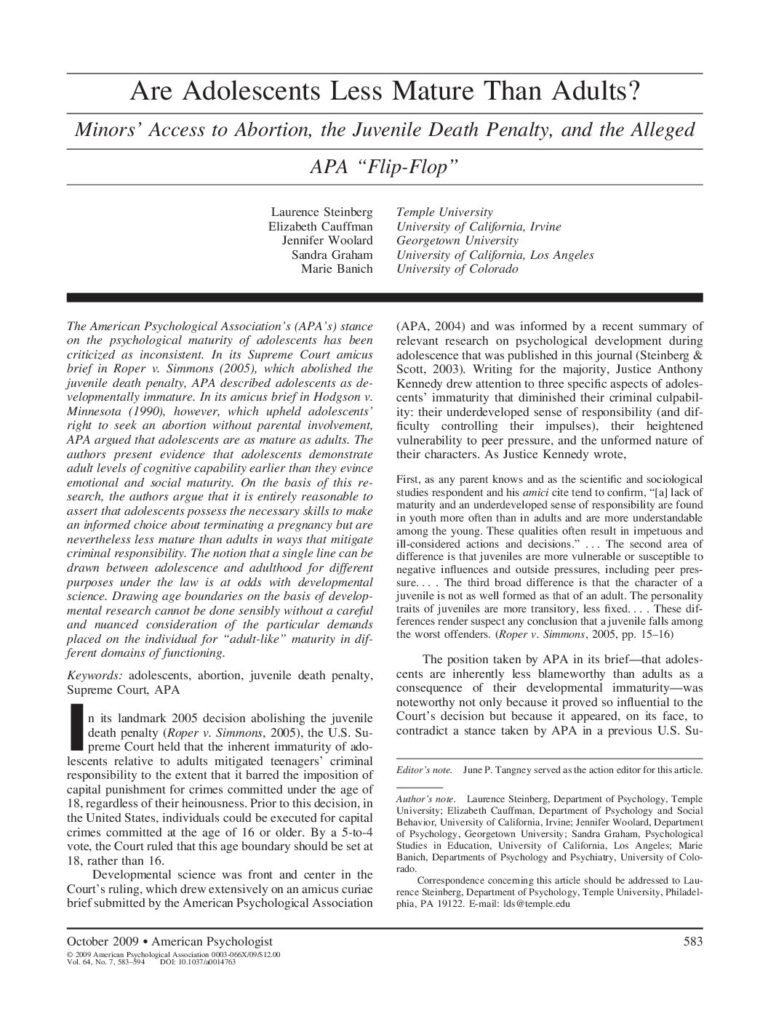
The American Psychological Association’s (APA’s) stance on the psychological maturity of adolescents has been criticized as inconsistent. In its Supreme Court amicus brief in Roper v. Simmons (2005), which abolished the juvenile death penalty, APA described adolescents as developmentally immature. In its amicus brief in Hodgson v. Minnesota (1990), however, which upheld adolescents’ right to…
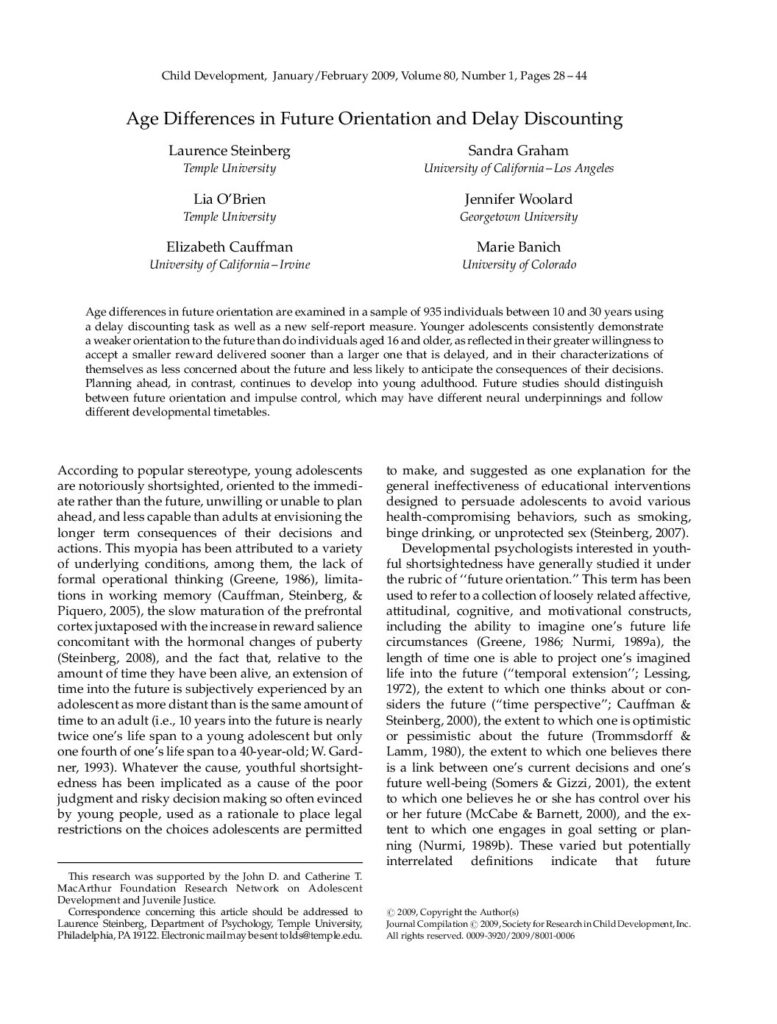
In this research article from Child Development, age differences in future orientation are examined in a sample of 935 individuals between 10 and 30 years using a delay discounting task as well as a new self-report measure. Younger adolescents consistently demonstrate a weaker orientation to the future than do individuals aged 16 and older, as…

This law review article from the publication Psychology, Public Policy and Law, looks at juvenile Miranda warnings and the comprehensibility of the warnings as applied to young people. From the Introduction: “Annually, more than 1.5 million [youth] offenders are arrested and routinely Mirandized with little consideration regarding the comprehensibility of these warnings. The current investigation…
“Prior research describes the development of susceptibility to peer pressure in adolescence as following an inverted U-shaped curve, increasing during early adolescence, peaking around age 14, and declining thereafter. This pattern, however, is derived mainly from studies that specifically examined peer pressure to engage in antisocial behavior. In the present study, age differences and developmental…
This article examines the legal history and social contexts of testimony and interrogation involving young people, developmental research on suggestibility and judgment, interactions between development and legal/sociological contexts, and the reasoning behind how young people are treated in different legal contexts. The authors argue (a) that young witnesses, victims, and suspects alike possess youthful characteristics…

This study examined the relationship of legal capacities to cognitive development, legal learning opportunities, and psychological symptoms. Participants were 152 male and female [adolescents] charged in juvenile court proceedings and held in detention, aged 11–17. The youth completed Grisso’s Instruments for Assessing Understanding and Appreciation of Miranda Rights, the Fitness Interview Test (Revised Edition), the…

The delinquent act itself is often the primary basis for determining intention and competency of children under 18 in adult or juvenile court. But behaviors result from one or more of a diverse range of factors, each of which has different effects on decision-making. The capacity of juveniles to plan or to stop an action…

The U.S. Supreme Court held that when mental health is a significant factor in an accused person’s defense, they must have the ability to hire an independent expert provided to the defense at the expense of the state if they cannot afford it. The Court reversed and remanded the holding of the Oklahoma Court of…
- « Previous
- 1
- 2
