
Electronic Monitoring
The Pennsylvania Superior Court reversed a young person’s probation revocation, finding that the state’s failure to provide defense counsel with notice and discovery violated the young person’s due process rights. The court stated in relevant part: We recognize that “[d]ue process is a flexible concept which ‘varies with the particular situation.’” Bundy v. Wetzel, 646 Pa.…


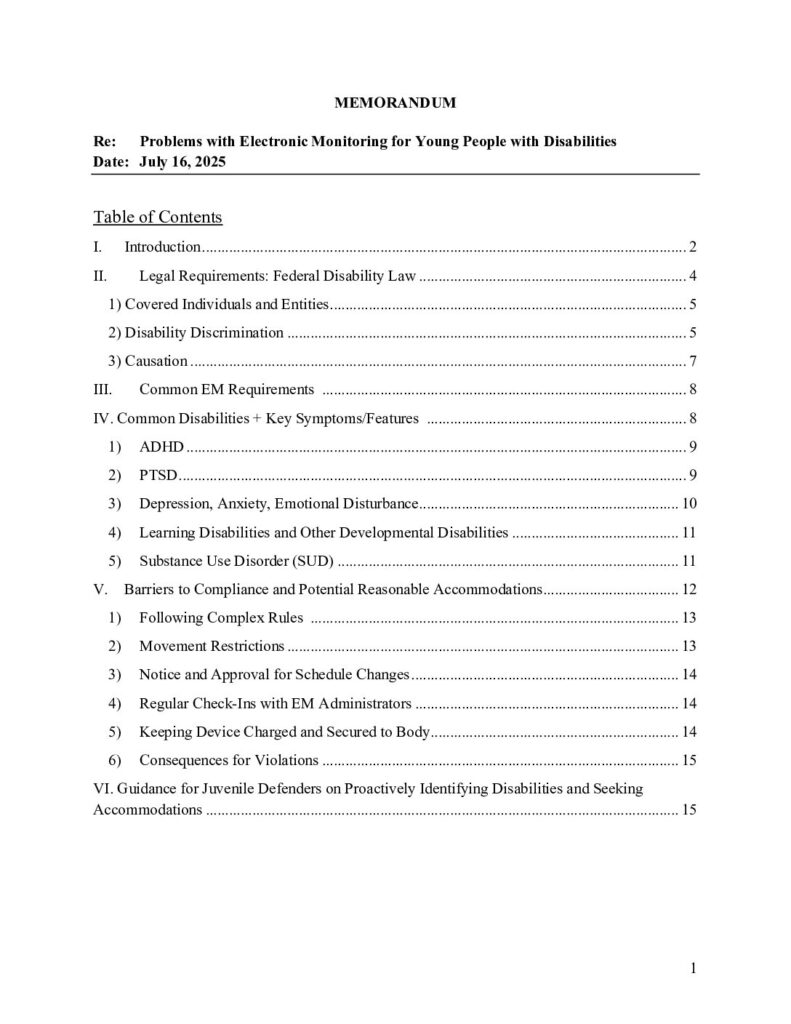
This memorandum from the American Civil Liberties Union provides litigation strategies for defenders challenging electronic monitoring conditions for young people with disabilities. From the Introduction to the memorandum: “Overall, this research project/memo aims to reduce the use of EM for kids with disabilities. Although there is no straightforward disability or accommodations-related argument for ending EM…


This report is the latest in a series of Juvenile Justice Initiative (JJI) reports on juvenile detention, building on prior research in concluding the time is ripe for a complete overhaul of the juvenile detention system in Illinois.


From the introduction: “This Guide proceeds in four parts. Part I provides a brief overview of the prevalence of disabilities among people under correctional control. Part II summarizes the relevant disability discrimination legal framework, with a focus on the requirement to provide reasonable accommodations. Part III provides an overview of (A) structural obstacles confronting people…

This article is a transcript of a lecture given by Professor Chaz P. Arnett at a Symposium hosted by the University of Maryland Francis King Carey School of Law’s Journal of Health Care Law & Policy. Professor Arnett discusses juvenile courts’ increased reliance on electronic monitoring, which he classifies as “e-carceration,” or the “the digital…


From the resource: “This poster is a tool to assess and understand differences between reforms that strengthen imprisonment and abolitionist steps that reduce its overall impact and grow other possibilities for wellbeing. As we work to dismantle incarceration in all its forms, we must resist common reforms that create or expand cages anywhere, including under…

From the introduction: “The COVID-19 pandemic has laid bare the dangers of the juvenile legal system; this should make it harder to look away from the societal inequities that are exacerbated by youth incarceration. Indeed, the current moment, including the unprecedented nationwide protests in response to the murders of George Floyd and Breonna Taylor in…

Between a Rock and a Hard Place: The Social Costs of Pretrial Electronic Monitoring in San Francisco
This report features findings from in-depth interviews from 66 people who were court-ordered to electronic monitoring (EM) in San Francisco County, California. Highlighting the nature and difficulties program participants face while trying to comply with EM programs, the report demonstrates the harms of EM, including finding safe housing, securing employment, social isolation, trouble maintaining physical and emotional connections to loved ones, and increased likelihood of new contacts with law enforcement. From…
