
The Washington Appeals Division 2 reversed a conviction involving allegations of an 11-year-old child charged with attempted rape of a child, finding that the state failed to produce clear and convincing evidence that the child was capable of committing a criminal sexual act. The court stated in relevant part: “A child of at least 8…
“Half a century ago, Congress “revolutionized” the way children with disabilities are educated in this country. Under the Individuals with Disabilities Education Act (“IDEA”), every year the public schools must prepare a “written statement” describing where each such child stands educationally, what educational goals she will work toward, and the special education services she will…

The Center for Democracy & Technology released a report on the current status of AI use in schools and emerging risks. This report covers the interaction of AI with the classroom, students, IEPs, literacy, deepfakes, student activity monitoring, and student privacy. From the report: “Artificial intelligence (AI) has continued to alter the educational experiences of…


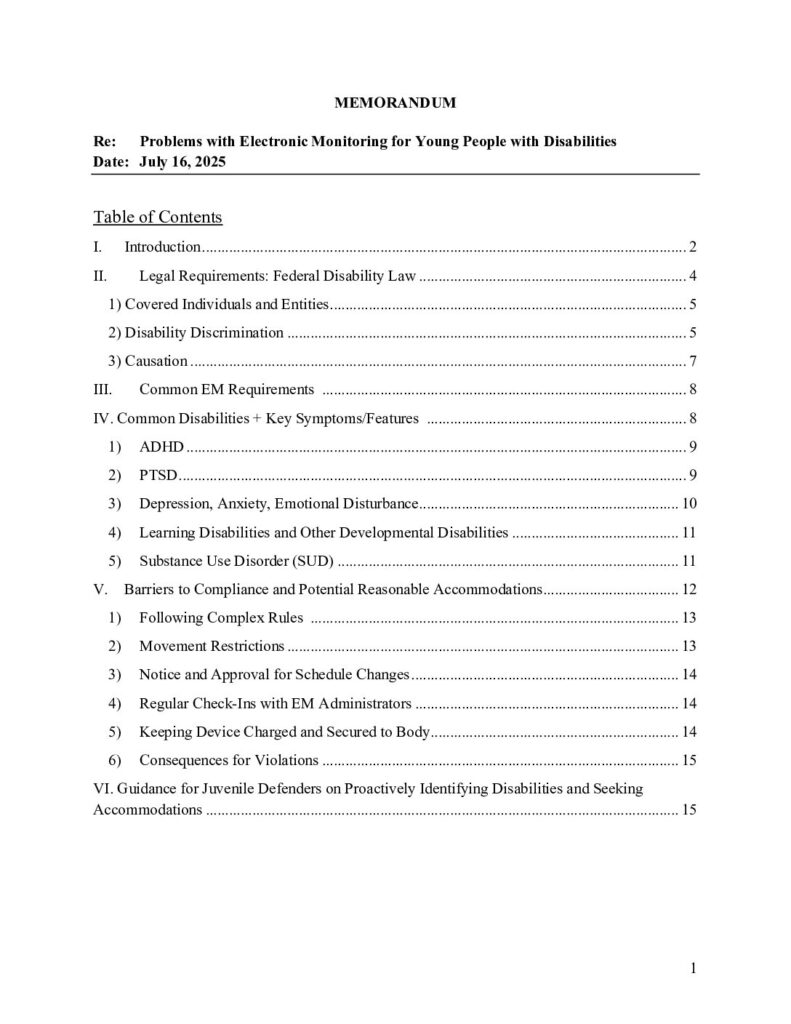
This memorandum from the American Civil Liberties Union provides litigation strategies for defenders challenging electronic monitoring conditions for young people with disabilities. From the Introduction to the memorandum: “Overall, this research project/memo aims to reduce the use of EM for kids with disabilities. Although there is no straightforward disability or accommodations-related argument for ending EM…
This memorandum from the Public Defender Service for the District of Columbia discusses the contemporary research and literature on electronic monitoring and its impacts on school attendance, family, and employment. The memorandum also discusses the real-world practicalities that make it difficult for youth to comply with the restrictive rules that often accompany electronic monitoring orders. From the memorandum: “The literature regarding the electronic monitoring of youth with disabilities has not yet been fully synthesized to…

From the conclusion” “Conclusion There is no question that the statistical picture of special education is bleak. But after its meeting of stakeholders, interviews with experts, and review of the research, NCD believes that IDEA and other related disability laws, with improved enforcement, can and should benefit at-risk students who are properly referred and served.…


Professor Kris Henning and Rebba Omer authored a law review article on decriminalizing normal adolescent behaviors, race, and disabilities. This article maps a way forward for all system actors in the juvenile legal system to mitigate and buffer against the harms of juvenile legal system involvement for youth with disabilities. Specifically, this article outlines youth…

On May 15, 2024, the DOJ submitted a letter to Kentucky Governor Andy Beshear to notify the state of the commencement of a DOJ investigation into nine juvenile facilities operated by the Kentucky Department of Juvenile Justice (DJJ). The specific issues the DOJ outlined they would investigate include excessive use of chemical force, physical and…

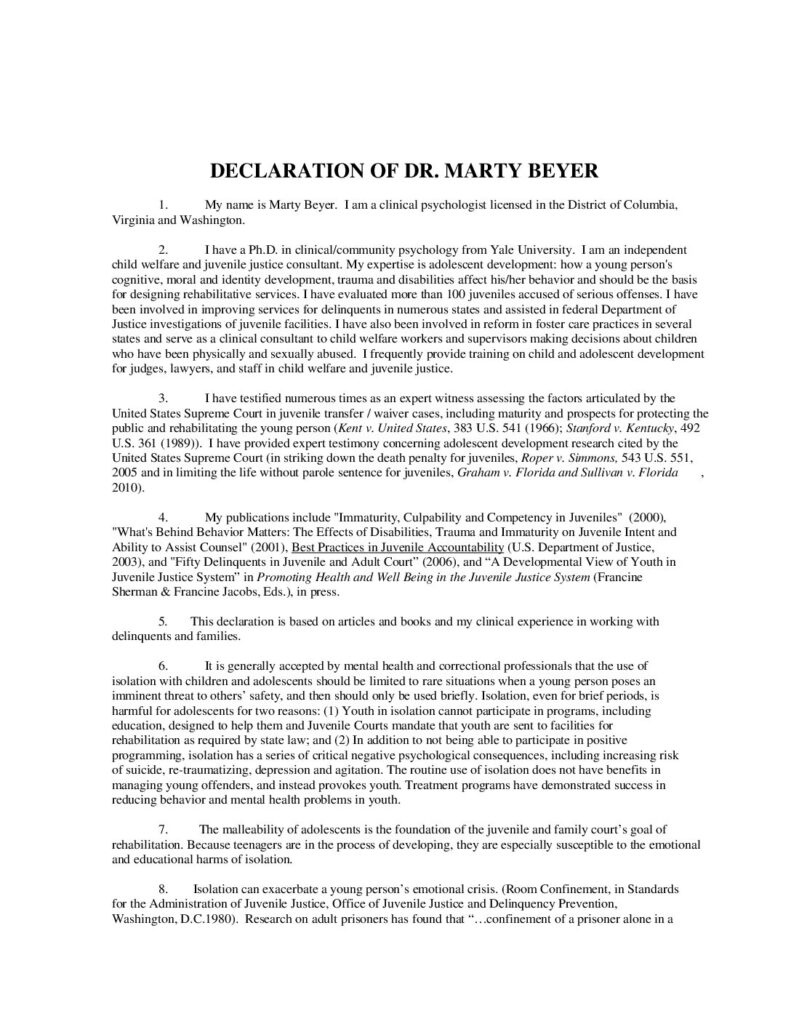
An expert declaration on the harms of the use of isolation on youth in juvenile correctional facilities.

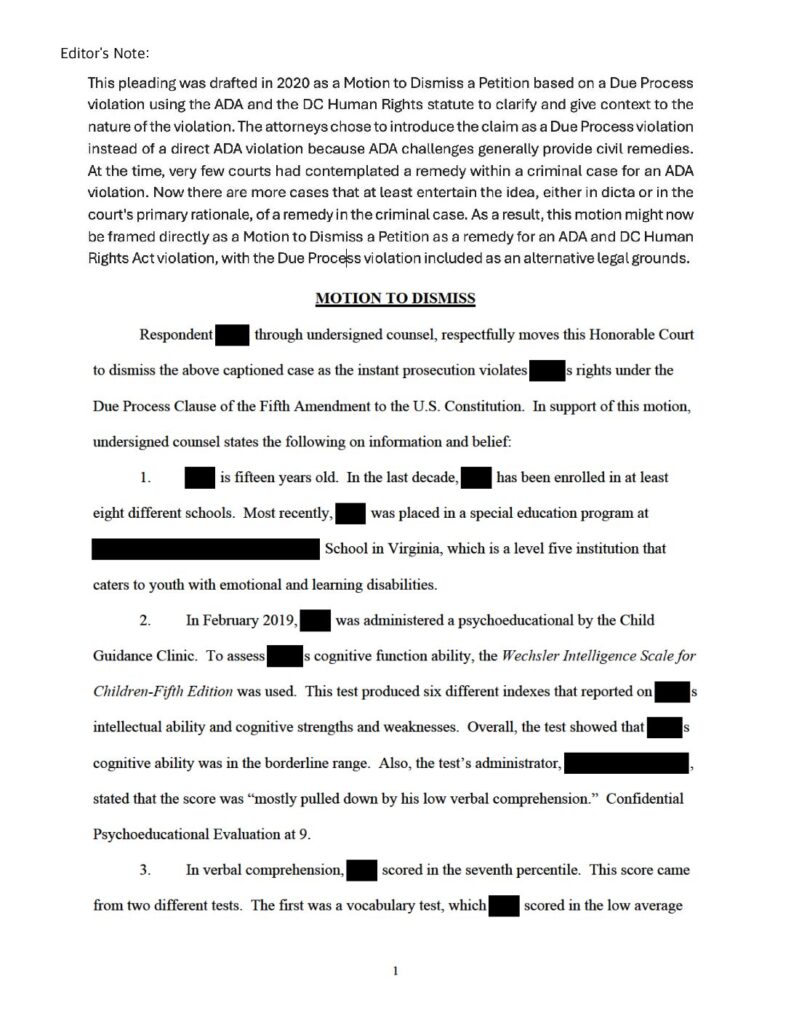
This is a sample motion from Maryland asking the court to dismiss a petition in the interest of justice based on the school district’s violation of the “Child Find” provisions of the Individuals with Disabilities Education Act (20 U.S.C. § 1401 et. seq.) as applied to the respondent, Jane Doe.

From the introduction: “Imagine you’re a student with a disability that impacts how you interact with others and process situations. In an instant, that disability may be criminalized, and you could find yourself thrust into a juvenile justice system that offers little support and few education resources. This scenario is all too common. Thousands of…

From the Executive Summary, developed by Equip for Equality: “The children in the Juvenile Temporary Detention Center (“JTDC”) are some of the most vulnerable youth in Cook County, many having experienced significant trauma and violence as part of their daily existence. The JTDC is the juvenile jail for Cook County, housing youth awaiting adjudication of their cases, as well…

From the introduction: “The COVID-19 pandemic has laid bare the dangers of the juvenile legal system; this should make it harder to look away from the societal inequities that are exacerbated by youth incarceration. Indeed, the current moment, including the unprecedented nationwide protests in response to the murders of George Floyd and Breonna Taylor in…

From the introduction: “One of our goals in producing this report is to inform school administrators, board members, and parent and student stakeholders, giving details about which groups of students are disproportionately arrested and about the gaps that exist in data reporting. We also want to provide guidance on how to address these issues. We…

On December 21, 2021, the DOJ released its investigation of the Connecticut Manson Youth Institution, finding that the conditions violate young people’s rights under the Eighth and Fourteenth Amendments and the Individuals with Disabilities Education Act. In its Investigation, the DOJ stated “specifically, we find that Manson’s isolation practices and inadequate mental health services seriously…

On May 26, 2021, the DOJ filed a Statement of Interest in a federal class action lawsuit on behalf students confined in the DC Jail during the Covid-19 pandemic, alleging violations of the Individuals with Disabilities Education Act (IDEA). The DOJ asserted that “[s]tudents with disabilities do not forfeit their right to special education and…

This Article explores how race functions to ascribe and criminalize disability. It posits that for White students in wealthy schools, disabilities or perceived disabilities are often viewed as medical conditions and treated with care and resources. For students of color, however, the construction of disability (if it exists) may be a criminalized condition that is…

On June 26, 2019, the DOJ closed its investigation of the Leflore County Juvenile Detention Center. In its closing letter, the DOJ stated “[w]e recognize that the state has made many improvements at the Detention Center School over the course of our involvement. . . . Specifically, the Detention Center School has made strides to…
