
Probation Revocation
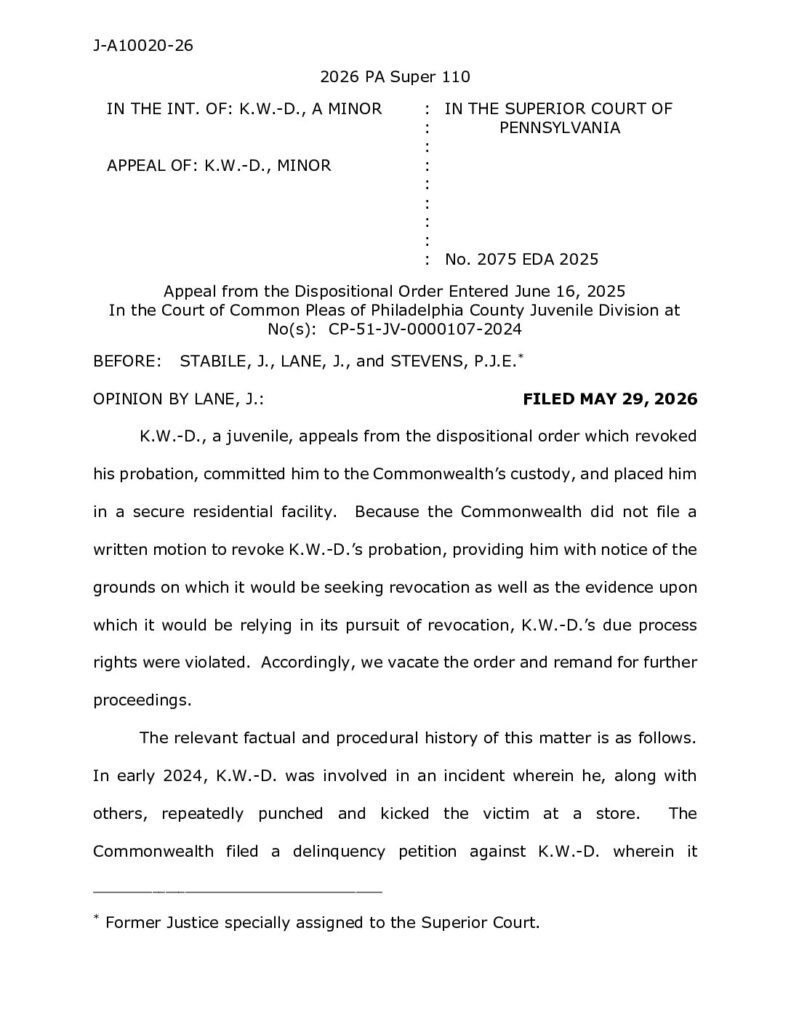
The Pennsylvania Superior Court vacated a probation revocation order, finding that the youth was deprived of their constitutional right to notice of the specific allegations and supporting evidence pertaining to the revocation. The court stated in relevant part: Based on our review, and in light of this Court’s ruling in K.G.-B., we conclude that K.W.-D. was…
“Being found in violation of probation has dire consequences. The person found in violation can be imprisoned, upending them from their job, family, and community. Unlike incarceration after a criminal trial, a sentence after a violation of probation is not the result of a legal process characterized by robust due process protections. It is also…
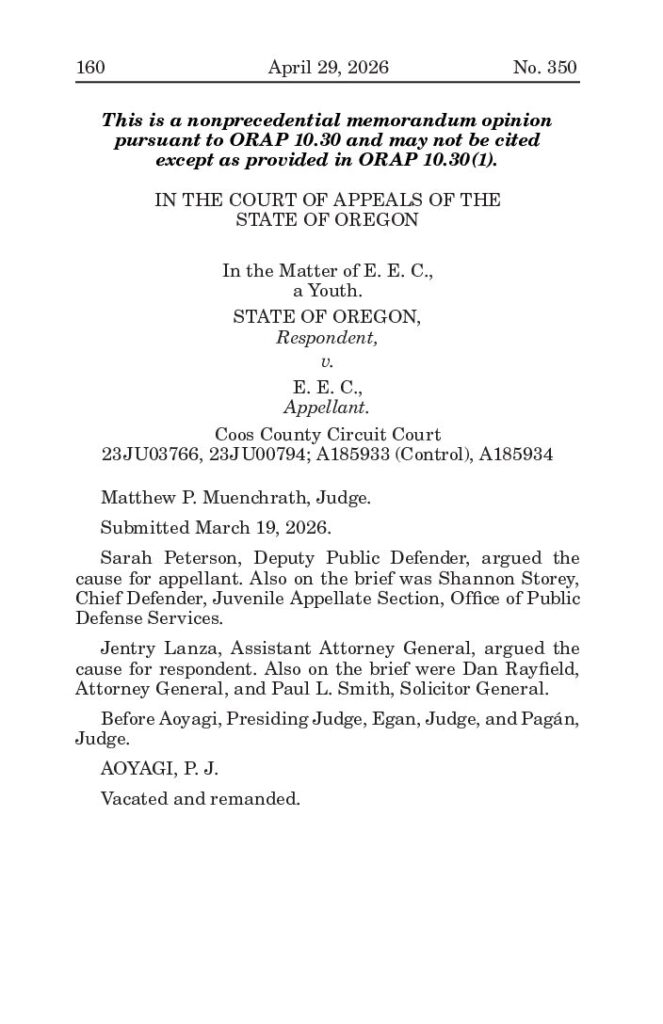
The Oregon Court of Appeals vacated and remanded a placement order, finding that the order lacked written findings justifying placement based on the best interests of the youth, as required under state statute. The court stated in relevant part: Under ORS 419C.478(1), a juvenile court placing a youth in OYA custody must include in its order…
Examines young people’s experiences on juvenile probation and the racialized history of juvenile probation in our country.
The Pennsylvania Superior Court reversed a young person’s probation revocation, finding that the state’s failure to provide defense counsel with notice and discovery violated the young person’s due process rights. The court stated in relevant part: We recognize that “[d]ue process is a flexible concept which ‘varies with the particular situation.’” Bundy v. Wetzel, 646 Pa.…

The Supreme Court of Wyoming held that a trial court must hold a separate disposition hearing in probation revocation proceeding. The court stated in relevant part: “Although Wyoming law does not require separate hearings for the adjudication and disposition phases of a probation revocation, each phase must be conducted in accordance with such law. The…
In re J.D., the Appellate Court of Maryland vacated the circuit court’s imposition of a suspended commitment to the Department of Juvenile Services because this dispositional option is not authorized by the Maryland Rules or the Juvenile Causes Act. The court offered the following language in support: “In our review of the Juvenile Causes Act, we found the statute to be clear and unambiguous. It plainly provides for three types of disposition: probation, commitment…
From the Abstract: “Technical probation violations are common among probation-involved youth and, across many jurisdictions, may result in detention or residential placement. The current study examined prevalence of technical violations occurring during one’s first probation period, the average time to technical violation, and individual-level and justice-related factors related to technical violations among probation-involved youth in…
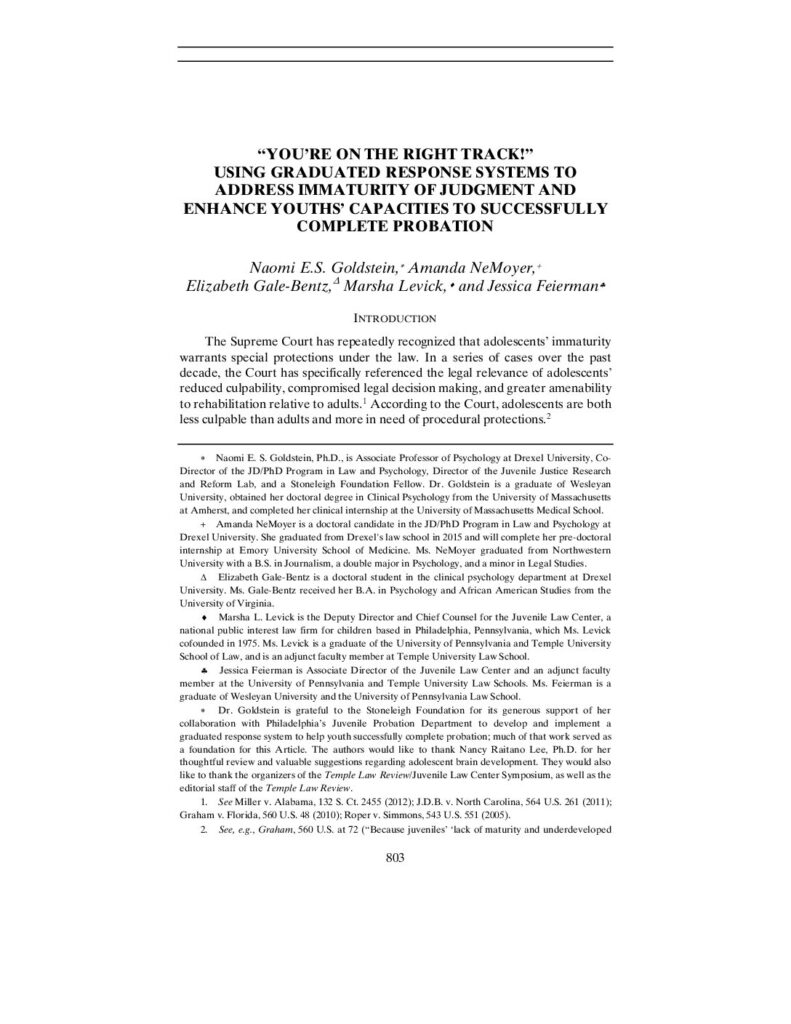
From the Introduction: “The Supreme Court has repeatedly recognized that adolescents’ immaturity warrants special protections under the law. In a series of cases over the past decade, the Court has specifically referenced the legal relevance of adolescents’ reduced culpability, compromised legal decision making, and greater amenability to rehabilitation relative to adults. According to the Court,…

On September 18, 2015, the U.S. Department of Justice entered into a settlement agreement with the state of Mississippi about their probation and diversion practices. The settlement agreement includes provisions on protecting a youth’s right against self-incrimination, requiring probation orders to be written in simple terms to prevent arbitrary and discriminatory enforcement, and ensuring the…

On October 24, 2012, the U.S. Department of Justice filed a complaint in the United States District Court, Southern District of Mississippi asserting that the City of Meridian, County of Lauderdale, and State of Mississippi are engaging in a “pattern or practice of unlawful conduct through which they routinely and systematically arrest and incarcerate children,…

On August 10, 2012, the U.S. Department of Justice released a findings report regarding their investigation of Lauderdale County Youth Court, Meridian Police Department, and Mississippi Division of Youth Services. The findings included the following violations: “(1) The City of Meridian Violates the Fourth Amendment by Arresting Children Without Assessing Probable Cause; (2) Lauderdale County…
