
Special Education


On January 12, 2016, the DOJ released its second investigation findings on the Leflore County Juvenile Detention Center in Greenwood, Mississippi. The DOJ found “reasonable cause to believe that the provision of special education and related services at the Detention Center violate the federal rights of children under IDEA.” Specifically, the DOJ stated, “Our investigation…

On September 18, 2015, the U.S. Department of Justice entered into a settlement agreement with the city of Meridian to address the practice of arresting students in schools. The settlement agreement includes provisions that limit school-based arrests, including “for behavior that is appropriately addressed as a school discipline issue, including incidents involving public order offenses…

On August 6, 2015, the DOJ released an updated findings letter on several juvenile facilities in Puerto Rico. The DOJ finds that young people confined in juvenile facilities face substantive due process and equal protection violations, in addition to infringements to their federal rights under the Individuals with Disabilities Education Act and the Rehabilitation Act…

On March 31, 2011, Leflore County, Mississippi entered into a Memorandum of Agreement (MOA) with the United States to address the DOJ’s investigation findings into the Leflore County Juvenile Detention Center (LCJDC). The MOA outlines that LCJDC must provide young people with reasonably safe conditions of confinement, protect youth from harm, limit the use of…

On May 12, 2015, the DOJ filed a complaint in the U.S. District Court for the Northern District of Mississippi against Leflore County, Mississippi for engaging “in a pattern or practice of conduct that violates the Constitutional and statutory rights of youth at the Detention Center.” The complaint outlines 14th Amendment violations based on Leflore…
From the summary: “It is critical for judicial officers, attorneys, probation officers, child welfare, and other professionals who work with youth to be knowledgeable about the impact of trauma on children’s development and on their emotional, behavioral, and cognitive functioning. Understanding trauma and the potential impacts on children who come before the juvenile and family…

On February 13, 2014, the DOJ filed a Statement of Interest in a federal class action lawsuit on behalf of young people confined in the Contra Costa County Juvenile Hall, alleging violations of the Individuals with Disabilities Education Act (IDEA). The DOJ reiterated that “Defendants (Contra Costa County) are required to provide special education and…

On October 24, 2012, the U.S. Department of Justice filed a complaint in the United States District Court, Southern District of Mississippi asserting that the City of Meridian, County of Lauderdale, and State of Mississippi are engaging in a “pattern or practice of unlawful conduct through which they routinely and systematically arrest and incarcerate children,…

On August 22, 2012, the DOJ released its investigation findings into the Pendleton Juvenile Correctional Facility in Indiana. The investigation finds that “Pendleton exposes incarcerated youth to significant harm in violation of their constitutional and federal statutory rights. Pendleton fails to take reasonable steps to prevent youth from committing suicide, fails to provide reasonably safe…

On August 10, 2012, the U.S. Department of Justice released a findings report regarding their investigation of Lauderdale County Youth Court, Meridian Police Department, and Mississippi Division of Youth Services. The findings included the following violations: “(1) The City of Meridian Violates the Fourth Amendment by Arresting Children Without Assessing Probable Cause; (2) Lauderdale County…

On March 31, 2011, the Department of Justice released the findings of their investigation into the Leflore County Juvenile Detention Center (LCJDC) in Greenwood, Mississippi. The DOJ found that “[o]ur investigation revealed systemic, egregious and dangerous abuses perpetuated by a lack of accountability and controls.” The DOJ investigation uncovered that LCJDC fails to prevent unconstitutional…
This amici brief by Juvenile Law Center, Rutgers Legal Clinic, The Gault Center, and others argues trial courts retain jurisdiction post-disposition to modify or change dispositional orders that are contrary to the purpose of the juvenile code. Further, the brief argues trial courts must provide oversight to ensure the safety of young people in abusive…
This amicus brief by South Dakota Advocacy Services, The Gault Center, and others argues the 8th Circuit’s interpretation of IDEA’s procedural safeguards are unconstutional under the 14th Amendment Due Process Clause and violate the plain language of the statute. The brief also outlines procedural protections from school exclusion for students with disabilities. As stated in…

On January 29, 2010, the Department of Justice issued a findings letter regarding an investigation of the Indianapolis Juvenile Correctional Facility (ICJF) pursuant to the Civil Rights of Institutionalized Persons Act, 42 U.S.C. § 1997 (CIPRA), and the pattern or practice provision of the Violent Crime Control and Law Enforcement Act of 1994, U.S.C. §14141…

On November 23, 2009, the DOJ and the Ohio Department of Youth Services entered into an amended consent decree to address the remaining conditions of confinement in the Scioto Juvenile Correctional Facility, following the closure of the Marion Juvenile Correctional Facility. Related Actions: [Ohio] Marion Juvenile Correctional Facility: Investigation [Ohio] DOJ Complaint in U.S. v.…

On May 16, 2008, the DOJ filed a complaint against the State of Ohio in the Southern District of Ohio Eastern Division for engaging in a pattern or practice of constitutional violations in juvenile facilities. Specifically, the complaint alleges that the state has engaged in a pattern or practice of violating young people’s right to…
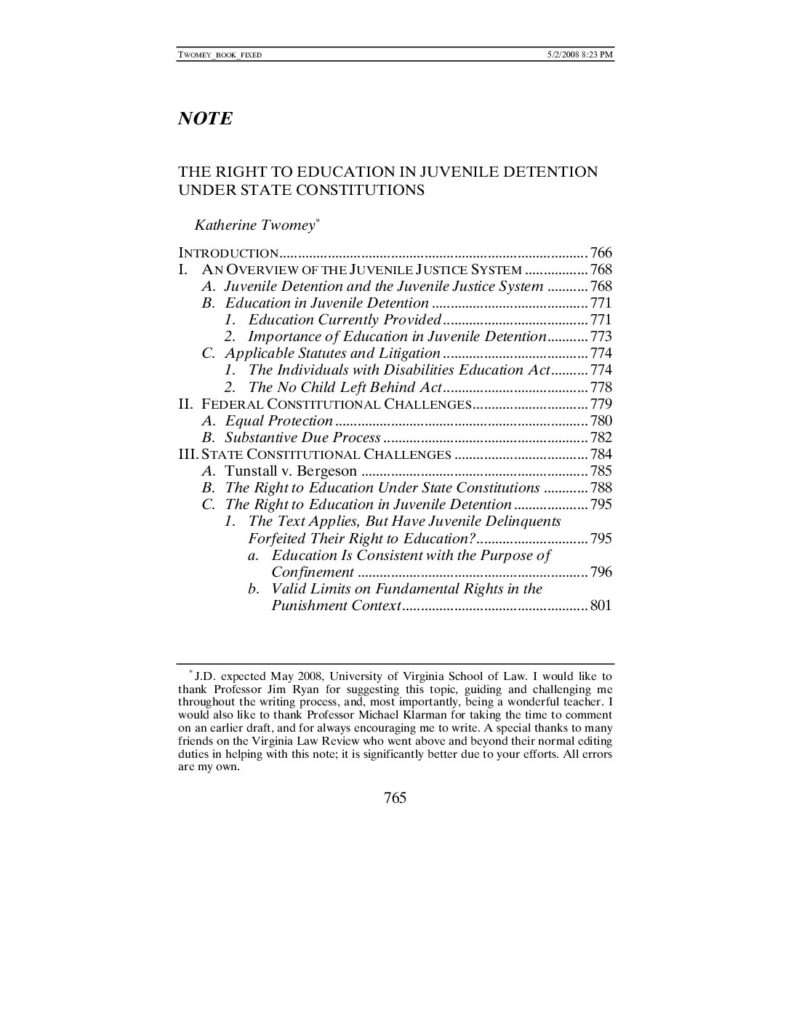
From the introduction: “This Note will argue that children in juvenile detention have a right to an adequate education based on state constitutional guarantees of education. This right can be used to challenge the inadequacy of the current educational services provided in juvenile detention facilities. The argument will proceed in three parts. Part I will…

On May 9, 2007, the DOJ released its investigation of the Marion County, Ohio Juvenile Correctional Facility, finding that the conditions violate federal and constitutional rights of youth. Specifically, the investigation highlights violations of young people’s right to reasonable safety, right to adequate mental health care, and right to special education services. Related actions: [Ohio]…

On May 9, 2007, the DOJ released its investigation of the Scioto Juvenile Correctional Facility, finding that the conditions violate federal and constitutional rights of youth. Specifically, the investigation highlights violations of young people’s right to reasonable safety, right to adequate mental health care, and right to special education services. Related actions: [Ohio] Marion Juvenile…


The delinquent act itself is often the primary basis for determining intention and competency of children under 18 in adult or juvenile court. But behaviors result from one or more of a diverse range of factors, each of which has different effects on decision-making. The capacity of juveniles to plan or to stop an action…

