
California


This amicus brief by the Santa Clara County Independent Defense Counsel Office argues the decision in People v. Hardin should be affirmed because historical legacies of racism disparately expose some adolescents to the legal system and this does not justify lifelong punishment without considering rehabilitation. From Introduction & Summary of Argument: “Youthful offender parole is authorized by age at the…

This amicus brief by American Civil Liberties Union and others argues that denying an opportunity for parole for young adults between the ages of 18 and 25 raises an equal protection violation given the racially disproportionate impact of life without parole sentences on young adults, resulting from “tough on crime” politics based in racial bias. From the Introduction: “In analyzing Petitioner Hardin’s equal protection…


This bill amends CA WIC § 707(a) by requiring a court to find by clear and convincing evidence that a minor is not amenable to rehabilitation while under juvenile court jurisdiction and requiring that court’s order to include the reasons supporting a finding that a minor is not amenable to rehabilitation in the juvenile court. This bill…

Between a Rock and a Hard Place: The Social Costs of Pretrial Electronic Monitoring in San Francisco
This report features findings from in-depth interviews from 66 people who were court-ordered to electronic monitoring (EM) in San Francisco County, California. Highlighting the nature and difficulties program participants face while trying to comply with EM programs, the report demonstrates the harms of EM, including finding safe housing, securing employment, social isolation, trouble maintaining physical and emotional connections to loved ones, and increased likelihood of new contacts with law enforcement. From…

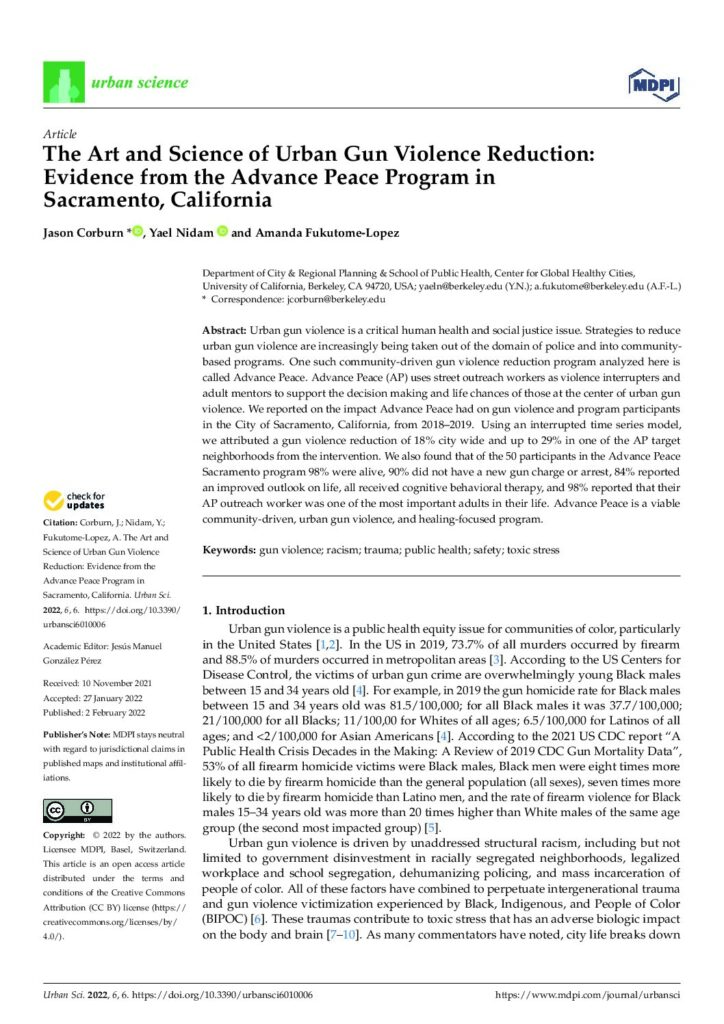
This article from Urban Science evaluates the success rate of the Advance Peace Sacramento gun crime reduction program and concludes that Advance Peace is a model for “urban public safety that combines inter-personal healing and community crime reduction. Abstract: “Urban gun violence is a critical human health and social justice issue. Strategies to reduce urban…


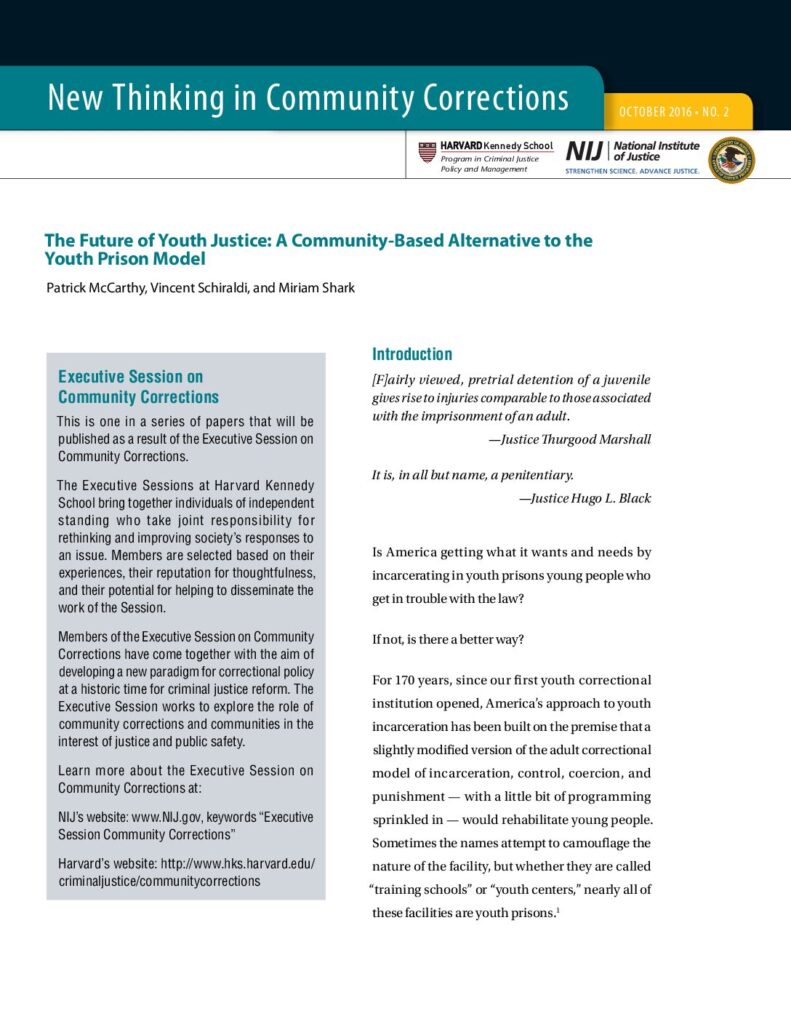
This paper from the Executive Session on Community Corrections at the Harvard Kennedy School examines the history of youth incarceration and discusses how the inherently flawed model of youth prisons demands systemic reforms, including closure of youth prisons, to actualize safer communities, and positive youth outcomes. From the introduction: “For 170 years, since our first youth correctional institution opened, America’s approach…
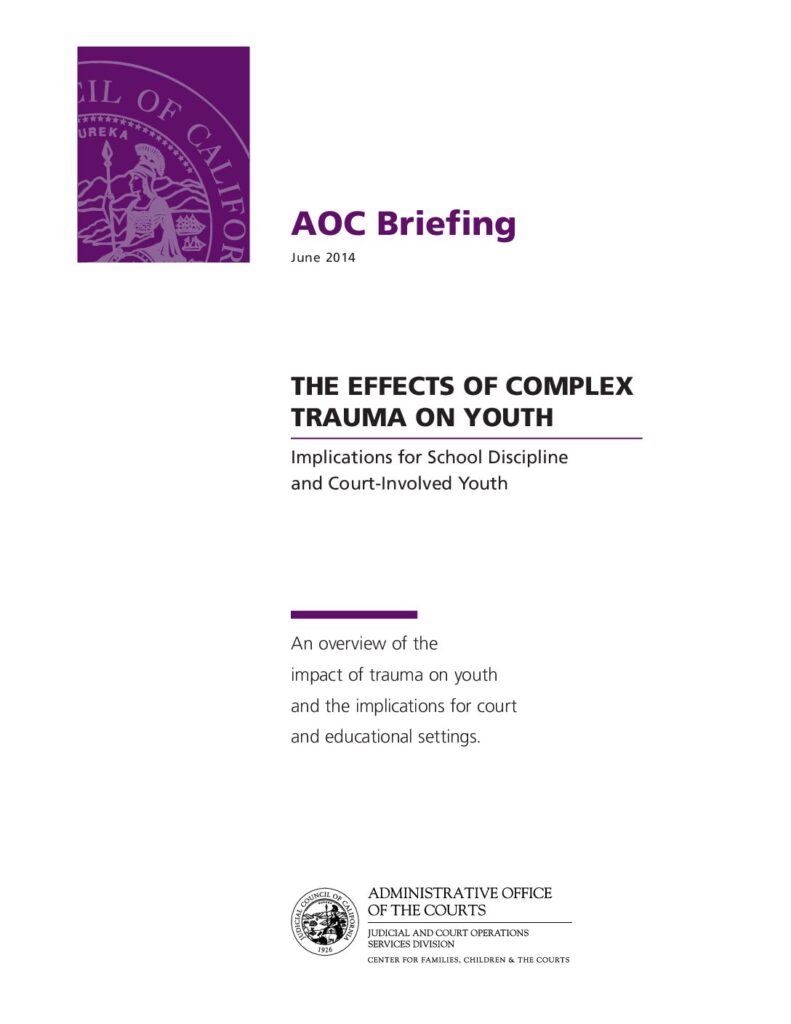
From the summary: “It is critical for judicial officers, attorneys, probation officers, child welfare, and other professionals who work with youth to be knowledgeable about the impact of trauma on children’s development and on their emotional, behavioral, and cognitive functioning. Understanding trauma and the potential impacts on children who come before the juvenile and family…

On February 13, 2014, the DOJ filed a Statement of Interest in a federal class action lawsuit on behalf of young people confined in the Contra Costa County Juvenile Hall, alleging violations of the Individuals with Disabilities Education Act (IDEA). The DOJ reiterated that “Defendants (Contra Costa County) are required to provide special education and…
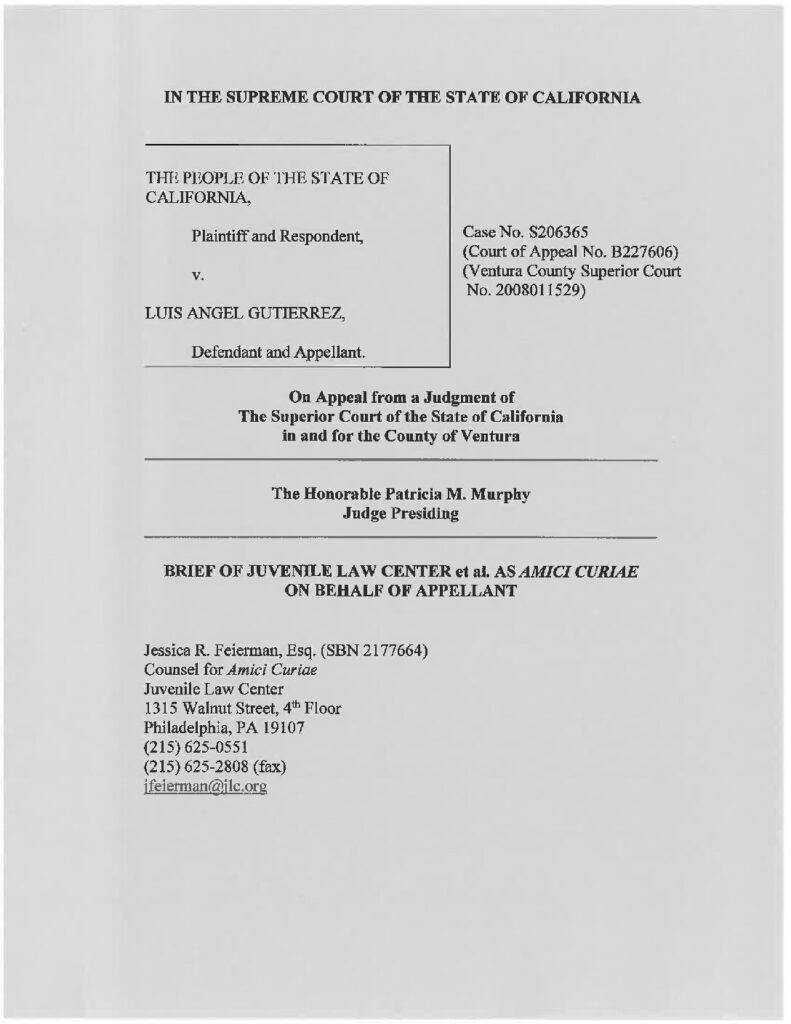
This amicus brief by Juvenile Law Center and others argues California Penal Code 190.5(b) is unconstitutional because it presumes life without parole is the appropriate sentence for certain young people in adult court and it disregards Miller’s requirement of individualized sentencing. Furthermore, amici argue that a young person’s sentence must provide a “meaningful opportunity to…
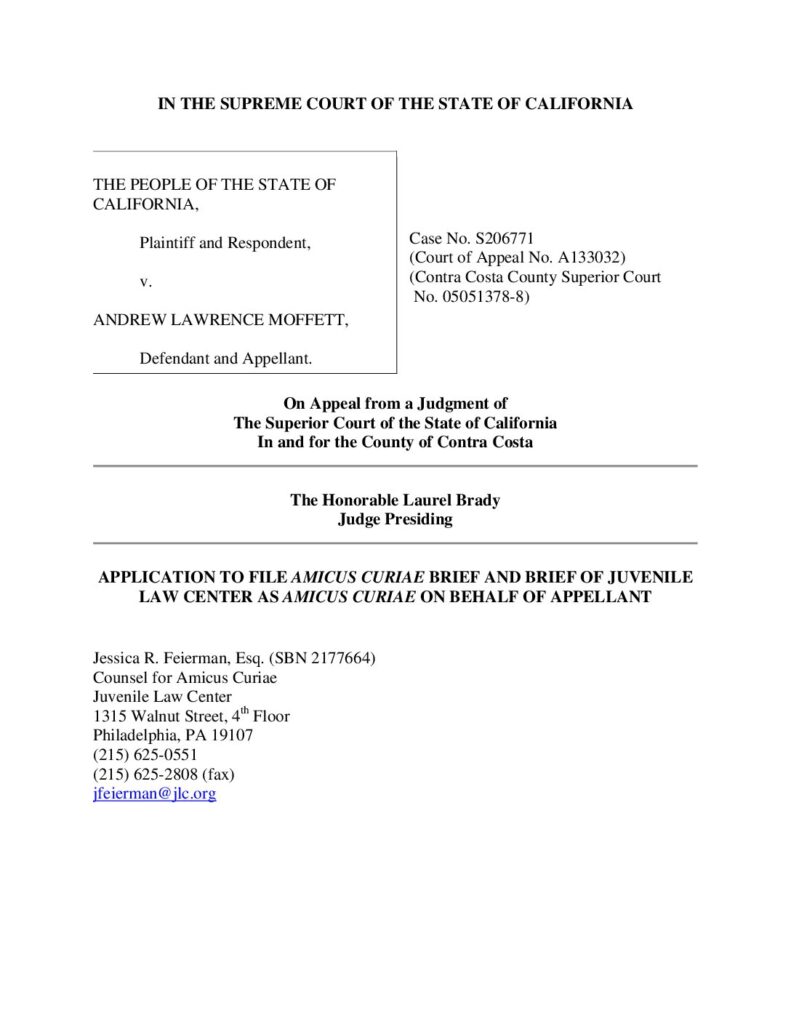
This amicus brief by Juvenile Law Center argues California’s Penal Code Sec. 190.5(b) is unconstitutional because it presumes life without parole is an appropriate sentence for [youth] and this presumption contravenes Miller’s requirement of individualized sentencing and that this type of sentence be uncommon for young people. Furthermore, amici argue any life without parole sentence…

On December 12, 2010, the Memorandum of Agreement (MOA) between Los Angeles County and the United States regarding the Los Angeles County Probation Camps was amended a second time. The amended MOA recognizes that the County implemented significant reforms and achieved substantial compliance with all but four paragraphs of the MOA, and thus extends the…

On October 31, 2010, Los Angeles County entered into a Memorandum of Agreement (MOA) with the United States to address the DOJ’s investigation findings into the Los Angeles County Probation Camps. The MOA provisions include implementing new policies that govern the use of force, restricting the use of chemical sprays, creating a system of review…

On March 29, 2010, the Memorandum of Agreement (MOA) between Los Angeles County and the United States regarding the Los Angeles County Probation Camps was amended. The amended MOA includes language outlining that “The Monitor shall ensure that the subset of the Monitoring Team that participates in these visits has the requisite experience and expertise…
- « Previous
- 1
- 2
- 3
- 4
- Next »
