
Disabilities

Intended for juvenile court judges, defense attorneys, prosecutors, and probation staff, the curriculum provides in-depth training materials on the most up-to-date adolescent development research and its application to juvenile court practice. As a part of the MacArthur Foundation’s project, Models for Change: Systems Reform in Juvenile Justice, this curriculum is available to jurisdictions across the…

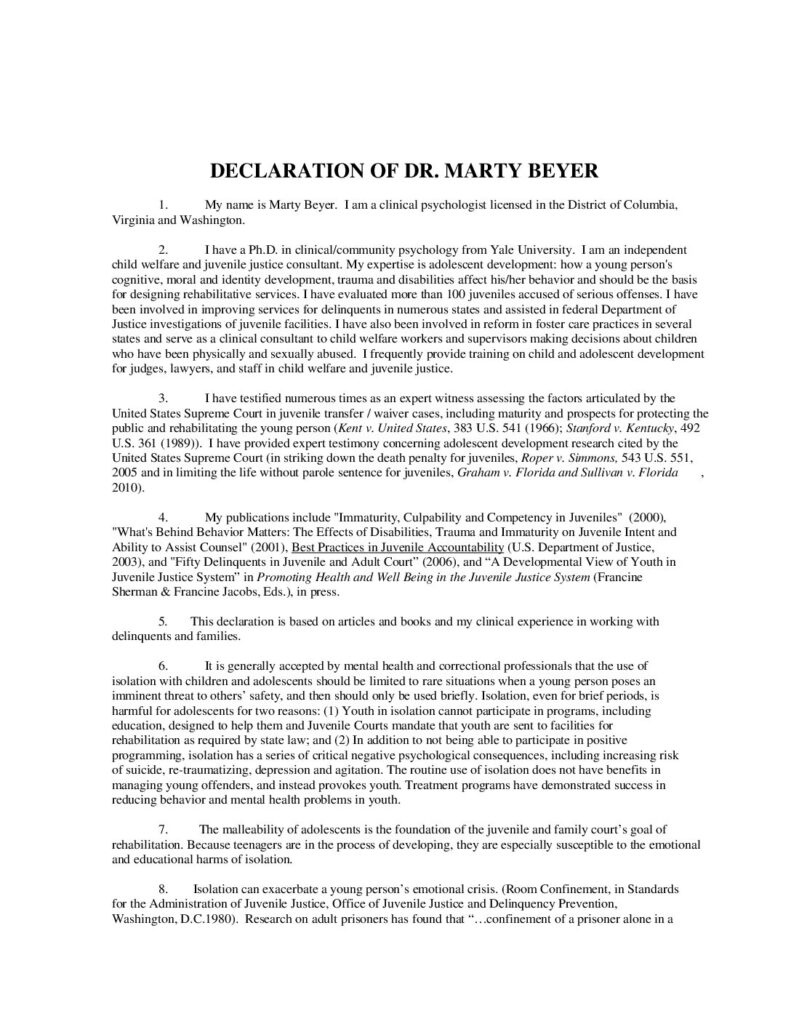
An expert declaration on the harms of the use of isolation on youth in juvenile correctional facilities.
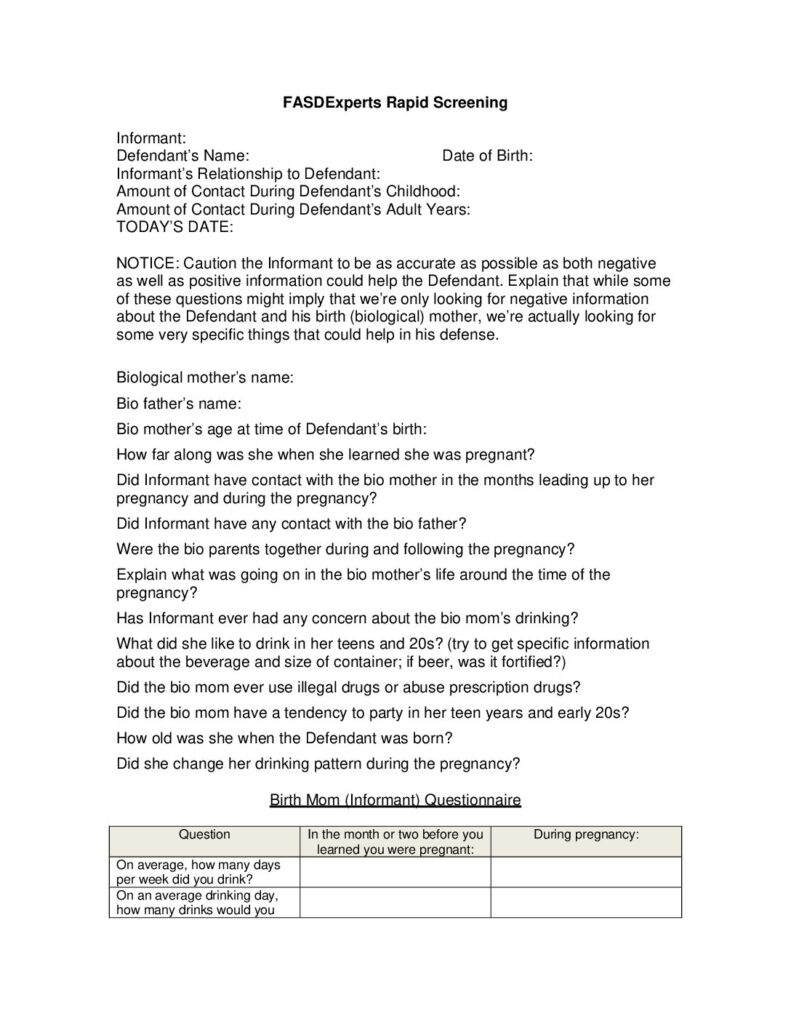
This is an example of a screening tool to be used in collaboration with defense experts, social work staff, and attorneys when gathering information as to whether a young person may have fetal alcohol spectrum disorder (FASD).

This is a sample motion from Maryland asking the court to dismiss a petition in the interest of justice based on the school district’s violation of the “Child Find” provisions of the Individuals with Disabilities Education Act (20 U.S.C. § 1401 et. seq.) as applied to the respondent, Jane Doe.

This research report by the ACLU provides an overview of surveillance technology (“EdTech Surveillance”) industry in K-12 schools and critically explores the industry’s claims, the efficacy of the products, and their impacts on students and schools. The report also provides recommendations for best protecting students and promoting better surveillance technology decision-making among elected officials, school…

From the introduction: “Imagine you’re a student with a disability that impacts how you interact with others and process situations. In an instant, that disability may be criminalized, and you could find yourself thrust into a juvenile justice system that offers little support and few education resources. This scenario is all too common. Thousands of…

From the executive summary: “On April 21, 2021, the Department of Justice opened a pattern or practice investigation of the Minneapolis Police Department (MPD) and the City of Minneapolis. By then, Derek Chauvin had been convicted in state court for the tragic murder of George Floyd in 2020. In the years before, shootings by other…
From the Introduction: “The U.S. Departments of Education and Justice (Departments) share with educators around the country the goal that all students attend schools where they are supported, safe, and able to access an excellent education. A school environment that is free from discrimination is essential to meeting that goal. Decades of enforcement activity by…


From the Executive Summary, developed by Equip for Equality: “The children in the Juvenile Temporary Detention Center (“JTDC”) are some of the most vulnerable youth in Cook County, many having experienced significant trauma and violence as part of their daily existence. The JTDC is the juvenile jail for Cook County, housing youth awaiting adjudication of their cases, as well…

From the abstract: “Drawing from legal pedagogy, litigation practice, and teaching experience, this article seeks to compile a set of key considerations for inclusive language decision-making in the clinical setting. Using a multi-factor framework—accuracy, precision, relevance, audience, and respect—this analysis explores the process for deciding on terms to use in practice and the potential implications…

From the executive summary: “The Department of Justice has reasonable cause to believe that the Louisville/Jefferson County Metro Government (Louisville Metro) and the Louisville Metro Police Department (LMPD) engage in a pattern or practice of conduct that deprives people of their rights under the Constitution and federal law: • LMPD uses excessive force, including unjustified…
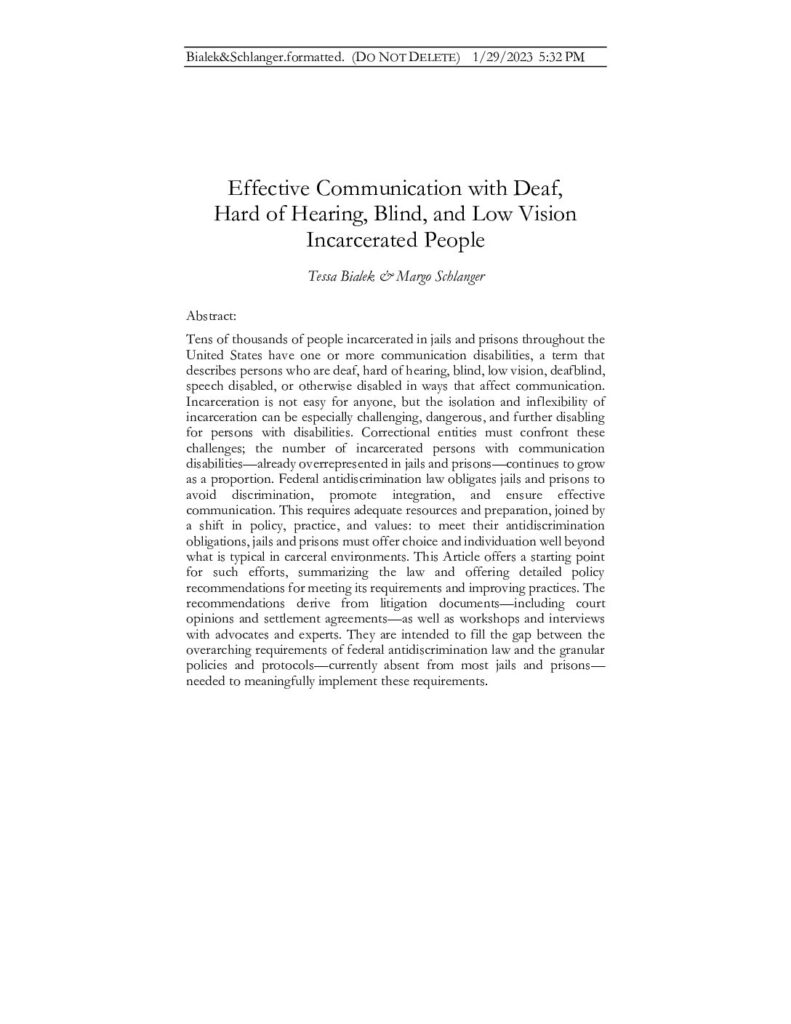
From the abstract: “Tens of thousands of people incarcerated in jails and prisons throughout the United States have one or more communication disabilities, a term that describes persons who are deaf, hard of hearing, blind, low vision, deafblind, speech disabled, or otherwise disabled in ways that affect communication. Incarceration is not easy for anyone, but…

From the introduction: “This brief offers context on the youth criminalization crisis in the United States. We then outline a series of harmful elements in the Bipartisan Safer Communities Act. Specifically, we review provisions that: • Increase funding for threat assessments, surveillance, and greater police presence in schools; • Expand data-sharing between law enforcement and…

From the abstract: “Disabled people are disproportionately incarcerated and segregated from society through a variety of institutions. Still, the links between disability and incarceration are underexplored, limiting understanding of how carceral institutions punish and contribute to the social exclusion of disabled people. Using data from the 2016 Survey of Prison Inmates, we estimated disability prevalence…

From the introduction: “The COVID-19 pandemic has laid bare the dangers of the juvenile legal system; this should make it harder to look away from the societal inequities that are exacerbated by youth incarceration. Indeed, the current moment, including the unprecedented nationwide protests in response to the murders of George Floyd and Breonna Taylor in…

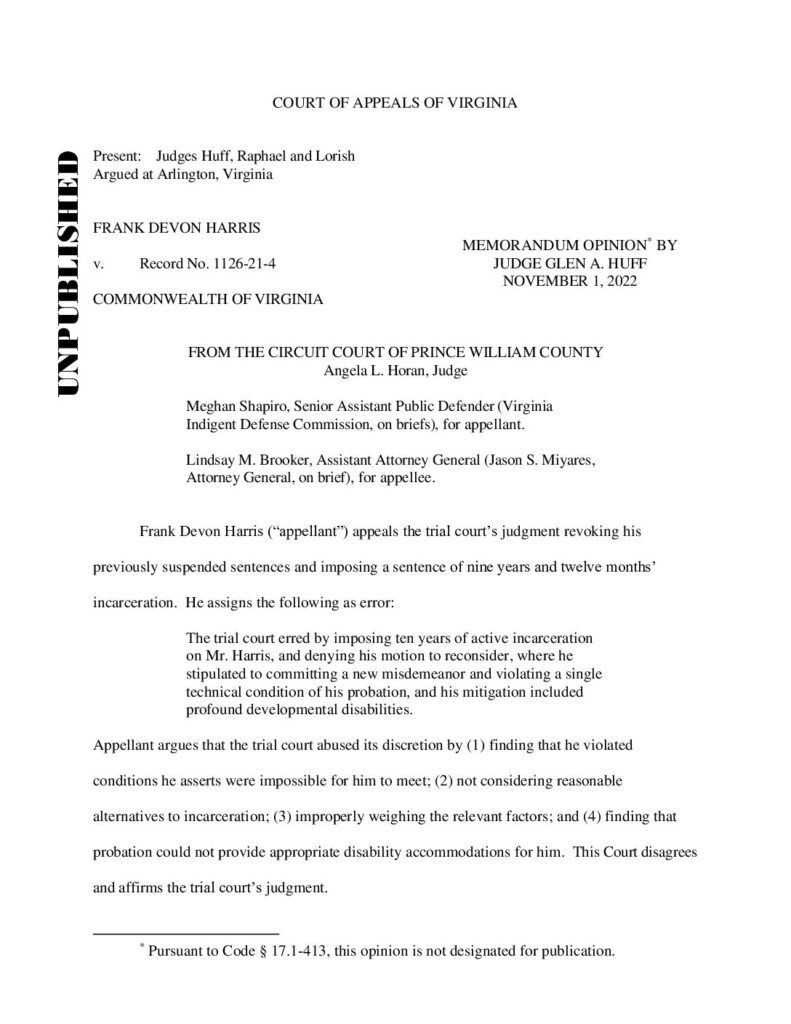
From the memorandum opinion: “Gary Montgomery, a mentally disabled man, was arrested in 2012 and charged with the murder of Deoni Jones. After five and a half years of incarceration pending trial, a jury found Montgomery not guilty. Montgomery’s amended complaint alleges that defendant District of Columbia violated his rights under Title II of the…

From the introduction: “Preventing, reducing, and improving interactions between autistic individuals and the criminal justice system are urgent research and policy priorities. Research should guide evidence-based programs and policies that limit unnecessary interactions between autistic individuals and the criminal justice system and address documented high rates of victimization among autistic individuals. A diverse team of…


From the introduction: “This Essay centers disability as a lens for analysis in Fourth Amendment jurisprudence. This Essay discusses the ways in which disability mediates interactions with law enforcement and how Fourth Amendment doctrine renders disabled people vulnerable to police intrusions and police violence. More specifically, this Essay critiques the Terry doctrine, consensual encounters, consent…

From the abstract: “Roughly one in four juveniles arrested in the U.S. spend time in a detention center prior to their court date. To study the consequences of this practice for youth, we link the universe of individual public school records in Michigan to juvenile and adult criminal justice records. Using a combination of exact…

From the introduction: “One of our goals in producing this report is to inform school administrators, board members, and parent and student stakeholders, giving details about which groups of students are disproportionately arrested and about the gaps that exist in data reporting. We also want to provide guidance on how to address these issues. We…
