
Due Process

On October 24, 2012, the U.S. Department of Justice filed a complaint in the United States District Court, Southern District of Mississippi asserting that the City of Meridian, County of Lauderdale, and State of Mississippi are engaging in a “pattern or practice of unlawful conduct through which they routinely and systematically arrest and incarcerate children,…


On August 10, 2012, the U.S. Department of Justice released a findings report regarding their investigation of Lauderdale County Youth Court, Meridian Police Department, and Mississippi Division of Youth Services. The findings included the following violations: “(1) The City of Meridian Violates the Fourth Amendment by Arresting Children Without Assessing Probable Cause; (2) Lauderdale County…

On December 17, 2012, the U.S. Department of Justice entered into a settlement agreement with Shelby County and the Juvenile Court of Memphis and Shelby County in Tennessee following their investigation into the juvenile court system. The settlement agreement includes remedial measures to align the following practices with the U.S. Constitution: probable cause determinations, notice…

In the case of C.P, the Ohio Supreme Court ruled that R.C. 2152.86, which created a new class of youth adjudicated of sex offenses who would automatically be subject to mandatory, lifetime sex-offender registration and notification requirements, violated the U.S. and Ohio Constitutions. In its ruling, the Court offered the following language in support: “In…
This amicus brief by The Juvenile Law Center and The Gault Center argues that young people have a constitutional right to a jury trial pursuant to the 6th and 14th Amendment, in cases with serious consequences, such as sex offenses with numerous collateral consequences, in juvenile court, without “comparable adult procedural protections”. Further, the brief…

This amicus brief by Juvenile Law Center, Campaign for Youth Justice, and The Gault Center argues the transfer hearing in the state juvenile court deprived the young person of due process when the judge only considered the intentional murder charge, when they were ultimately convicted on the lesser offense of felony murder and second degree…
Plaintiffs in this case are two youth who sought compensatory and punitive damages, and declaratory and injunctive relief for injuries they suffered while in the custody of New Jersey’s “Juvenile Justice Commission”. The harms that were alleged included excessive room isolation, deprivation of basic necessities such as proper clothing, and lack of access to mental…

On March 31, 2011, the Department of Justice released the findings of their investigation into the Leflore County Juvenile Detention Center (LCJDC) in Greenwood, Mississippi. The DOJ found that “[o]ur investigation revealed systemic, egregious and dangerous abuses perpetuated by a lack of accountability and controls.” The DOJ investigation uncovered that LCJDC fails to prevent unconstitutional…

This amicus brief by Loyola Civitas ChildLaw Center, Juvenile Law Center, The Gault Center, and others argues there is a per se conflict of interest when a child’s defense attorney also acts as their guardian ad litem. The brief argues the guardian ad litem’s ethical and legal obligation to act in the child’s “best interest”…
This amicus brief by The Gault Center and others argues that Virigina curtails a child’s right to challenge the effectiveness of representation by defense counsel. Amici outline that habeas review is the only method that young people are able to protect their due process right to effective assistance of counsel, as no right exists to…
This amicus brief by Center on Wrongful Convictions of Youth, Juvenile Law Center, and others argues that a juvenile court adjudication should not be used to enhance a sentence in adult court under Apprendi v. New Jersey, 530 U.S. 466 (2000), because a juvenile court adjudication lacks the same reliability as a criminal conviction, and…

This amicus brief by The Gault Center, Children’s Law Center, Inc., and the American Civil Liberties Union of Ohio Foundation, Inc. argues mandating young people to register on sex offender registries is improper since youth adjudicated of sex offenses are vastly different from adults convicted of sex offenses, registries frustrate the purpose of juvenile court,…

This amicus brief by The Gault Center, Juvenile Law Center, and National Center for Lesbian Rights argue that strict liability statutes run counter to the principles of adolescent development. Here, amici argue that a 12-year old child who engaged in non-forcible sexual conduct with his peer, who was then prosecuted under a strict liability sex…
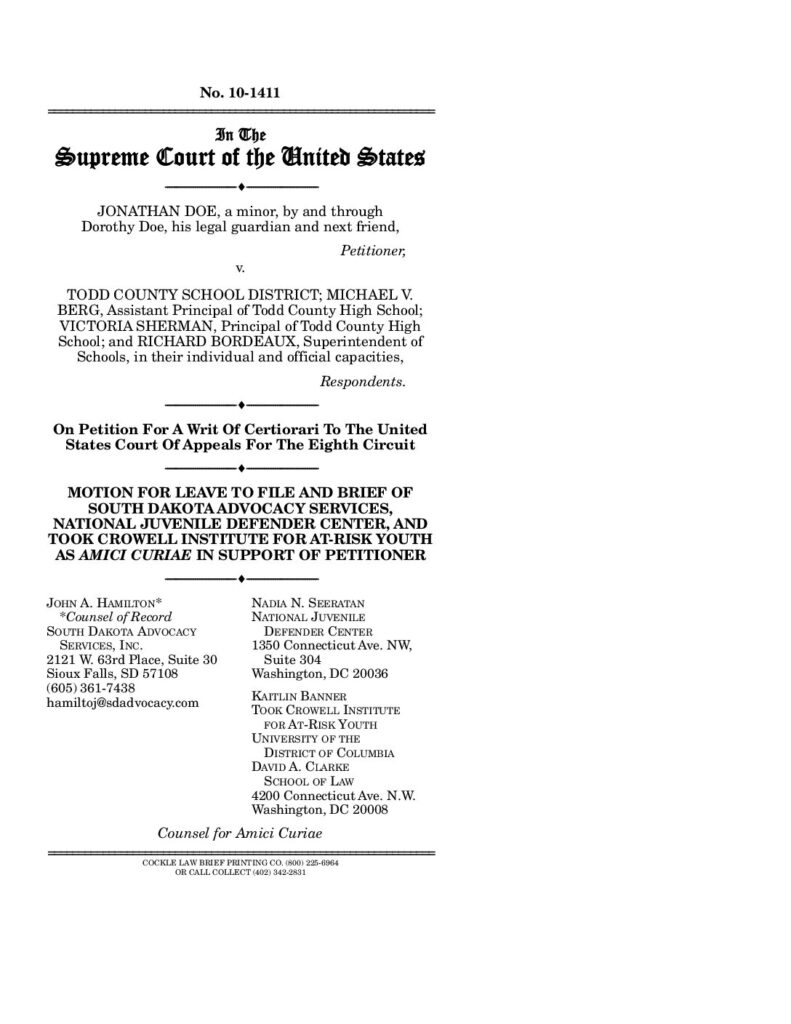
This amicus brief by South Dakota Advocacy Services, The Gault Center, and others argues the 8th Circuit’s interpretation of IDEA’s procedural safeguards are unconstutional under the 14th Amendment Due Process Clause and violate the plain language of the statute. The brief also outlines procedural protections from school exclusion for students with disabilities. As stated in…

This amicus brief by The Gault Center and others argues Nevada’s certification statute violates a child’s right to effective assistance of counsel as it interferes with counsel’s ability to plan and participate in the adversarial fact-finding process and it fails to measure up to essentials of due process and fair treatment. Furthermore, amici argue this…

This amicus brief by Southern Poverty Law Center, The Gault Center, and others argues Sherri Jefferson, a youth defense attorney in Georgia, must have her contempt conviction overturned after she professionally and zealously advocated on behalf of her young client in an adjudication in juvenile court. Amici argue the Supreme Court clearly held that children…
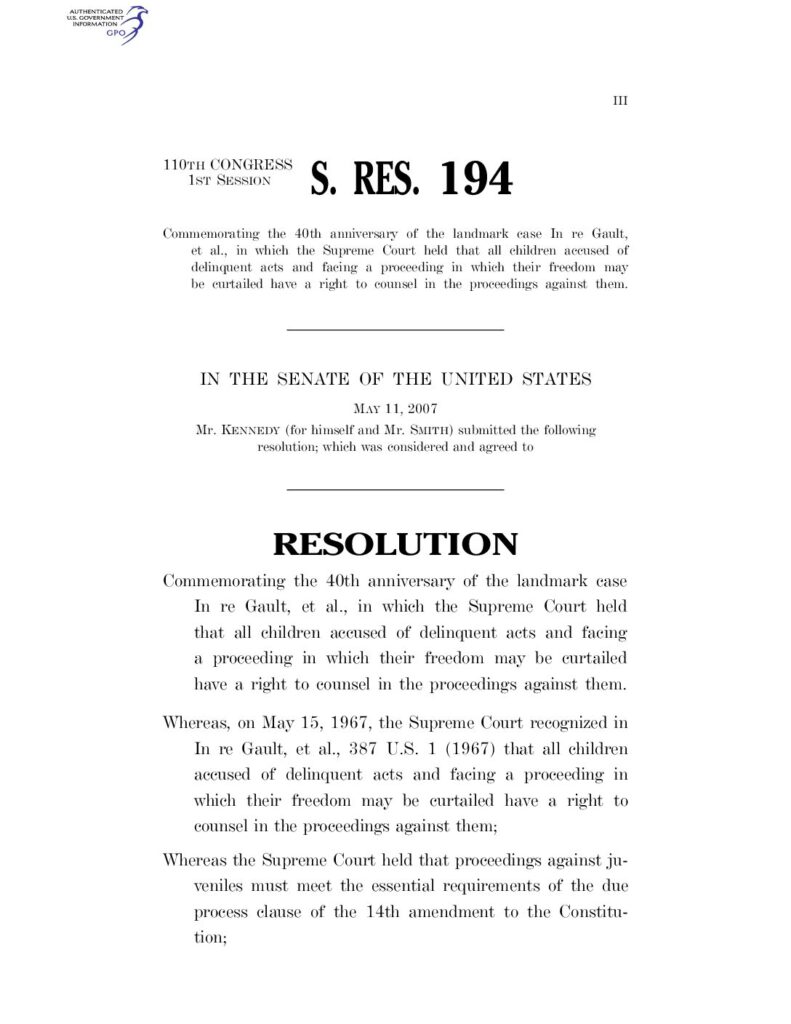
On May 11, 2007, the Senate passed a resolution commemorating the 40th anniversary of the In re Gault decision, which upheld the right to counsel for children in juvenile court. The resolution reiterates the Supreme Court’s holding that juvenile court proceedings must “meet the essential requirements of the due process clause of the 14th Amendment to the…

This research paper from the Journal of Interpretation looks at the intersection of a subset of deaf people, who are classified as semilingual (meaning they are functionally illiterate (reading level grade 2.9 or below) and lack proficient English or sign language skills.), and their involvement in the legal system. The research paper examines eleven frequently…
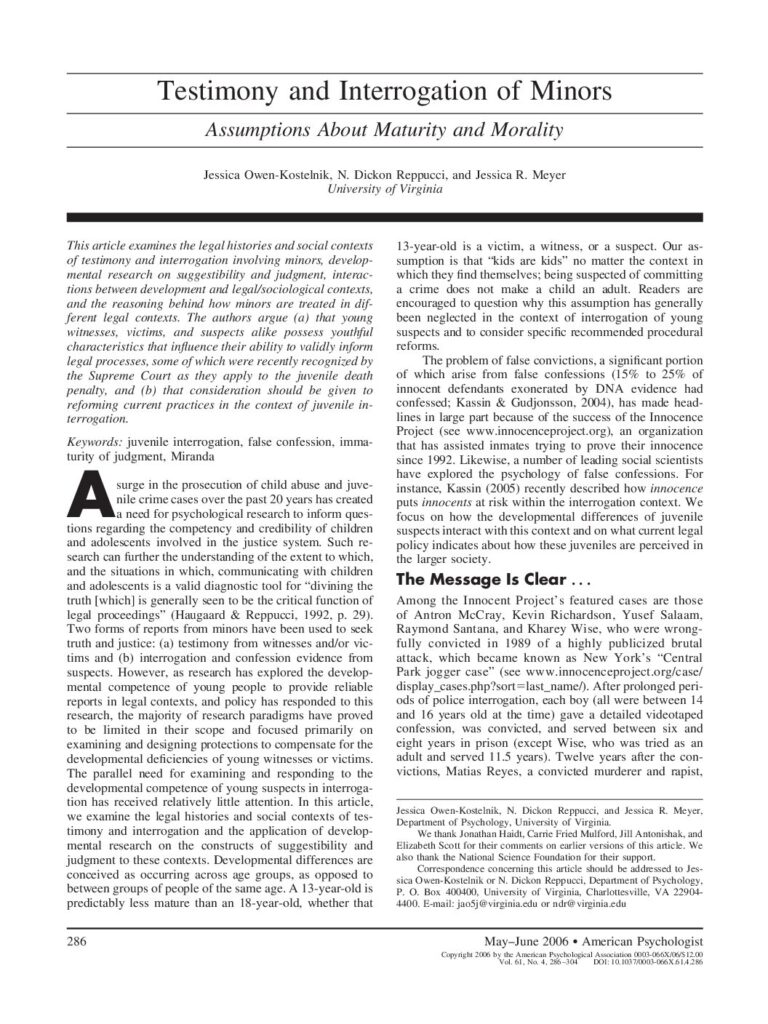
This article examines the legal history and social contexts of testimony and interrogation involving young people, developmental research on suggestibility and judgment, interactions between development and legal/sociological contexts, and the reasoning behind how young people are treated in different legal contexts. The authors argue (a) that young witnesses, victims, and suspects alike possess youthful characteristics…


The U.S. Supreme Court reversed the conviction and death sentence in Petitioner Kyle’s case where the state knowingly failed to disclose evidence favorable to the accused before and during trial. The Court reasoned that because the net effect of the evidence withheld by the state “raises a reasonable probability that its disclosure would have produced…
