
Due Process

Young people and their families are routinely assessed fees, fines, and other costs in delinquency matters. These financial assessments are often ordered without an ability-to-pay analysis by the court. A young person’s inability to pay can lead to long-lasting consequences, increased recidivism, and youth and their families having to choose between paying fees or buying…

From the executive summary: “• Police increasingly replace stop-and-frisk practices with databases that crudely profile Black and Latinx youth based on their neighborhoods, peer groups, and clothing. • These databases ruin lives: police typecast minority youths as gang members without evidence, putting them at risk of false arrest and wrongful deportation. • Many police departments…

The Court considers a question of first impression — whether a criminal defendant must be provided in-person interpreting services, rather than video remote interpreting (VRI) services, at his jury trial.



Creates a case for holding states liable for abdicating their duty to ensure that all children have zealous representation.


From the introduction: “This paper collects and summarizes existing scholarship on the effects of video technology in court proceedings. Federal courts, immigration courts, and state courts have long used video technology for certain kinds of proceedings. While the available scholarship on the use of video proceedings is limited, existing research suggests reason for caution in…

The Ohio Appellate Court vacated a youth’s convictions and transfer order and offered the following language in support. “Because the juvenile court (1) did not identify all of the factors it considered, i.e., the “other information factors” referenced at the amenability hearing, (2) did not identify or discuss the factual or evidentiary basis for its…


The Louisiana Supreme Court took up defense counsel’s writ following the trial court’s denial of a motion to quash following the State’s dismissal and refiling of charges following two adverse rulings, in effect evading all appellate review of the court’s ruling. The court found the accused, Mr. Reimonenq’s, 14th Amendment right to due process and…

This brief highlights the United States Supreme Court’s most important language in landmark cases about young people’s rights. These quotes can be used to bolster the arguments and pleadings of juvenile defense attorneys and advocates as they defend youth caught in the legal system.

On November 15, 2018, a joint settlement was reached to address the conditions of confinement in Florida’s Palm Beach County Jail. The settlement agreement outlines comprehensive changes in the facility, including giving young people time and access to appropriate recreational activities outside of their cells during school hours. The settlement also limits the amount of…

On October 1, 2018, the DOJ filed a Statement of Interest in a federal class action lawsuit on behalf of young people confined in Florida’s Palm Beach County Jail. The DOJ highlights the protections afforded to students with disabilities under the Individuals with Disabilities Education Act (IDEA), and the “independent and shared” responsibilities and obligations…

On June 21, 2018, a federal class action lawsuit was filed on behalf of young people confined in the Palm Beach County Jail, alleging violations of their 8th and 14th Amendment rights under the U.S. Constitution. The plaintiffs are youth whose cases have been direct-filed in adult court in Palm Beach County, Florida. The complaint…
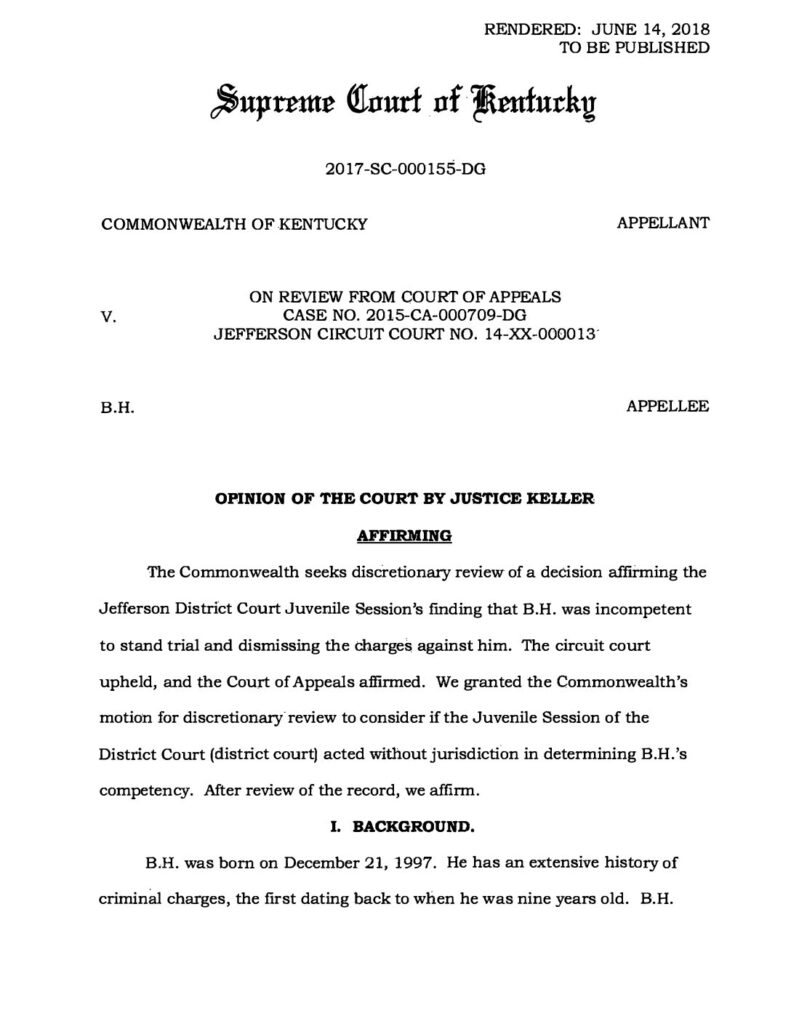
The Kentucky Supreme Court found that competency attaches for young people at transfer hearings pursuant to the 6th and 14th Amendments of the U.S. Constitution as well as Section 11 of the Kentucky Constitution. The Court reasoned that because transfer hearings are critically important proceedings as identified in Kent, competence must be established before transfer…

“In this article, we address the question left unanswered by the Court in J.D.B.: In light of the substantial research establishing that children’s understanding and appreciation of the Miranda warnings are quite limited, must the traditional test for assessing the validity of an individual’s waiver of their Miranda rights be re-calibrated to take into account…


