
Equal Protection
From the Abstract: “This article is a practical guide in the fight to abolish the prison-industrial complex as well as institutionalized transphobia and cissexism. Focusing specifically on the practice area of criminal defense, this article proposes a model that must be replicated across jurisdictions wherever transgender people are criminalized. By instituting an interdisciplinary team approach…
The Delaware Family Court granted a motion for relief from sex offender registration requirements in Delaware in a case involving an individual who was adjudicated of a sex offense as a youth in New Jersey and now works full-time in Delaware. The court stated in relevant part: First, under the Privileges and Immunities Clause of Article…
This testimony from the No Tech Criminalization in Education Coalition (NOTICE) opposes funds for AI surveillance technologies in Minnesota schools and outlines the ways these technologies violate the rights of youth and young adults including student data privacy concerns, the known pathway these technologies create to algorithmic discrimination in schools, and the scientific validation and…
“In the Supreme Court’s recent United States v. Skrmetti (2025) decision, Justice Amy Coney Barrett raised the novel question: Does the United States have a long-standing history of de jure discrimination against transgender people, perpetrated by state actors through the force of law? This Essay provides the beginnings of an answer to Justice Barrett’s inquiry, demonstrating that throughout the…
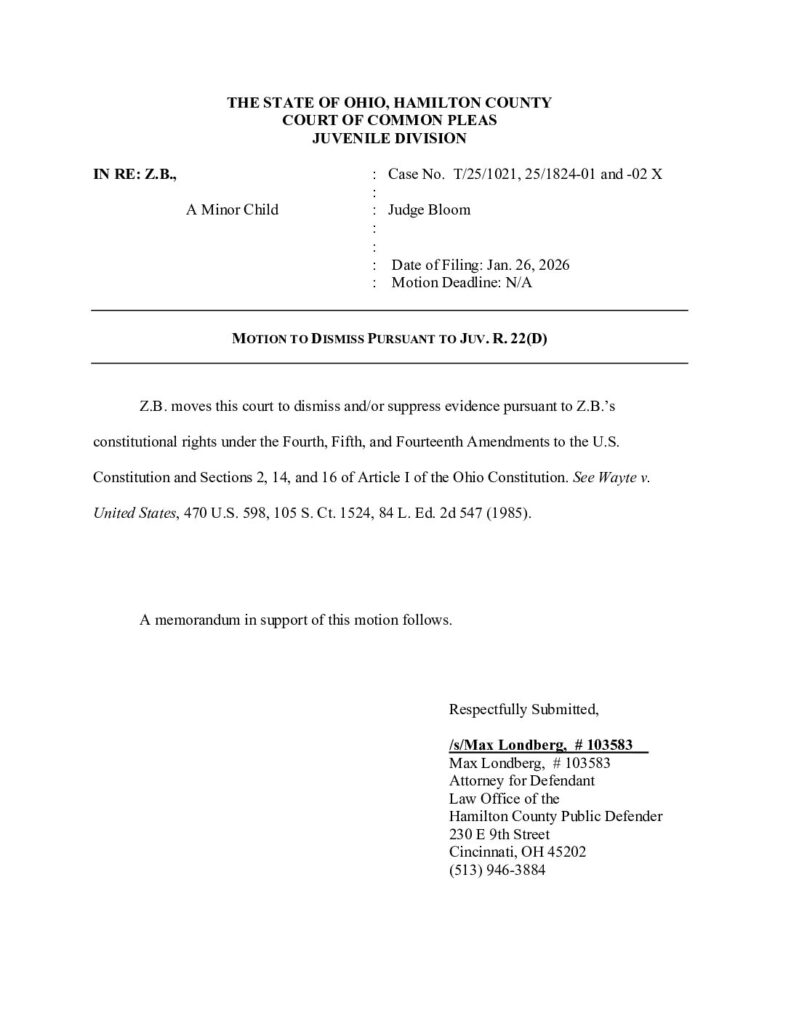
This sample motion argues for special discovery and dismissal and/or suppression based on a claim of selective prosecution in a jaywalking case. Highlighting local police data on racial disparities in jaywalking-related stops, this motion argues that police conduct had a discriminatory effect on Black youth in Cincinnati, in violation of their state and federal equal…
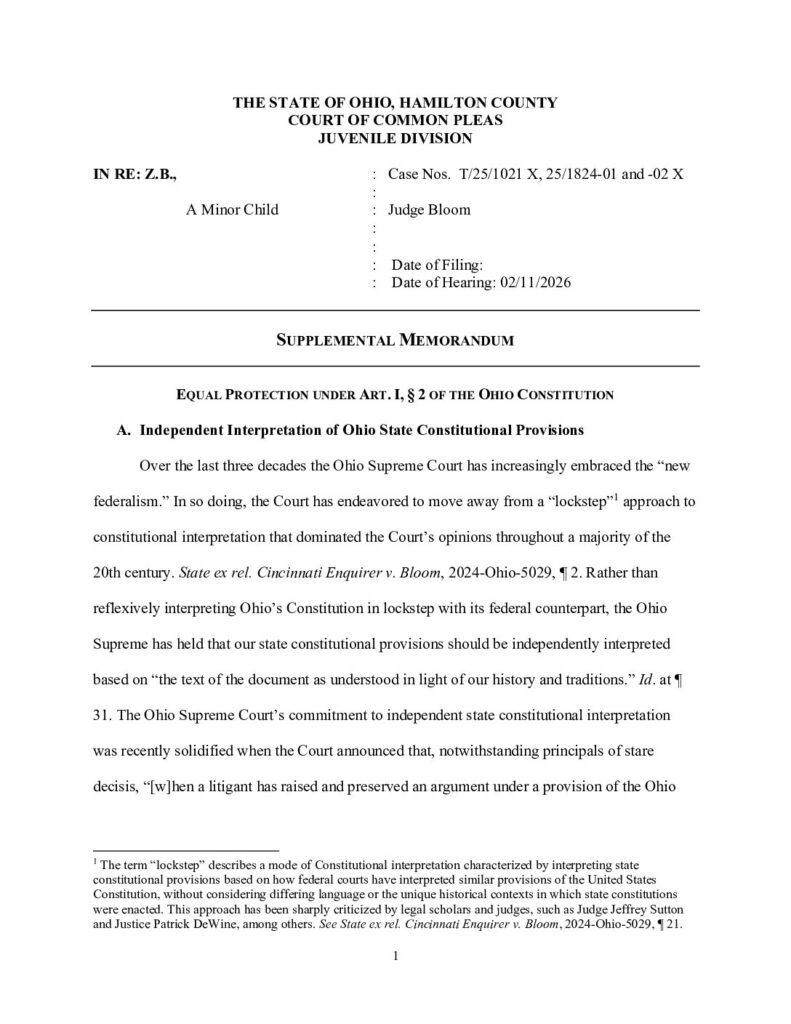
This supplemental memorandum is related to the sample motion to dismiss and/or suppress evidence based on selective prosecution, which argues for special discovery and dismissal and/or suppression based on a claim of selective prosecution in a jaywalking case. This supplemental memorandum outlines Ohio’s Equal Protection guarantee in the context of the impact of implicit racial…

“The Supreme Court upheld the criminalization of public survival by unhoused people in City of Grants Pass v. Johnson in June 2024. This article examines that decision and considers why Grants Pass had not enforced its camping ban against unhoused people when the author visited the city one year later. One important reason is that…
The California Supreme Court held that the imposition of punitive fines and ancillary costs ordered as part of a criminal sentencing raises equal protection issues that require courts to consider ability to pay before imposing fines and costs. The Court stated in relevant part: “In sum, in light of the Legislature’s provision of fee waivers…

In October 2025, the Gault Center convened over three hundred youth defense lawyers and advocates at our annual Youth Defender Leadership Summit. Together, we practiced the cultivation of community in service of building a more just, more liberated, and more human humanity for all children and for us all. This resource captures the shared learnings…

“In the period of the 1960s through 2015, the U.S. Supreme Court issued a set of canonical, key decisions expanding the constitutional doctrines of sexual liberty and privacy, equality, and substantive due process for women and sexual and gender minorities. The Court interpreted these principles to protect contraceptive use, abortion, interracial marriage, the private consumption…
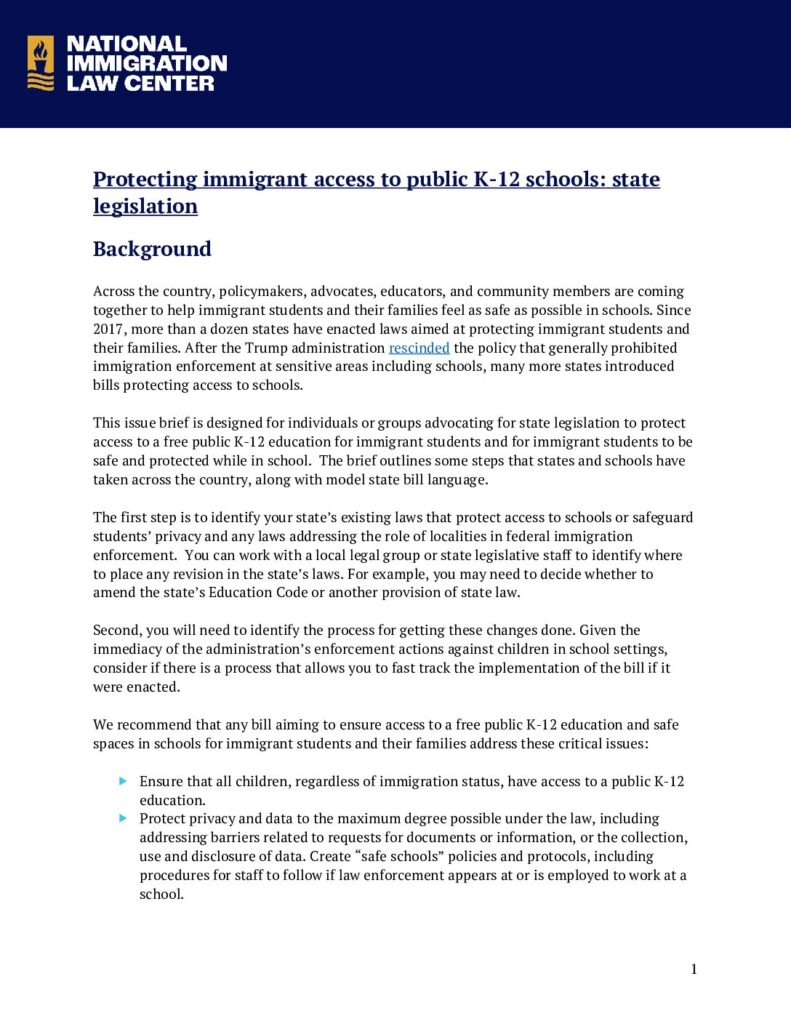
From the Background of this issue brief by National Immigration Law Center: “This issue brief is designed for individuals or groups advocating for state legislation to protect access to a free public K-12 education for immigrant students and for immigrant students to be safe and protected while in school. The brief outlines some steps that…

From the introduction: “Probation, parole, and other forms of post-conviction supervision are challenging for anyone, requiring strict adherence to dozens of complex rules under threat of incarceration for any slip-up. For the high number of people on supervision who have disabilities, supervision is even more challenging. Disabled people regularly face barriers to understanding their supervision…


The Court of Appeals of Washington remanded a transfer case to the superior court and offered the following language in support. “Our Supreme Court has made clear that trial courts must be vigilant in addressing the threat of explicit or implicit racial bias that affects a defendant’s right to a fair trial. We hold that…
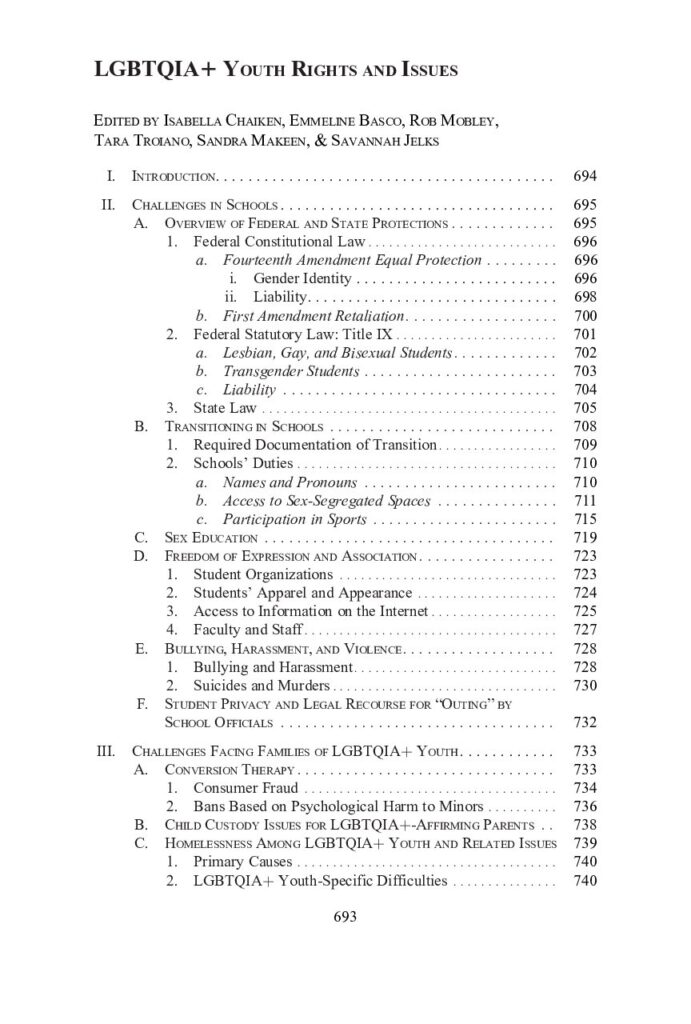
From the introduction: “This Article discusses the myriad challenges lesbian, gay, bisexual, transgender, and questioning (LGBTQIA+) youth face in the United States (U.S.). The Article focuses on issues LGBTQIA+ (the “plus” holds space for other sexual identities not represented within the acronym) youth confront in school as well as the issues faced by families with…

This User Guide provides advocates with a step-by-step outline of how to actualize the vision of the National Youth Defense System Standards to equip and invest in youth defense teams to fight for the liberation of all youth.The User Guide outlines constitutional rights detailed in the System Standards, provides a checklist to assess the presence…

From the introduction: “Although racial discrimination in the Deep South is not the outright focus of this Note—many other scholars have tackled this subject—it remains an underlying ugly truth that is woven into the conversation throughout. Rather than illuminate an already expansive area of jurisprudence, the Author has sought to address racial disparities in sentencing…

This report reviews the expanding infrastructure of police surveillance in public schools and highlights the failure of AI technologies and digital surveillance in making schools safer. Further, the report discusses the harms these technologies may cause to Black and Latine youth and youth from other historically vulnerable communities. Calling on youth justice advocates, youth leaders,…

From the introduction: “This Guide proceeds in four parts. Part I provides a brief overview of the prevalence of disabilities among people under correctional control. Part II summarizes the relevant disability discrimination legal framework, with a focus on the requirement to provide reasonable accommodations. Part III provides an overview of (A) structural obstacles confronting people…
