
Probable Cause

The California Supreme Court found that a small amount of loose marijuana scattered on the rear floor of a car does not violate a state statute prohibiting driving while under the impairment of marijuana. The court further held that these circumstances did not create probable cause to conduct a search of the vehicle. The court…
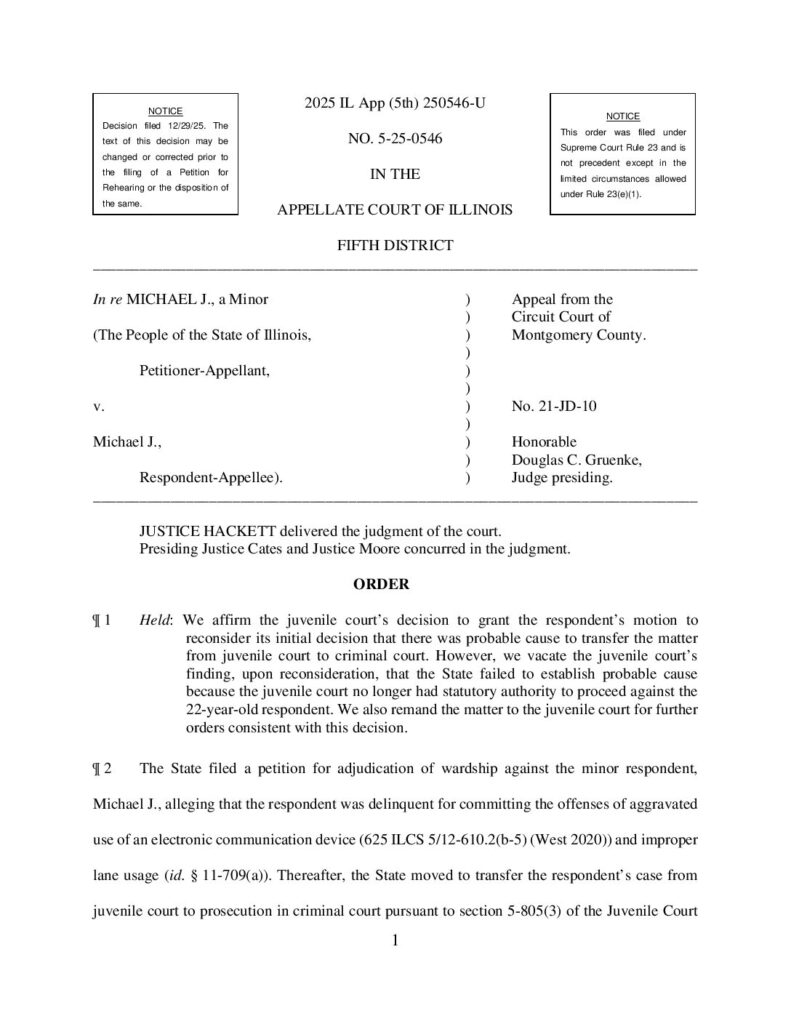
The Illinois 5th District Court of Appeals found that the juvenile court lacked statutory authority to proceed on a transfer determination once a young person turned 22 years old. This case involved an initial transfer determination followed by a reconsideration request by the defense based on lack of probable cause to justify the initial transfer…

The U.S. District Court for the District of New Jersey heard two Motions to Dismiss filed by the Plainfield Public School District, Board of Education, and others, stemming out of a lawsuit filed by fifteen-year-old I.A.’s parents after the detention, search, arrest and prosecution of I.A., by Plainfield school officials and Plainfield Police Officers. In…


The New Jersey Supreme Court held the Family Part did not abuse its discretion when it decided to hear the State’s request for waiver motion before E.S.’s suppression motion. The court declined to adopt a bright line rule for the order in which a Family Part should hear waiver and suppression motions but instead provided…

Challenging the Status Quo: Mobilizing Youth Defense Teams to Uphold Youth Rights & Uproot Injustice
This Racial Justice Webinar was hosted by the Gault Center and Georgetown Law’s Juvenile Justice Clinic & Initiative on May 29, 2024. The webinar focused on a collective call to action for the youth defense community to transform the juvenile legal system by centering youth and their constitutional rights to freedom, liberty, and equality. This…

This checklist can be used to assess the presence of constitutional violations throughout the course of a client’s case. Please refer to the National Youth Defense Systems Standards and their accompanying User Guide for litigation strategies to challenge potential constitutional violations noted in this checklist.

This User Guide provides advocates with a step-by-step outline of how to actualize the vision of the National Youth Defense System Standards to equip and invest in youth defense teams to fight for the liberation of all youth.The User Guide outlines constitutional rights detailed in the System Standards, provides a checklist to assess the presence…

Outlines steps that states must take to comply with the minimum requirements of the U.S. Constitution to protect the rights of youth facing deprivations of liberty.


This is a sample motion from Maryland asking the court to exclude tangible evidence recovered during a stop and arrest based on lack of probable cause for the search. The motion includes arguments about implicit racial bias, structural racism, procedural justice, racial justice, and adolescent brain development.

On December 14, 2016, the U.S. Department of Justice entered into a settlement agreement with the St. Louis County Family Court to remedy constitutional violations. The settlement agreement covers policies and practices to ensure the due process and equal protection rights of all youth are upheld. This includes early appointment of youth defense counsel, prohibition…

On September 18, 2015, the U.S. Department of Justice entered into a settlement agreement with the city of Meridian to address the practice of arresting students in schools. The settlement agreement includes provisions that limit school-based arrests, including “for behavior that is appropriately addressed as a school discipline issue, including incidents involving public order offenses…

On July 31, 2015, the U.S. Department of Justice released its investigation findings into the St. Louis County Family Court, finding due process and equal protection violations. The findings include right to counsel violations by denying constitutionally adequate defense representation, privilege against self-incrimination violations by requiring a child to admit to allegations for diversion, inadequate…

This amicus brief by Juvenile Law Center, The Gault Center, and others argues Ohio’s mandatory bindover statute violates the Due Process protections guaranteed by the 14th Amendment of the U.S. Constitution as the mandatory scheme does not allow for individualized sentencing and recognition of the unique characteristics of youth. Further, amici argue individualized transfer proceedings…

This amicus brief prepared by Children’s Law Center, Inc., the Office of the Ohio Public Defender, The Gault Center, and others argues that due process and fundamental fairness, pursuant to the 5th Amendment, the 14th Amendment and Ohio law, require the state to provide full discovery to a young person prior to a probable cause…

On December 17, 2012, the U.S. Department of Justice entered into a settlement agreement with Shelby County and the Juvenile Court of Memphis and Shelby County in Tennessee following their investigation into the juvenile court system. The settlement agreement includes remedial measures to align the following practices with the U.S. Constitution: probable cause determinations, notice…

The Court of Appeals of Indiana found the juvenile court abused its discretion when it denied a 12-year-old’s continuance of his waiver hearing after his attorney only had four business days to investigate and prepare for the hearing. The court reversed the child’s conviction in adult court and remanded the proceeding to juvenile court offering…

On October 24, 2012, the U.S. Department of Justice filed a complaint in the United States District Court, Southern District of Mississippi asserting that the City of Meridian, County of Lauderdale, and State of Mississippi are engaging in a “pattern or practice of unlawful conduct through which they routinely and systematically arrest and incarcerate children,…

On August 10, 2012, the U.S. Department of Justice released a findings report regarding their investigation of Lauderdale County Youth Court, Meridian Police Department, and Mississippi Division of Youth Services. The findings included the following violations: “(1) The City of Meridian Violates the Fourth Amendment by Arresting Children Without Assessing Probable Cause; (2) Lauderdale County…

On December 17, 2012, the U.S. Department of Justice entered into a settlement agreement with Shelby County and the Juvenile Court of Memphis and Shelby County in Tennessee following their investigation into the juvenile court system. The settlement agreement includes remedial measures to align the following practices with the U.S. Constitution: probable cause determinations, notice…

This amicus brief by Advocates for Children’s Services of Legal Aid of North Carolina, American Civil Liberties Union, The Gault Center, and others argues the suspicionless search of all female students at an alternative school is unconstitutional under the 4th Amendment where the search’s main purpose was arrest and prosecution by law enforcement. Further, the…
