
Racial and Ethnic Disparities
From the Introduction: “The U.S. Departments of Education and Justice (Departments) share with educators around the country the goal that all students attend schools where they are supported, safe, and able to access an excellent education. A school environment that is free from discrimination is essential to meeting that goal. Decades of enforcement activity by…
This amicus brief by the Juvenile Law Center and Rise for Youth argues schools and school officials are increasingly entangled with law enforcement, especially, through the use of school resource officer programs, impacting students’ constitutional rights. The brief argues that O.W., a 13-year old student in this case, had his Fifth Amendment rights violated when his vice principal and the school resource officer compelled him to make an incriminating statement…
From the Introduction: “This Article will focus on the difficulties ex-juvenile offenders face when seeking expungement of their juvenile records to prevent collateral consequences. Specifically, I will argue that a person under the age of eighteen should not be subject to the same statutory expungement bar as adults when seeking an expungement in New Jersey.…
This statement from the American Academy of Child and Adolescent Psychiatry makes several recommendations to minimize the “harms of childhood incarceration.” The Academy recommends adopting state and federal policy that establishes a minimum age of at least fourteen years old for juvenile court jurisdiction, establishes a maximum age of jurisdiction to include young people to…

From the introduction: “A growing body of literature has demonstrated that when schools suspend students, the suspension acts not as a deterrent but as an amplifier of future punishment. Labeling theory has emerged as the predominant explanation for this phenomenon, suggesting that the symbolic label conferred along with a suspension shapes how other people perceive…

This article discusses the legal landscape of school surveillance, including digital and artificial intelligence surveillance, through the lens of Fourth Amendment and federal privacy laws. From the Abstract: “Since the Covid-19 pandemic, schools have escalated their use of educational technology to improve students’ in-school and at-home learning. Although educational technology has many educational benefits for…
From the abstract: National attention toward recent highly publicized police killings and the coronavirus disease abstract 2019 pandemic, which has disproportionately impacted communities of color, highlight the continued systematic oppression of racial and ethnic minorities in the United States. Furthermore, burgeoning evidence demonstrates that police contact is associated with adverse health outcomes for Black and…


From the executive summary: “The Department of Justice has reasonable cause to believe that the Louisville/Jefferson County Metro Government (Louisville Metro) and the Louisville Metro Police Department (LMPD) engage in a pattern or practice of conduct that deprives people of their rights under the Constitution and federal law: • LMPD uses excessive force, including unjustified…


From the introduction: “This report summarizes changes in youth incarceration following the onset of COVID-19, the key factors that drove and supported Utah’s shift away from incarceration, and the work that the jurisdiction still must do to sustain and build on these early successes.”


From the introduction: “This brief offers context on the youth criminalization crisis in the United States. We then outline a series of harmful elements in the Bipartisan Safer Communities Act. Specifically, we review provisions that: • Increase funding for threat assessments, surveillance, and greater police presence in schools; • Expand data-sharing between law enforcement and…


From the introduction: “This report focuses on individuals who were under the age of 18 at the time the sexual offense occurred and who were adjudicated delinquent in the juvenile justice system or tried and convicted in adult criminal court. While significant research shows the ineffectiveness and harm of registration for individuals who were 18…
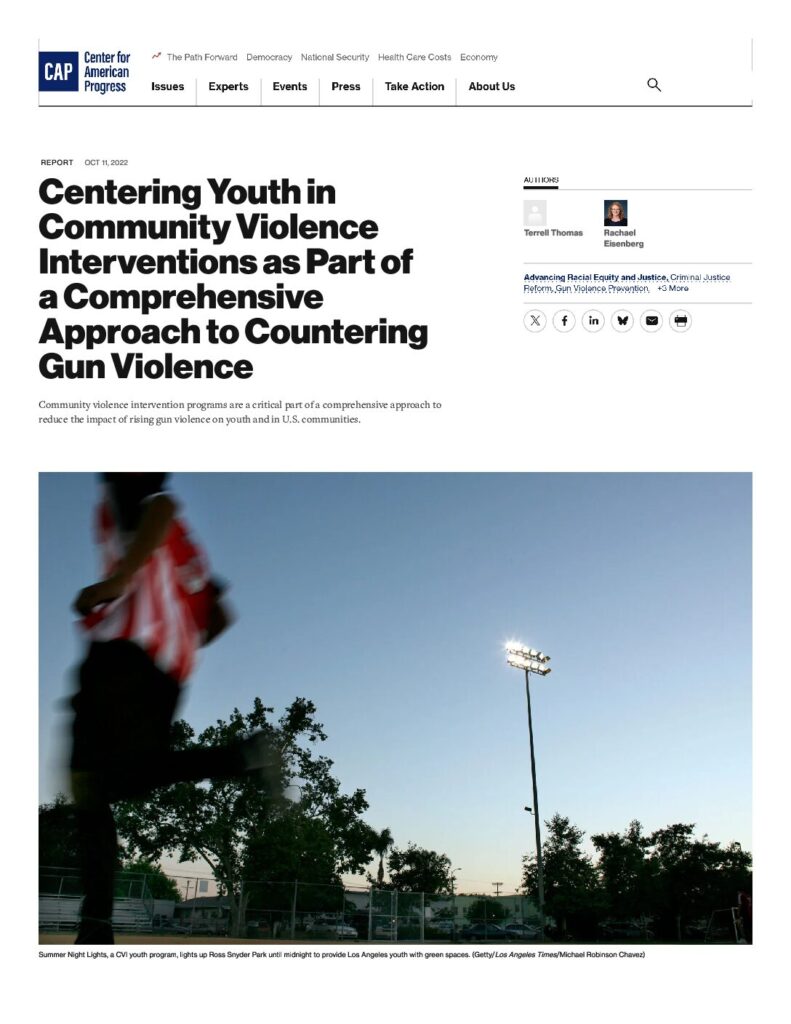
This policy brief draws on Sentencing Project analysis, CDC data, and law enforcement statistics to identify youth gun violence data trends, highlight the racial disparities in victimization by gun violence, and frame the problem of gun violence within the societal factors that create it. It presents new empirical research and synthesizes evidence supporting a public…

From the abstract: “Disabled people are disproportionately incarcerated and segregated from society through a variety of institutions. Still, the links between disability and incarceration are underexplored, limiting understanding of how carceral institutions punish and contribute to the social exclusion of disabled people. Using data from the 2016 Survey of Prison Inmates, we estimated disability prevalence…
This report draws on neurodevelopmental science, empirical studies, meta-analyses, national survey data, government reports, and Supreme Court jurisprudence to highlight that confinement of youth exacerbates neurodevelopmental harm. From the summary: Every year, about 700,000 youth arrests occur in the United States, creating significant neurodevelopmental strain; this is especially concerning as most of these youth have early life adversity exposures that…

From the introduction: “The COVID-19 pandemic has laid bare the dangers of the juvenile legal system; this should make it harder to look away from the societal inequities that are exacerbated by youth incarceration. Indeed, the current moment, including the unprecedented nationwide protests in response to the murders of George Floyd and Breonna Taylor in…
