
Racial and Ethnic Disparities

From the conclusion: “Maryland has the most extreme racial disparities for those incarcerated for long terms in the United States. That should alarm Maryland leadership and its residents. These disparities are rooted in policing practices that target communities of color, a lack of investment and opportunity in historically disadvantaged neighborhoods, and an overly punitive sentencing,…

This Article explores how race functions to ascribe and criminalize disability. It posits that for White students in wealthy schools, disabilities or perceived disabilities are often viewed as medical conditions and treated with care and resources. For students of color, however, the construction of disability (if it exists) may be a criminalized condition that is…

From the executive summary: ‘This comprehensive study of 804 New York City public middle and high schools sought to isolate the independent impacts of suspension, as well as to disentangle the effects, if any, of student, school, and neighborhood characteristics. Conversely, the study also explored the relationship of restorative justice and other positive practices to…

From the introduction: “At the turn of the 20th century, states began creating juvenile justice systems because they recognized that children are different from adults, are capable of change, and need support and opportunities for healthy development. Unfortunately, over time these juvenile justice systems became a maze – with many entrances in, and few exits…
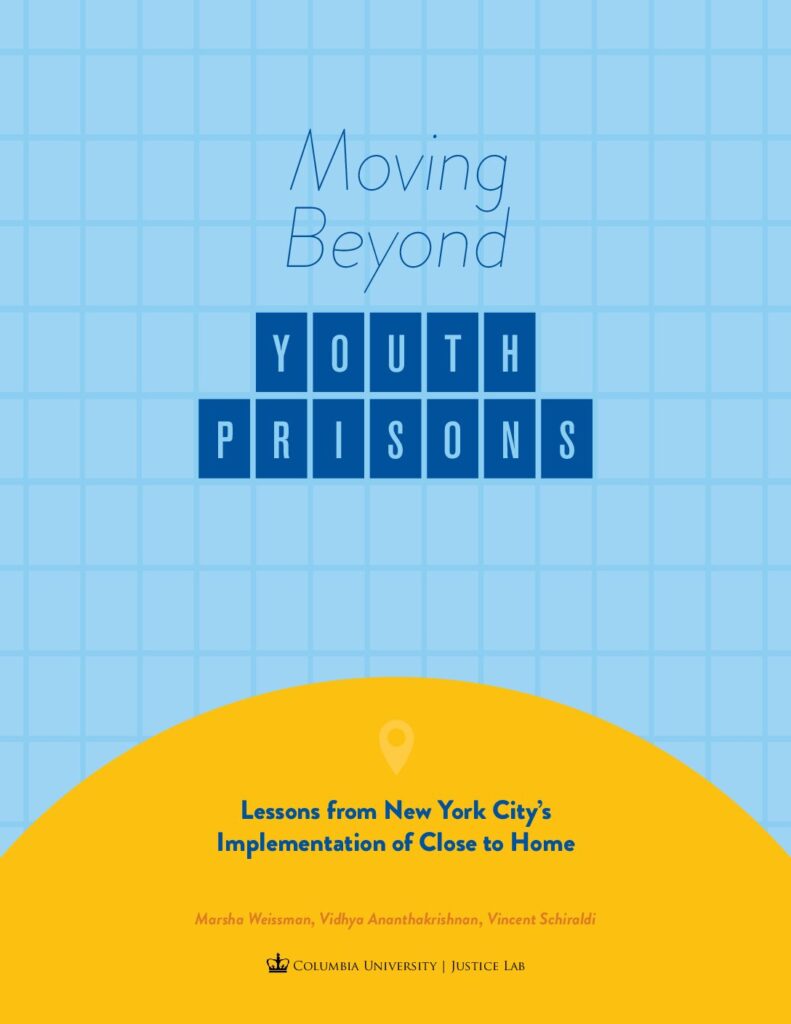
The Columbia University Justice Lab released a report spotlighting New York City’s Close to Home initiative, an effort that reduced the rate of youth sent to state-operated prisons in New York City. “This case study describes the development of the Close to Home (C2H) initiative, beginning with a review of what the system looked like…


“The week of December 10, 2018, Congress passed H.R. 6964, the Juvenile Justice Reform Act of 2018 (the Act) with overwhelming bipartisan support. The President signed the bill into law on December 21, 2018, amending the Juvenile Justice Delinquency Prevention Act (JJDPA) after years of collaborative efforts among juvenile justice organizations and advocates across the…

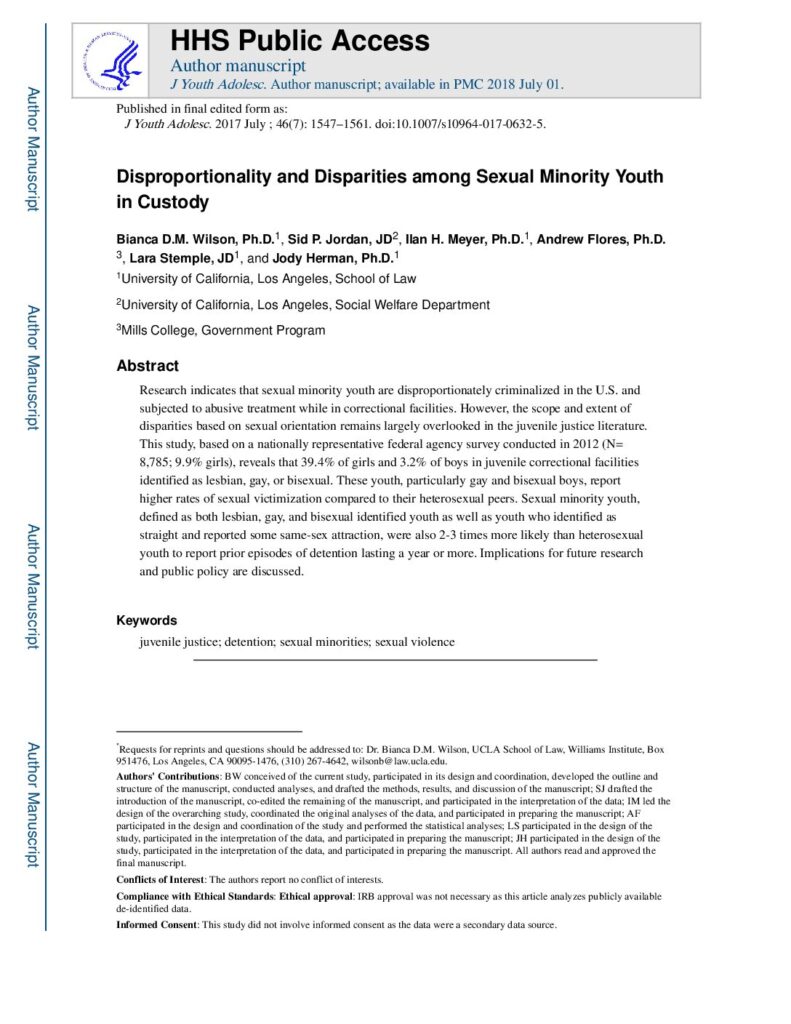
Abstract: Research indicates that sexual minority youth are disproportionately criminalized in the U.S. and subjected to abusive treatment while in correctional facilities. However, the scope and extent of disparities based on sexual orientation remains largely overlooked in the juvenile justice literature. This study, based on a nationally representative federal agency survey conducted in 2012 (N=8,785;…

On December 14, 2016, the U.S. Department of Justice entered into a settlement agreement with the St. Louis County Family Court to remedy constitutional violations. The settlement agreement covers policies and practices to ensure the due process and equal protection rights of all youth are upheld. This includes early appointment of youth defense counsel, prohibition…


On November 28, 2016, the DOJ filed a Statement of Interest in response to a lawsuit filed in South Carolina, challenging two state statutes as void for vagueness in violation of the Due Process Clause. The lawsuit alleged that the vague language in the statute resulted in the criminalization of common youthful behavior, racial disparities,…
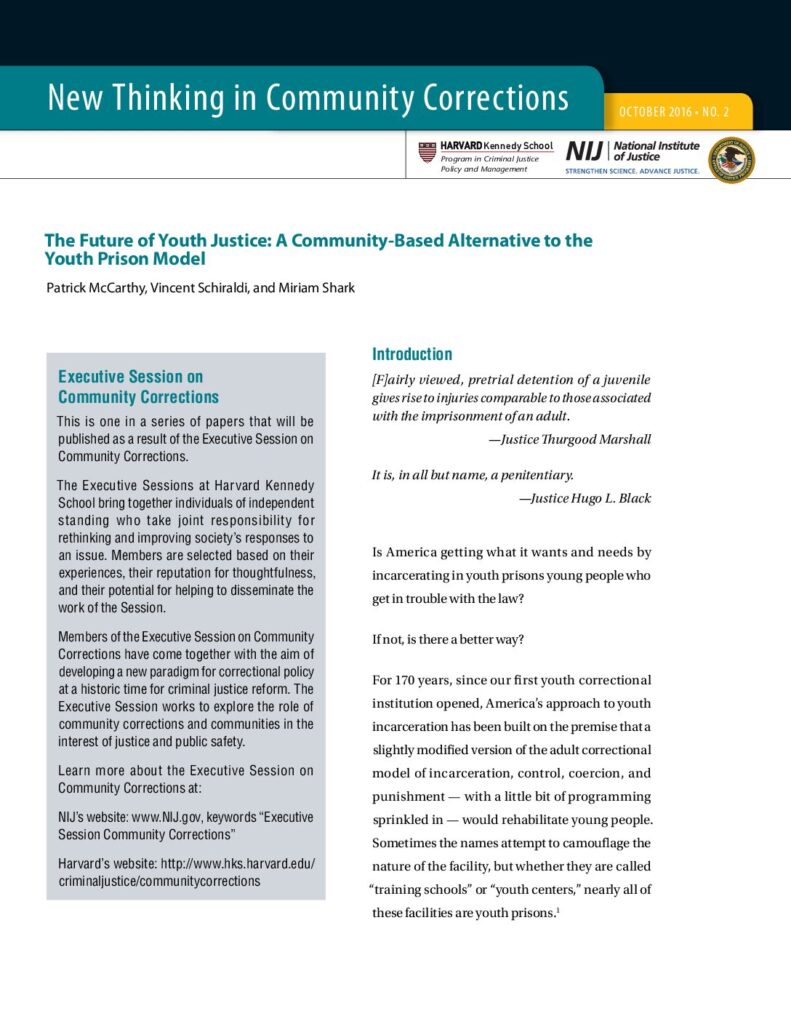
This paper from the Executive Session on Community Corrections at the Harvard Kennedy School examines the history of youth incarceration and discusses how the inherently flawed model of youth prisons demands systemic reforms, including closure of youth prisons, to actualize safer communities, and positive youth outcomes. From the introduction: “For 170 years, since our first youth correctional institution opened, America’s approach…
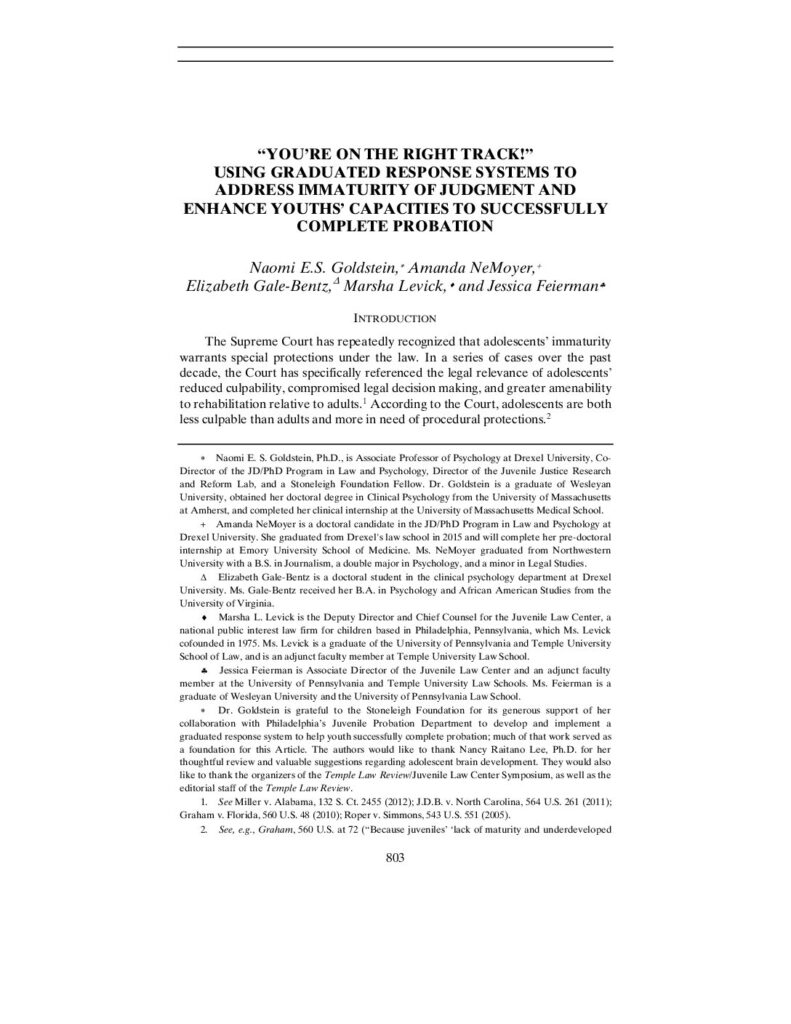
From the Introduction: “The Supreme Court has repeatedly recognized that adolescents’ immaturity warrants special protections under the law. In a series of cases over the past decade, the Court has specifically referenced the legal relevance of adolescents’ reduced culpability, compromised legal decision making, and greater amenability to rehabilitation relative to adults. According to the Court,…
In the national conversation about youth overincarceration and disproportionate minority contact in the juvenile legal system, Native American youth are often statistically invisible. Closer attention, however, reveals that Native youth who come into contact with the juvenile legal system are more likely to be locked in secure confinement than other youth, with disproportionality rates in…


On September 18, 2015, the U.S. Department of Justice entered into a settlement agreement with the city of Meridian to address the practice of arresting students in schools. The settlement agreement includes provisions that limit school-based arrests, including “for behavior that is appropriately addressed as a school discipline issue, including incidents involving public order offenses…

On September 18, 2015, the U.S. Department of Justice entered into a settlement agreement with the state of Mississippi about their probation and diversion practices. The settlement agreement includes provisions on protecting a youth’s right against self-incrimination, requiring probation orders to be written in simple terms to prevent arbitrary and discriminatory enforcement, and ensuring the…

On July 31, 2015, the U.S. Department of Justice released its investigation findings into the St. Louis County Family Court, finding due process and equal protection violations. The findings include right to counsel violations by denying constitutionally adequate defense representation, privilege against self-incrimination violations by requiring a child to admit to allegations for diversion, inadequate…

This article summarizes a study conducted by Yale Law School, Columbia Law School and Mailman School of Public Health at Columbia University, examining the influence of street stops by police on the legal socialization of adolescents and emerging adults ages 18-26 in New York City. The study showed an association between the number of police…

From the introduction: “This report will describe, dissect, and draw lessons from Connecticut’s striking success in juvenile justice reform for other states and communities seeking similar progress. The first section details the timeline and dimensions of change in Connecticut’s juvenile justice system over the past two decades. In 1992, Connecticut routinely locked up hundreds of…

On December 17, 2012, the U.S. Department of Justice entered into a settlement agreement with Shelby County and the Juvenile Court of Memphis and Shelby County in Tennessee following their investigation into the juvenile court system. The settlement agreement includes remedial measures to align the following practices with the U.S. Constitution: probable cause determinations, notice…

On October 24, 2012, the U.S. Department of Justice filed a complaint in the United States District Court, Southern District of Mississippi asserting that the City of Meridian, County of Lauderdale, and State of Mississippi are engaging in a “pattern or practice of unlawful conduct through which they routinely and systematically arrest and incarcerate children,…

On August 10, 2012, the U.S. Department of Justice released a findings report regarding their investigation of Lauderdale County Youth Court, Meridian Police Department, and Mississippi Division of Youth Services. The findings included the following violations: “(1) The City of Meridian Violates the Fourth Amendment by Arresting Children Without Assessing Probable Cause; (2) Lauderdale County…

On December 17, 2012, the U.S. Department of Justice entered into a settlement agreement with Shelby County and the Juvenile Court of Memphis and Shelby County in Tennessee following their investigation into the juvenile court system. The settlement agreement includes remedial measures to align the following practices with the U.S. Constitution: probable cause determinations, notice…
