
Racial Justice


From the introduction: “Youth justice advocates, including lawyers, organizers, and other youth and adult movement builders, want to replace the current damaging, discriminatory, and ineffective juvenile and criminal legal systems1 with better approaches. We envision approaches that support children, help them f lourish, and contribute to a safe, equitable, and healthy community. How do we…

Professor Kris Henning and Rebba Omer authored a law review article on decriminalizing normal adolescent behaviors, race, and disabilities. This article maps a way forward for all system actors in the juvenile legal system to mitigate and buffer against the harms of juvenile legal system involvement for youth with disabilities. Specifically, this article outlines youth…

This resource is part of the Youth Defender Advocacy Program (YDAP) curriculum, a specialized trial advocacy training program for youth defenders.


From the abstract: “The carceral state is everywhere. Legal and social science scholars are increasingly using the carceral state concept to criticize various aspects, or even the entirety, of the United States. But despite how popular and common this term has become in writings about mass incarceration, criminal processes and punishments, and other forms of…


From the abstract: “This Article frames the experience of traffic stops for noncitizens as a form of “slow deportation.” It describes how the use of traffic stops to police noncitizens extends the system of racialized social control to immigrant communities with the effect of surveilling both race and status. It surveys scholarship across disciplines, racial…

On February 28, 2025, the Michigan Court of Appeals ruled that the trial court’s denial of a racial justice expert violated a young person’s due process rights to present a defense. This case involved an altercation between two middle school students involving the use of a racial slur and other racially derogatory comments. Defense counsel…

From the executive summary: “This report offers recommendations for researchers, policymakers, diversion programs, and community organizations focused on diverting Black women, girls, trans and gender nonconforming people from criminal punishment systems. Our recommendations are based on an assessment of diversion programs through a Black feminist lens, which starts from the standpoint of the women and…

One-page infographic on the seven key developmental needs of adolescence.

In August 2024, the Office for Access to Justice hosted a convening on youth defense, calling attention to the urgent need to invest in youth defense specialization. “Such investments from the state and federal level are essential to safeguarding young people’s constitutional rights. Well-trained and specialized counsel help young people understand their rights as they…
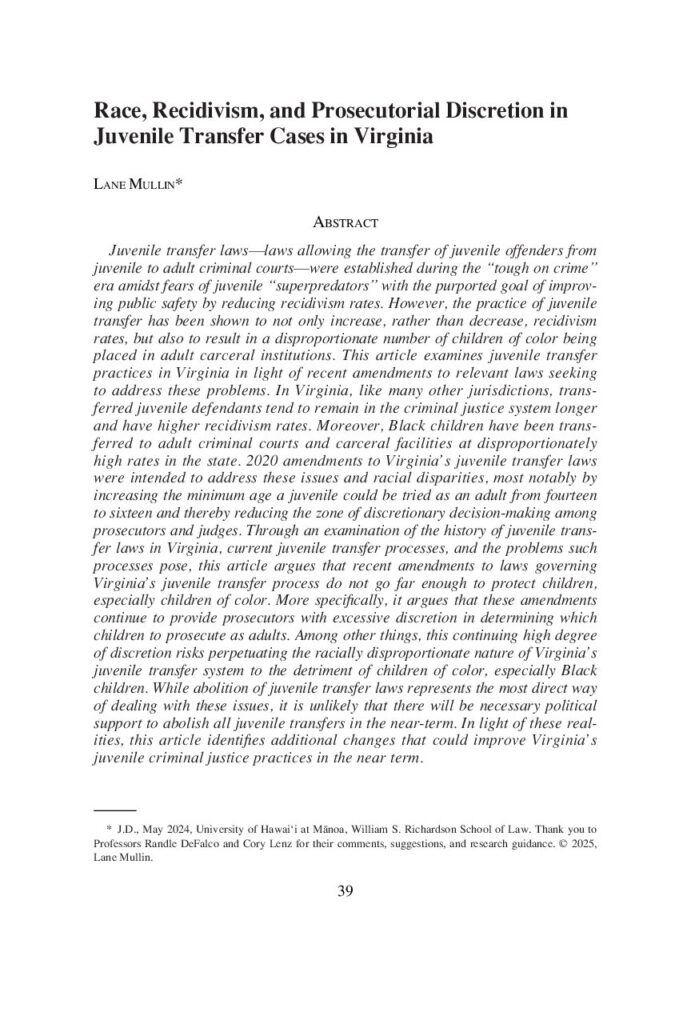
From the Abstract: Juvenile transfer laws—laws allowing the transfer of juvenile offenders from juvenile to adult criminal courts—were established during the “tough on crime” era amidst fears of juvenile “superpredators” with the purported goal of improving public safety by reducing recidivism rates. However, the practice of juvenile transfer has been shown to not only increase,…


This research report by the NAACP Legal Defense Fund provides an in-depth overview of the “At-Risk Youth Program” created by the Pasco County Sheriff’s Office in Tampa Bay, Florida. The Pasco County sheriff’s office relied on a “rudimentary, person-based predictive policing system” based on inherently biased criteria to identify young people who were “destined to…


The Center for Native American Youth (CNAY) at the Aspen Institute released a report detailing survey results of nearly one thousand Native youth on their needs and priorities across issues that matter most to them. This survey was built and disseminated by Native youth leaders who worked in partnership with CNAY staff to practice and…

From the abstract: “In this report, we invite readers to explore the historical, racialized, disablist, and political economic contexts of mass incarceration, including the ways that incarceration has expanded beyond prisons, jails, and correctional supervision in the 21st century. As well, publics often think of incarceration narrowly, such that they make invisible the containment of…

