
Racial Justice

This User Guide provides advocates with a step-by-step outline of how to actualize the vision of the National Youth Defense System Standards to equip and invest in youth defense teams to fight for the liberation of all youth.The User Guide outlines constitutional rights detailed in the System Standards, provides a checklist to assess the presence…

This report examines racial disparities, policing landscapes, and budgets in twelve jurisdictions across the country, comparing the city and county spending priorities with those of community organizations and their members. While many community members, supported by research and established best practices, assert that increased spending on police do not make them safer, cities and counties…

This report presents the evolution of the second look movement, which started with ensuring compliance with the U.S. Supreme Court’s decisions in Graham v. Florida (2010) and Miller v. Alabama (2012) on the constitutionality of juvenile life without parole (“JLWOP”) sentences.12 This reform has more recently expanded to other types of sentences and populations, such…

This article calls for the categorical exclusion of young children from juvenile court jurisdiction as a pathway toward the abolition of the juvenile legal system in its current form. This article highlights the landscape of age-based jurisdictional boundaries across the country: 24 states have no minimum age of arrest and prosecution, while 18 states have…

A concentration of a few states has unevenly complied with Miller and the possibility of resentencing provided by Montgomery. Some states have refused to comply at all. This uneven implementation of the Miller decision has a particularly profound impact on racial disparities among those serving JLWOP. An analysis of those deemed worth protecting from JLWOP…

From the introduction: “In In re Personal Restraint of Asaria Miller, at the urging of merits counsel from the University of Washington’s Race and Justice Clinic, supported by amicus counsel from Seattle University School of Law’s Civil Rights Clinic, the Washington State Court of Appeals took an important step in accounting for the ways that…
Abstract: “This article demonstrates how advocates can leverage empirical literature regarding adultification bias to craft doctrinal interventions that recognize and remedy the disproportionately harsh treatment of Black youth in the juvenile and adult criminal legal system. Through case examples, all of which I litigated in the Civil Rights Clinic at Seattle University School of Law, I demonstrate how adultification…

This report is an update to the December 2022 report that analyzed incidents of violence by school police officers against students and the disproportionate impact on Black and Latino/a students attending low-income schools. This update provides additional incidents from the 2022-2023 school year and more context about the reported incidents, such as geographical region and…
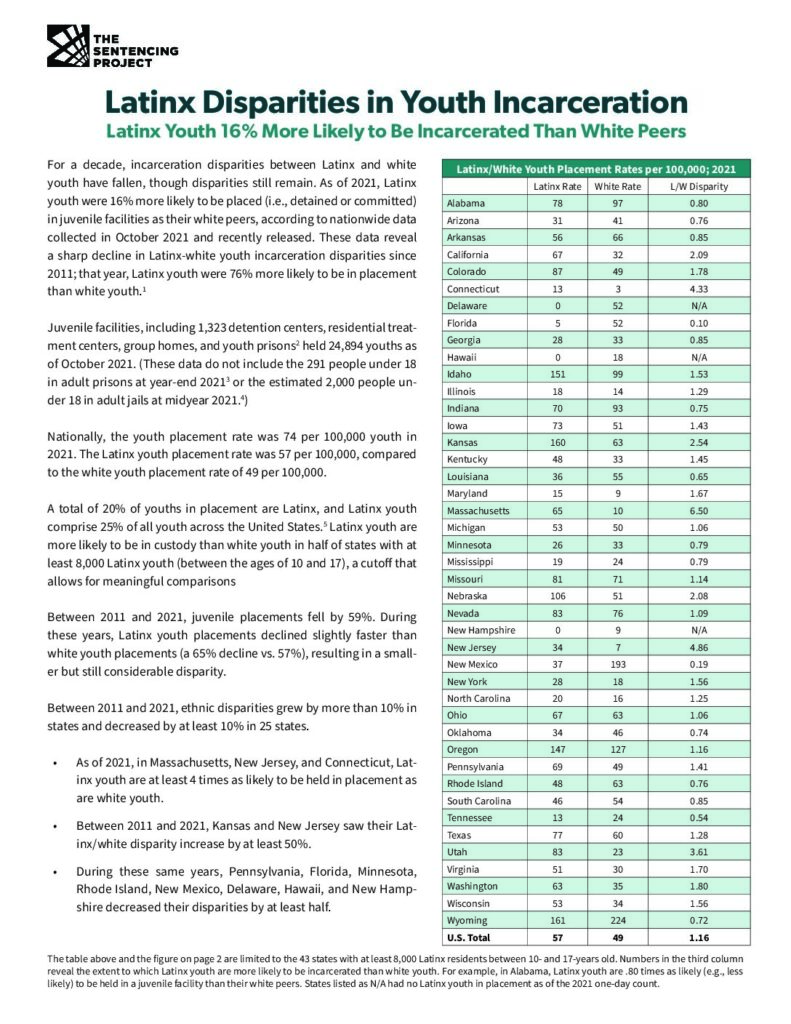
The Sentencing Project released three factsheets highlighting racial disparities in the incarceration of youth: Black Disparities in Youth Incarceration, Disparities in Tribal Youth Incarceration, and Latinx Disparities in Youth Incarceration. These factsheets highlight youth placement rates in 2021 by state and demonstrate that racial disparities persist. Notably, Black youth nationwide are nearly five times more…

The Sentencing Project released three factsheets highlighting racial disparities in the incarceration of youth: Black Disparities in Youth Incarceration, Disparities in Tribal Youth Incarceration, and Latinx Disparities in Youth Incarceration. These factsheets highlight youth placement rates in 2021 by state and demonstrate that racial disparities persist. Notably, Black youth nationwide are nearly five times more…

The Sentencing Project released three factsheets highlighting racial disparities in the incarceration of youth: Black Disparities in Youth Incarceration, Disparities in Tribal Youth Incarceration, and Latinx Disparities in Youth Incarceration. These factsheets highlight youth placement rates in 2021 by state and demonstrate that racial disparities persist. Notably, Black youth nationwide are nearly five times more…

This article calls for the use of the Thirteenth Amendment to abolish federal and state gang statutes. Highlighting the lineage of modern-day gang statutes from Black Codes to vagrancy laws from the Jim Crow era to gang injunctions, this article establishes how current gang statutes remain as “badges and incidents” of slavery. This article walks…


This infographic details statistics on the overrepresentation of Native and Indigenous communities in the criminal legal system, noting in particular that the incarceration rate of American Indian/Alaska Native communities increased 60 percent from 1990 to 2020. It cautions that current data collection practices on Native and Indigenous communities are often incomplete and inaccurate due to…


This Article is one of the first to explore the racialized impact of the two most controversial and ubiquitous forms of what we call “imputed liability murder.” An analysis of ten years of murder prosecutions in the state of Minnesota reveals that imputed liability murder is anything but a fringe subtype of homicide: an astounding…


