
State Constitutions

The Court of Appeals of Washington remanded a transfer case to the superior court and offered the following language in support. “Our Supreme Court has made clear that trial courts must be vigilant in addressing the threat of explicit or implicit racial bias that affects a defendant’s right to a fair trial. We hold that…

This paper is part of the Series on Learning from Civil Rights Lawsuits from the Civil Rights Litigation Clearinghouse and focuses on parole review procedures for individuals serving long sentences for crimes committed under age 18, discusses constitutional dimensions of parole review for this group, and proposes model policies supporting a meaningful opportunities for release. From the Executive Summary: “In recent years, people serving…
Abstract: “This article demonstrates how advocates can leverage empirical literature regarding adultification bias to craft doctrinal interventions that recognize and remedy the disproportionately harsh treatment of Black youth in the juvenile and adult criminal legal system. Through case examples, all of which I litigated in the Civil Rights Clinic at Seattle University School of Law, I demonstrate how adultification…

The Antiracism and Community Lawyering Practicum at Boston University School of Law, Fred T. Korematsu Center for Law and Equality, and the NAACP Legal Defense and Educational Fund submitted a brief in support of the appellant, Derek Lee, in a case before the Supreme Court of Pennsylvania regarding the use of mandatory life without parole…


This amicus brief by the Santa Clara County Independent Defense Counsel Office argues the decision in People v. Hardin should be affirmed because historical legacies of racism disparately expose some adolescents to the legal system and this does not justify lifelong punishment without considering rehabilitation. From Introduction & Summary of Argument: “Youthful offender parole is authorized by age at the…
This amicus brief from former Massachusetts judges, the Boston Bar Association, and the Massachusetts Bar Association argues life without parole sentences violate the Commonwealth’s prohibition on cruel and unusual punishment for late adolescents between 18-20 years old for the same reasons they did for youth under 18 years old (as articulated in Diatchenko). Additionally, the brief argues late adolescents have a great propensity…
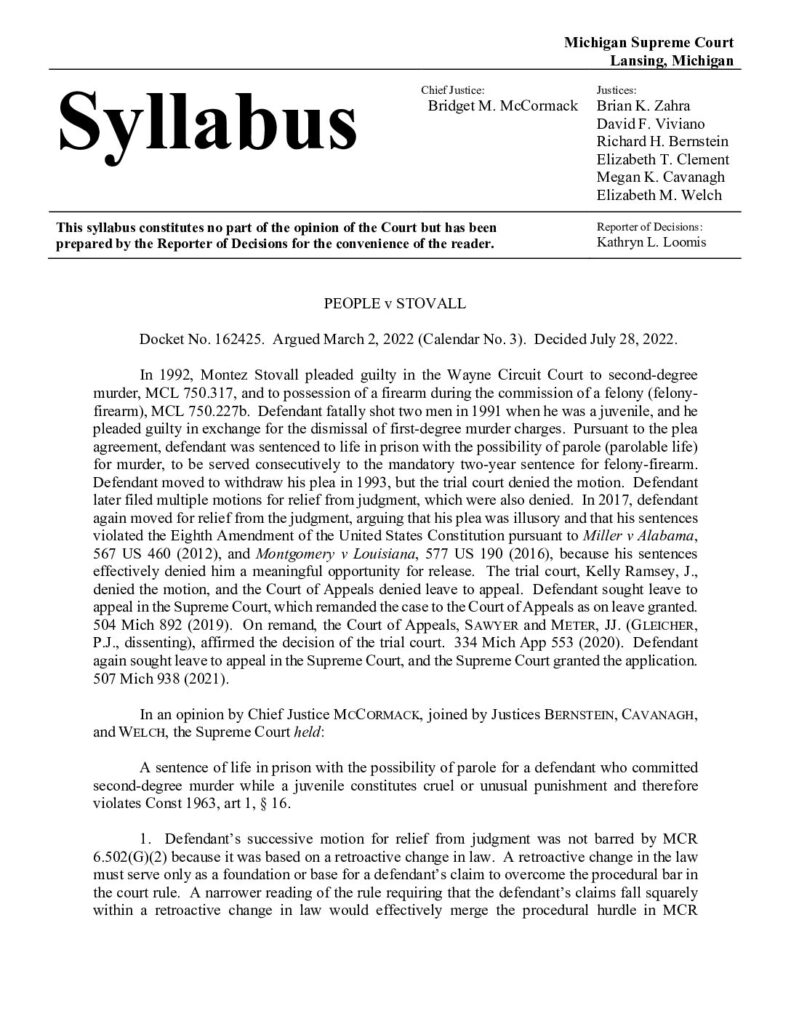
In People v. Stovall, the Michigan Supreme Court vacated Stovall’s sentence of a parolable life sentence for second-degree murder finding it violated Article 1, Section 16 of the Michigan constitution prohibition against cruel and unusual punishment. The court offered the following language in support: “The Michigan Constitution, however, is different. Article 1, § 16 of the Michigan Constitution provides that “[e]xcessive bail shall not be…

The Washington Supreme Court ruled the trial court was required to consider an accused person’s race and ethnicity in the totality of the circumstances when determining whether a person was “seized” in Washington state constitution’s prohibition against unlawful seizure. The court offered the following language in support: As noted above, the article I, section 7…

The Ohio Appellate Court vacated a youth’s convictions and transfer order and offered the following language in support. “Because the juvenile court (1) did not identify all of the factors it considered, i.e., the “other information factors” referenced at the amenability hearing, (2) did not identify or discuss the factual or evidentiary basis for its…

The Louisiana Supreme Court took up defense counsel’s writ following the trial court’s denial of a motion to quash following the State’s dismissal and refiling of charges following two adverse rulings, in effect evading all appellate review of the court’s ruling. The court found the accused, Mr. Reimonenq’s, 14th Amendment right to due process and…

A sample motion arguing child pornography laws are unconstitutional as applied to a children engaging in sexting. The motion argues the statute is void-for-vagueness since it fails to provide fair notice regarding prohibited conduct for children under 18 and it encourages arbitrary and discriminatory enforcement because the distinction between offender and victim is blurred. Furthermore,…

The Iowa Supreme Court struck down mandatory minimum sentencing schemes as applied to a young person transferred to adult court, finding mandatory minimum sentences to be in violation of federal and state prohibitions against cruel and unusual punishment and the best interest clause in Iowa’s juvenile code. The court notes “the statutory recognition of the…

A practice guide for youth defenders in delinquency cases when litigating suppression issues. This guide covers all aspects of litigating a suppression motion: from drafting the motion, securing witnesses, evidentiary considerations, appellate preservation, and procedural aspects of the suppression hearing that may arise at the suppression hearing, during trial. and on appeal.

The Court of Appeals of Indiana found the juvenile court abused its discretion when it denied a 12-year-old’s continuance of his waiver hearing after his attorney only had four business days to investigate and prepare for the hearing. The court reversed the child’s conviction in adult court and remanded the proceeding to juvenile court offering…

In the case of C.P, the Ohio Supreme Court ruled that R.C. 2152.86, which created a new class of youth adjudicated of sex offenses who would automatically be subject to mandatory, lifetime sex-offender registration and notification requirements, violated the U.S. and Ohio Constitutions. In its ruling, the Court offered the following language in support: “In…
This amicus brief by The Juvenile Law Center and The Gault Center argues that young people have a constitutional right to a jury trial pursuant to the 6th and 14th Amendment, in cases with serious consequences, such as sex offenses with numerous collateral consequences, in juvenile court, without “comparable adult procedural protections”. Further, the brief…

This amicus brief by Advocates for Children’s Services of Legal Aid of North Carolina, American Civil Liberties Union, The Gault Center, and others argues the suspicionless search of all female students at an alternative school is unconstitutional under the 4th Amendment where the search’s main purpose was arrest and prosecution by law enforcement. Further, the…

This amicus brief by Juvenile Law Center and The Gault Center argues Illinois automatic transfer law does not comply with recent research and findings on adolescent development as recognized by the Supreme Court jurisprudence in Roper and Graham. Further, amici argue the state’s automatic transfer statute violates the proportionality clause of Article I, Section 11…

This amicus brief by The Gault Center, Children’s Law Center, Inc., and the American Civil Liberties Union of Ohio Foundation, Inc. argues mandating young people to register on sex offender registries is improper since youth adjudicated of sex offenses are vastly different from adults convicted of sex offenses, registries frustrate the purpose of juvenile court,…
- « Previous
- 1
- 2
- 3
- Next »
