
Surveillance

This report reviews the expanding infrastructure of police surveillance in public schools and highlights the failure of AI technologies and digital surveillance in making schools safer. Further, the report discusses the harms these technologies may cause to Black and Latine youth and youth from other historically vulnerable communities. Calling on youth justice advocates, youth leaders,…


This infographic from the No Tech Criminalization in Education (NOTICE) Coalition provides a walkthrough of a student’s experience in a data-driven school from kindergarten to the end of high school. The resource includes information on different forms of information sharing and surveillance technologies and individual know your rights information for students navigating digital surveillance.

This research report by the ACLU provides an overview of surveillance technology (“EdTech Surveillance”) industry in K-12 schools and critically explores the industry’s claims, the efficacy of the products, and their impacts on students and schools. The report also provides recommendations for best protecting students and promoting better surveillance technology decision-making among elected officials, school…

From the executive summary: “• Police increasingly replace stop-and-frisk practices with databases that crudely profile Black and Latinx youth based on their neighborhoods, peer groups, and clothing. • These databases ruin lives: police typecast minority youths as gang members without evidence, putting them at risk of false arrest and wrongful deportation. • Many police departments…

From the resource: “This poster is a tool to assess and understand differences between reforms that strengthen imprisonment and abolitionist steps that reduce its overall impact and grow other possibilities for wellbeing. As we work to dismantle incarceration in all its forms, we must resist common reforms that create or expand cages anywhere, including under…

This article discusses the legal landscape of school surveillance, including digital and artificial intelligence surveillance, through the lens of Fourth Amendment and federal privacy laws. From the Abstract: “Since the Covid-19 pandemic, schools have escalated their use of educational technology to improve students’ in-school and at-home learning. Although educational technology has many educational benefits for…

From the introduction: “This brief offers context on the youth criminalization crisis in the United States. We then outline a series of harmful elements in the Bipartisan Safer Communities Act. Specifically, we review provisions that: • Increase funding for threat assessments, surveillance, and greater police presence in schools; • Expand data-sharing between law enforcement and…

Between a Rock and a Hard Place: The Social Costs of Pretrial Electronic Monitoring in San Francisco
This report features findings from in-depth interviews from 66 people who were court-ordered to electronic monitoring (EM) in San Francisco County, California. Highlighting the nature and difficulties program participants face while trying to comply with EM programs, the report demonstrates the harms of EM, including finding safe housing, securing employment, social isolation, trouble maintaining physical and emotional connections to loved ones, and increased likelihood of new contacts with law enforcement. From…

From the Urban Institute: Jurisdictions across the country are changing how they administer juvenile probation and better aligning policy and practice with developmental science and positive youth development to improve outcomes for youth, families, and communities. These changes often advance two goals: divert most youth from system involvement altogether and shrink probation caseloads, and change…

This article from Education Week examines the implications of the Pasco County sheriff’s office in Florida using school data and records from the Department of Children and Families to create a list of students that were “at-risk for a life of crime.” Data privacy experts shared with the media that the actions of the Sheriff’s…
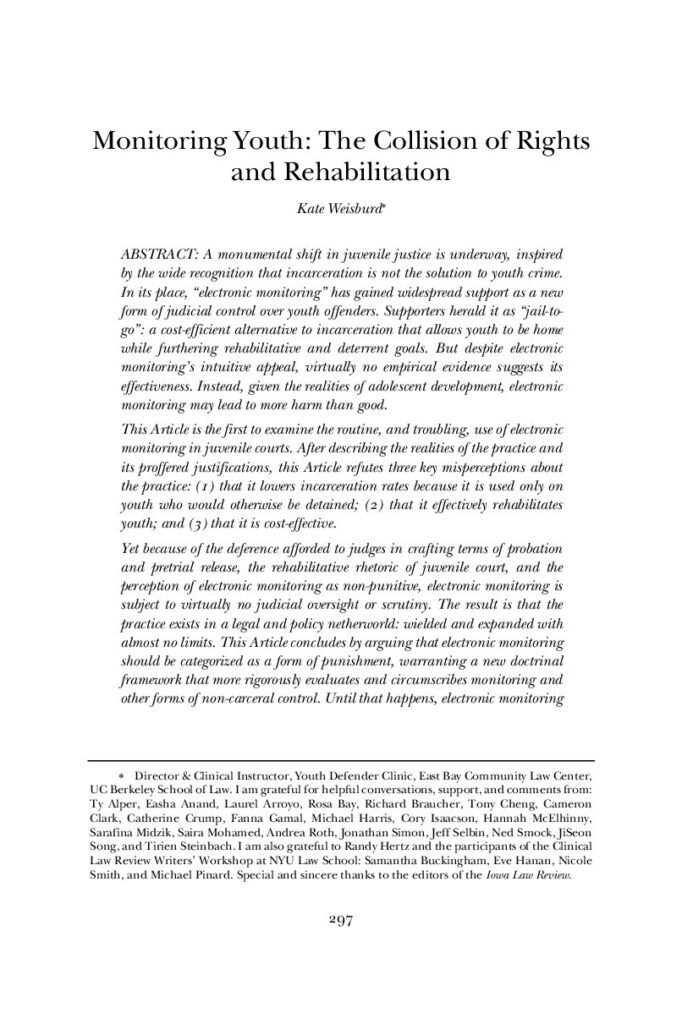
From the abstract: “A monumental shift in juvenile justice is underway, inspired by the wide recognition that incarceration is not the solution to youth crime. In its place, “electronic monitoring” has gained widespread support as a new form of judicial control over youth offenders. Supporters herald it as “jail-to-go”: a cost-efficient alternative to incarceration that…
- « Previous
- 1
- 2
