

From the resource by Case Western Reserve University Schubert Center for Child Studies: “This document offers an overview of the most current and reliable national and Ohio-specific guidance and resources to support practitioners and providers working with immigrant children. It is organized in the following child and youth-specific settings: Each section provides practical tools, current…
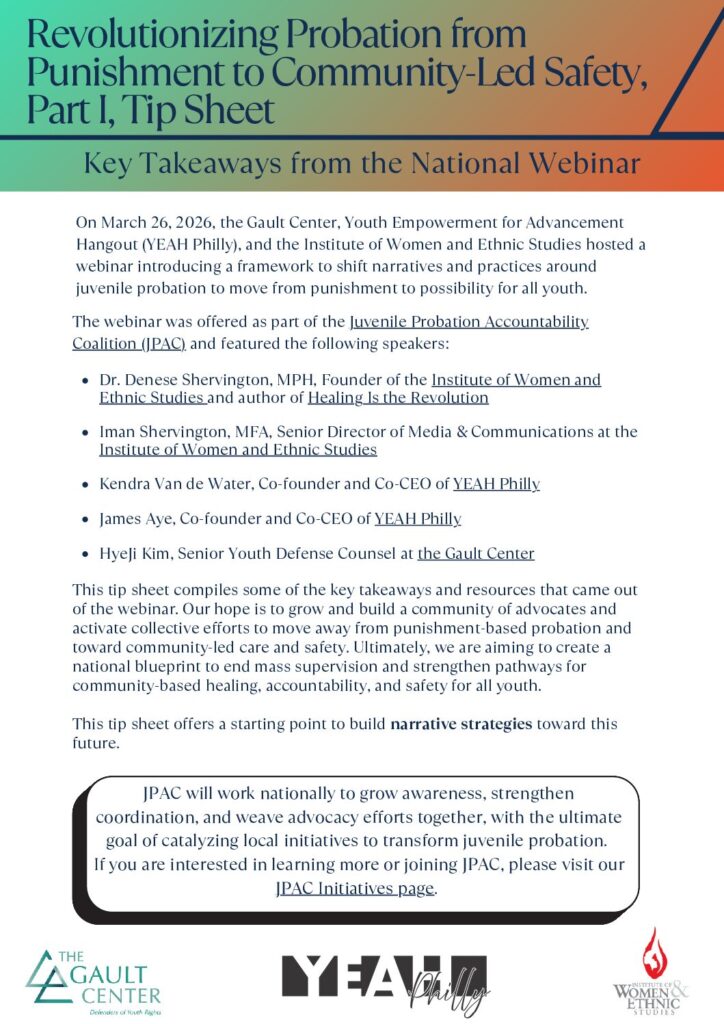
Compiles key takeaways and resources on building narrative strategies to transform juvenile probation, offered during a webinar on Revolutionizing Probation from Punishment to Community-Led Safety.

From the abstract: “Juvenile correctional programs that focus solely on safety, education, and structure yield suboptimal outcomes. Youth in these facilities often have learning disorders, and adaptive challenges, have been exposed to severe trauma, and have mental disorders, including autism spectrum disorder. Consequently, rehabilitation programs must be comprehensive, individualized, developmentally informed, and trauma informed to…

Provides tangible opportunities probation officers have to support positive youth development equitably for all youth, regardless of immigration status and circumstances beyond a young person’s control.

This paper is part of the Series on Learning from Civil Rights Lawsuits from the Civil Rights Litigation Clearinghouse and focuses on parole review procedures for individuals serving long sentences for crimes committed under age 18, discusses constitutional dimensions of parole review for this group, and proposes model policies supporting a meaningful opportunities for release. From the Executive Summary: “In recent years, people serving…

Abstract: “Nearly sixty years ago, In re Gault guaranteed children in juvenile court the right to counsel. However, Gault fell short. While recognizing children’s distinct vulnerability, the Court created a right for children that is weaker than that of adults and failed to recognize how youth in fact require a more expansive right to counsel. Grounded in the stories of…
This toolkit from All Rise and Justice for Vets provides support to treatment courts serving individuals with traumatic brain injury. Additionally, this toolkit includes an overview of brain injury and treatment courts, screening methods for brain injury-related challenges, and resources for making accommodations for brain injury in the legal system. From the Summary: As expressed…

From the executive summary: “On April 21, 2021, the Department of Justice opened a pattern or practice investigation of the Minneapolis Police Department (MPD) and the City of Minneapolis. By then, Derek Chauvin had been convicted in state court for the tragic murder of George Floyd in 2020. In the years before, shootings by other…

From the executive summary: “The Department of Justice has reasonable cause to believe that the Louisville/Jefferson County Metro Government (Louisville Metro) and the Louisville Metro Police Department (LMPD) engage in a pattern or practice of conduct that deprives people of their rights under the Constitution and federal law: • LMPD uses excessive force, including unjustified…

On April 14, 2022, the DOJ filed a complaint against the South Carolina Department of Juvenile Justice for depriving youth confined in the Broad River Road Complex facility of their constitutional rights. The complaint highlights Fourteenth Amendment violations, namely that the Department of Juvenile Justice “(i) failed to reasonably protect children from youth-on-youth violence; and…

On April 14, 2022, the DOJ released its investigation findings of South Carolina Department of Juvenile Justice’s Broad River Road Complex. The investigation finds “, that there is reasonable cause to believe, based on the totality of the conditions, practices, and incidents, that: (1) the conditions at the Broad River Road Complex (BRRC), South Carolina’s…

On April 14, 2022, the DOJ entered into a settlement agreement with the South Carolina Department of Juvenile Justice to remedy conditions that violated young people’s constitutional rights at the Broad River Road Complex facility. The settlement agreement includes provisions that the Department “shall, at all times, provide youth at BRRC with safe living conditions,”…

[South Carolina] Department of Juvenile Justice’s Broad River Road Complex: Notice and Investigation
On February 5, 2020, the DOJ sent notice to the Governor of South Carolina regarding the alleged conditions they have reasonable cause to believe violate the U.S. Constitution at the Broad River Road Complex juvenile facility. The notice states, in part, “After carefully reviewing the evidence, we conclude that there is reasonable cause to believe…

Sexual Abuse of Juveniles in Correctional Facilities: A Violation of the Prison Rape Elimination Act
From the Introduction: This Comment argues that states are failing to adhere to PREA in juvenile correctional facilities, resulting in a violation of individuals’ Eighth Amendment constitutional right to be protected from cruel and unusual punishment. Part II discusses PREA and summarizes the basic principles of Eighth Amendment jurisprudence. Part III argues that states’ protections…

This policy report features interviews of young people who have been incarcerated in youth facilities in Colorado and details the harmful conditions and culture in these programs. From the Executive Summary: “Despite a mission of rehabilitation rather than punishment, the culture of the Colorado Division of Youth Corrections (DYC) is plagued by punitive practices that…

This paper from the Executive Session on Community Corrections at the Harvard Kennedy School examines the history of youth incarceration and discusses how the inherently flawed model of youth prisons demands systemic reforms, including closure of youth prisons, to actualize safer communities, and positive youth outcomes. From the introduction: “For 170 years, since our first youth correctional institution opened, America’s approach…
On October 2, 2015 the DOJ filed a Statement of Interest in a federal lawsuit on behalf of two students who were seized and handcuffed by a school resource officer (SRO), alleging violations under the Fourth and Fourteenth Amendments and Title II of the Americans with Disabilities Act (ADA). The DOJ asserted that the Sheriff’s…
A proposed settlement agreement between the United States and Lauderdale County in the State of Mississippi after an investigation of the substantive and procedural due process rights of youth who appear in Lauderdale County Youth Court. The Settle Agreement proposes several remedial measures the named parties must take including creating a probation process that complies…

On March 31, 2011, Leflore County, Mississippi entered into a Memorandum of Agreement (MOA) with the United States to address the DOJ’s investigation findings into the Leflore County Juvenile Detention Center (LCJDC). The MOA outlines that LCJDC must provide young people with reasonably safe conditions of confinement, protect youth from harm, limit the use of…
This report from Human Rights Watch provides an overview of the impact of Florida’s direct file statute on youth tried as adults in the state. Additionally, the report contains recommendations to different systems practitioners and decisionmakers for ending the direct file practice. From the report: Florida transfers more children out of the juvenile system and…

On December 17, 2012, the U.S. Department of Justice entered into a settlement agreement with Shelby County and the Juvenile Court of Memphis and Shelby County in Tennessee following their investigation into the juvenile court system. The settlement agreement includes remedial measures to align the following practices with the U.S. Constitution: probable cause determinations, notice…

On December 17, 2012, the U.S. Department of Justice entered into a settlement agreement with Shelby County and the Juvenile Court of Memphis and Shelby County in Tennessee following their investigation into the juvenile court system. The settlement agreement includes remedial measures to align the following practices with the U.S. Constitution: probable cause determinations, notice…

On March 20, 2012, the DOJ released its investigation findings into the conditions of confinement at the Walnut Grove youth Correctional Facility (WGYCF) in Walnut Grove, Mississippi. The investigation concludes, “the State of Mississippi is deliberately indifferent to the constitutional rights of young men confined at WGYCF. Evidence discovered at WGYCF reveals systematic, egregious, and…
