
Adolescent Development
The Arizona Supreme Court ruled the juvenile court did not abuse its discretion when it found a 16-year old youth’s consent to a warrantless blood draw was involuntary and granted his motion to suppress. The court offered the following language in support: “We hold now that, independent of § 28-1321, the Fourth Amendment requires an…

This amicus brief by Center on Wrongful Convictions of Youth, The Gault Center, and others argue a 15-year-old child from South Dakota did not knowingly and intelligently waive her Miranda rights when the police failed to allow her to consult with her mother before interrogation, minimized the importance of the Miranda warnings, and did not…

From the introduction: “This report will describe, dissect, and draw lessons from Connecticut’s striking success in juvenile justice reform for other states and communities seeking similar progress. The first section details the timeline and dimensions of change in Connecticut’s juvenile justice system over the past two decades. In 1992, Connecticut routinely locked up hundreds of…
This research article from Frontiers in Human Neuroscience asks, “does the brain activity underlying the production of deception differ depending on whether or not one believes their deception can be detected? To address this question, we had participants commit a mock theft in a laboratory setting, and then interrogated them while they underwent functional MRI…

This amicus brief by the Center on Wrongful Convictions of Youth, Vanderbilt Professor of Law and Medicine Terry A. Maroney, The Gault Center, and others. Amici argue a 16-year-old youth’s waiver of his Miranda rights was involuntary and his confession must be suppressed pursuant to the 5th and 14th Amendments, where he was threatened during…

On December 17, 2012, the U.S. Department of Justice entered into a settlement agreement with Shelby County and the Juvenile Court of Memphis and Shelby County in Tennessee following their investigation into the juvenile court system. The settlement agreement includes remedial measures to align the following practices with the U.S. Constitution: probable cause determinations, notice…

On December 17, 2012, the U.S. Department of Justice entered into a settlement agreement with Shelby County and the Juvenile Court of Memphis and Shelby County in Tennessee following their investigation into the juvenile court system. The settlement agreement includes remedial measures to align the following practices with the U.S. Constitution: probable cause determinations, notice…

In the case of C.P, the Ohio Supreme Court ruled that R.C. 2152.86, which created a new class of youth adjudicated of sex offenses who would automatically be subject to mandatory, lifetime sex-offender registration and notification requirements, violated the U.S. and Ohio Constitutions. In its ruling, the Court offered the following language in support: “In…


This amici brief prepared by the Juvenile Law Center et al. highlights the particular characteristics of adolescent development and youth that make juvenile life without parole sentences unconstitutional and in violation of the 8th Amendment to the U.S. Constitution. The brief addresses youth’s culpability, potential for change, and risk taking behavior compared to adults as…

This amicus brief by Juvenile Law Center, Campaign for Youth Justice, and The Gault Center argues the transfer hearing in the state juvenile court deprived the young person of due process when the judge only considered the intentional murder charge, when they were ultimately convicted on the lesser offense of felony murder and second degree…
This amicus brief by Juvenile Law Center, Children’s Law Center, Inc., The Gault Center, and others argues Ohio should adopt a bright line rule requiring meaningful access to counsel for all young people at the interrogation stage of a delinquency proceeding. Amici argue counsel at interrogation is essential given the developmental and neuroscientific differences between…

This amicus brief by Juvenile Law Center and The Gault Center argues Illinois automatic transfer law does not comply with recent research and findings on adolescent development as recognized by the Supreme Court jurisprudence in Roper and Graham. Further, amici argue the state’s automatic transfer statute violates the proportionality clause of Article I, Section 11…

This amicus brief by Juvenile Law Center and others argues young people are different for purposes of the Miranda custody analysis and the Supreme Court should afford young people Constitutional protections in light of Supreme Court jurisprudence on interrogations and recently under the 8th Amendment as well as social science research about the particular vulnerability…
This amicus brief by Center on Wrongful Convictions of Youth, Juvenile Law Center, and others argues that a juvenile court adjudication should not be used to enhance a sentence in adult court under Apprendi v. New Jersey, 530 U.S. 466 (2000), because a juvenile court adjudication lacks the same reliability as a criminal conviction, and…

This amicus brief by The Gault Center, Children’s Law Center, Inc., and the American Civil Liberties Union of Ohio Foundation, Inc. argues mandating young people to register on sex offender registries is improper since youth adjudicated of sex offenses are vastly different from adults convicted of sex offenses, registries frustrate the purpose of juvenile court,…

This amicus brief by The Gault Center, Juvenile Law Center, and National Center for Lesbian Rights argue that strict liability statutes run counter to the principles of adolescent development. Here, amici argue that a 12-year old child who engaged in non-forcible sexual conduct with his peer, who was then prosecuted under a strict liability sex…

The U.S. Supreme Court held juvenile life without parole for non-homicide offenses violates the 8th Amendment and offered the following language in support. “Roper established that because juveniles have lessened culpability they are less deserving of the most severe punishments. 543 U.S., at 569, 125 S. Ct. 1183, 161 L. Ed. 2d 1. As compared…
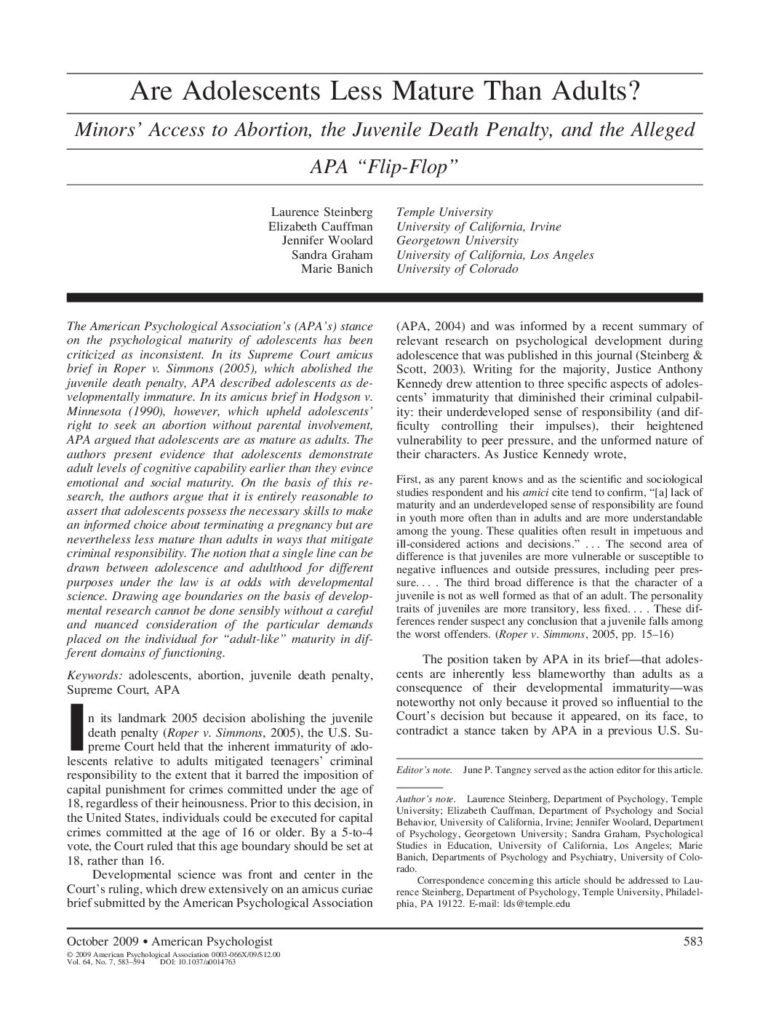
The American Psychological Association’s (APA’s) stance on the psychological maturity of adolescents has been criticized as inconsistent. In its Supreme Court amicus brief in Roper v. Simmons (2005), which abolished the juvenile death penalty, APA described adolescents as developmentally immature. In its amicus brief in Hodgson v. Minnesota (1990), however, which upheld adolescents’ right to…

This amicus brief by The Juvenile Law Center, The Gault Center, and others highlights the unique developmental status of youth, relevant social science research, and Supreme Court Jurisprudence, that make a life without parole sentence for non-homicide crimes unconstitutional in violation of the 8th Amendment of the U.S. Constitution. As stated in their brief: “The…

An expert affidavit from Professor Franklin Zimring outlining relevant data, studies and research supporting that youth who are charged with sex offenses in juvenile court should not be subject to sex offender registry requirements or stigmatization that comes with sex offense adjudications. The affidavit analyzes recent studies highlighting that “the empirical research to date supports…
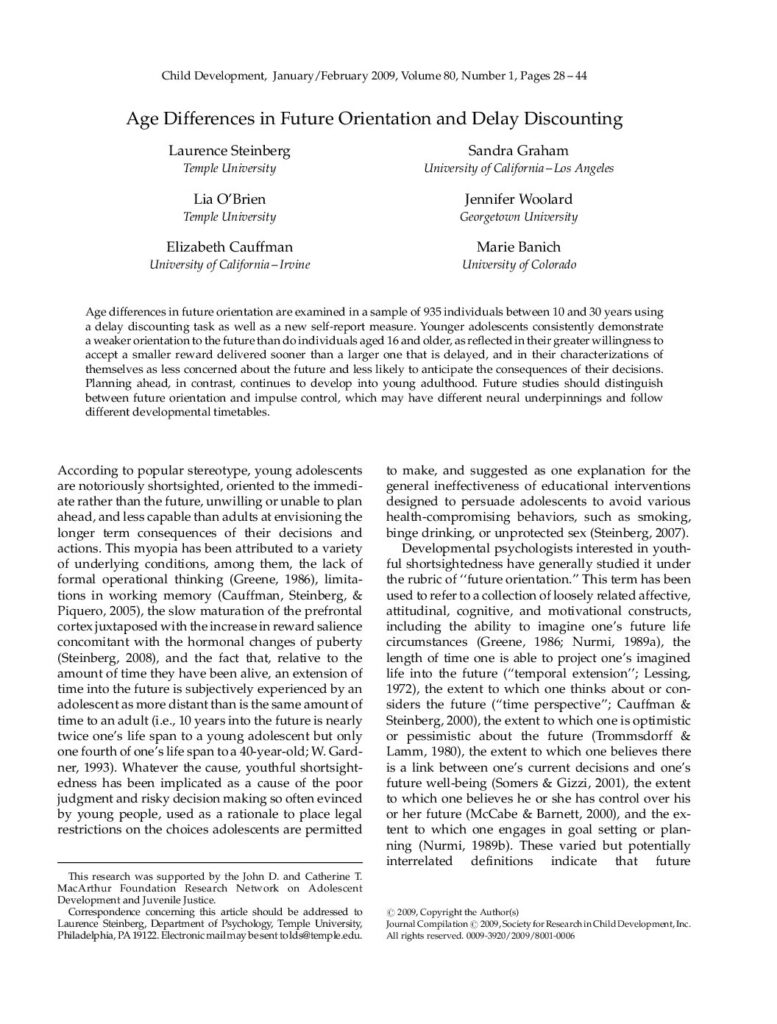
In this research article from Child Development, age differences in future orientation are examined in a sample of 935 individuals between 10 and 30 years using a delay discounting task as well as a new self-report measure. Younger adolescents consistently demonstrate a weaker orientation to the future than do individuals aged 16 and older, as…

This law review article from the publication Psychology, Public Policy and Law, looks at juvenile Miranda warnings and the comprehensibility of the warnings as applied to young people. From the Introduction: “Annually, more than 1.5 million [youth] offenders are arrested and routinely Mirandized with little consideration regarding the comprehensibility of these warnings. The current investigation…
