
Brain Development
The Illinois 1st District Court of Appeals granted an individual to proceed on a postconviction hearing to challenge his life sentence based on the state’s proportionate penalties clause. The court held that the individual who 18 at the time of the offense was entitled to present mitigating evidence about his age and youthfulness. The court…
The D.C. Court of Appeals held that age and youthfulness should be considered as mitigating evidence in sentencing reconsiderations pursuant to D.C.’s Incarceration Reduction Amendment Act. The court stated in relevant part: As our prior decisions have made clear, the “[District of Columbia] Council initially passed the IRAA in response to several ‘constitutional imperatives’ declared…

The 1st District Court of Appeals of Michigan vacated a life without parole sentence following a felony murder conviction, finding that trial counsel was ineffective by failing to raise mitigating evidence on adolescent brain development and childhood trauma and abuse. The court stated in relevant part: Appellate counsel obtained a mitigation expert, Mary Cuddehe, to…

From the abstract: “Over the past several decades, there have been an alarming number of instances where young Americans have had their lives ruined due to their involvement as confidential informants in law enforcement narcotics investigations. These tragedies have garnered national attention and inspired attempts at reform several times. Yet, the reckless use of the…
This law review article written by Professor Kristina Kersey explores transfer as a form of punishment and calls for jurisdictions to enact a moratorium on transfer, drawing lessons from the movement to end the death penalty. Noting similarities between transfer and the death penalty, this article analogizes the two and argues that transfer mechanisms operate…
“Juvenile sex offender registration was never a natural fit for the youth justice system, but in the digital age, it has become deeply harmful. What began as a paper-based precaution has evolved into a sprawling digital regime that permanently brands adolescents at the most formative stage of life. This Article examines how technological change has…
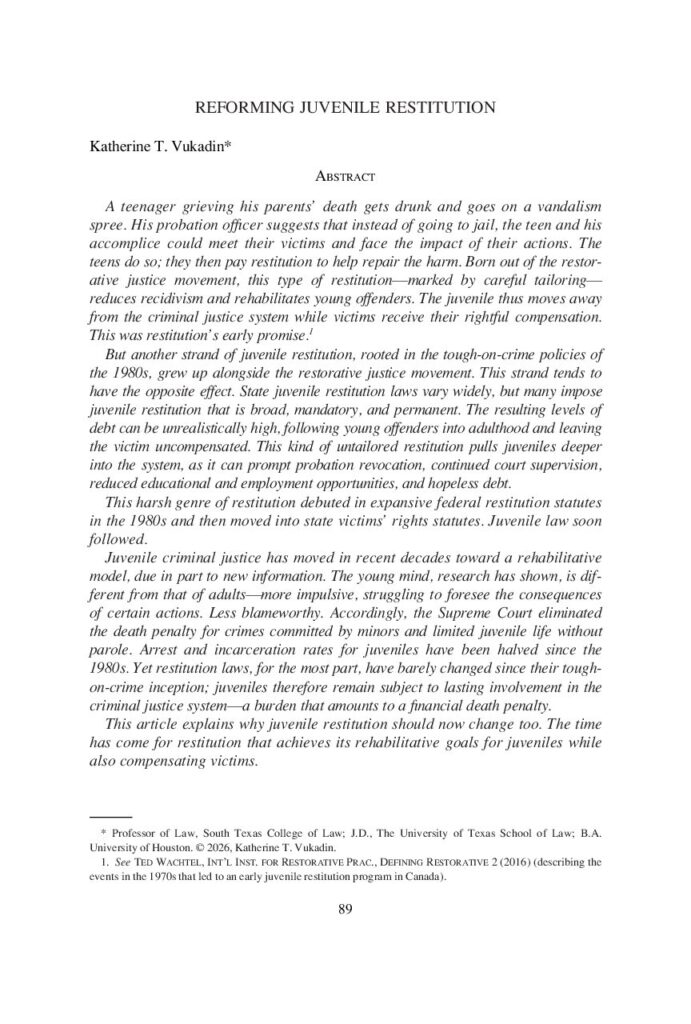
“Restitution laws, for the most part, have barely changed since their tough on-crime inception; juveniles therefore remain subject to lasting involvement in the criminal justice system—a burden that amounts to a financial death penalty. This article explains why juvenile restitution should now change too. The time has come for restitution that achieves its rehabilitative goals…
This amicus brief by forty developmental science scholars and nonprofits argues transformative growth during ages 18-20 makes mandatory LWOP for individuals in that age range a disproportionate sentence in violation of Article 1, Section 16 of the Michigan constitution. From the Summary of the Argument: “People v Parks held that Article 1, Section 16…
This amicus brief from the Center for Law, Brain, and Behavior highlights the adolescent capacity for significant growth and social maturation as well as criminological evidence on the unlikelihood of reoffending and responsiveness to evidence-based treatment among youth accused of sex offenses. The brief ultimately calls for the court to find that a de facto life without parole sentence is grossly disproportionate based on developmental science and research. From the Summary of Argument: “Evan McCarrick Jerald is…

Abstract: “While there has been momentum at both the federal and state levels to curtail extreme punishments for justice-involved juveniles (The Campaign for the Fair Sentencing of Youth, 2023), 22 states continue to permit the sentence of juvenile life without parole (JLWOP). Pennsylvania is among them. This essay focuses on judicial rationale in five JLWOP re-sentencing cases in…

This amicus brief from former Massachusetts judges, the Boston Bar Association, and the Massachusetts Bar Association argues life without parole sentences violate the Commonwealth’s prohibition on cruel and unusual punishment for late adolescents between 18-20 years old for the same reasons they did for youth under 18 years old (as articulated in Diatchenko). Additionally, the brief argues late adolescents have a great propensity…
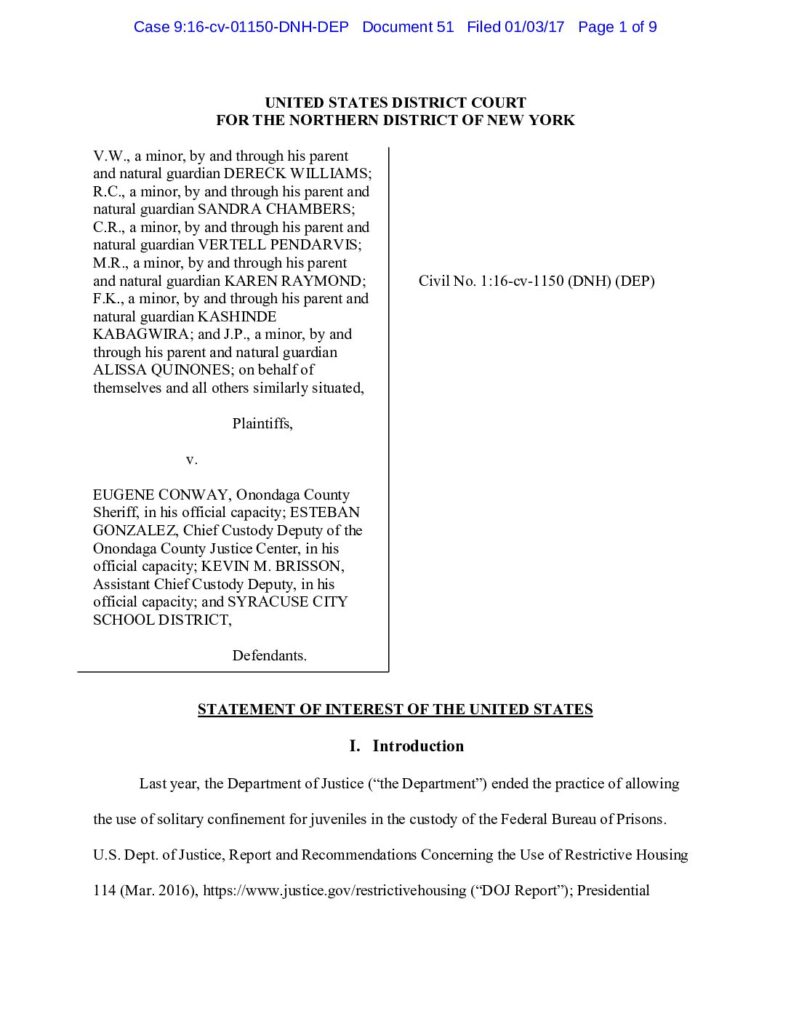
The U.S. Department of Justice filed a Statement of Interest in a federal class action lawsuit challenging the use of solitary confinement for 16- and 17-year-old youth in custody, including youth with disabilities. Calling for the federal district court to consider Supreme Court jurisprudence and growing scientific research on adolescent development, the DOJ asserts, “Juveniles…
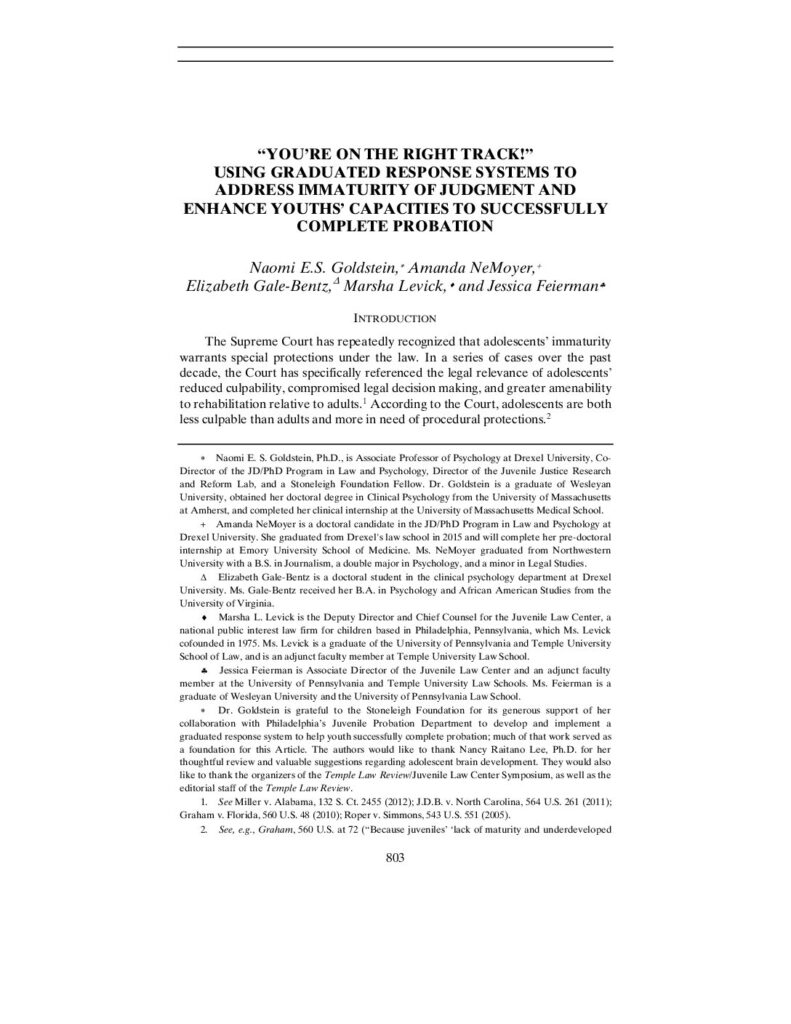
From the Introduction: “The Supreme Court has repeatedly recognized that adolescents’ immaturity warrants special protections under the law. In a series of cases over the past decade, the Court has specifically referenced the legal relevance of adolescents’ reduced culpability, compromised legal decision making, and greater amenability to rehabilitation relative to adults. According to the Court,…

On March 13, 2015, the U.S. Department of Justice filed a Statement of Interest in a lawsuit challenging the deprivation of children’s right to meaningful representation in the Cordele Judicial Circuit of Georgia. In upholding the constitutional necessity of youth defense specialization, the DOJ asserted, “The right to counsel means more than just a lawyer…
