
Developmental Maturity
The Supreme Court of Massachusetts held that a transfer hearing is a “critical stage of the criminal process” that requires effective assistance of counsel under the 6th Amendment of the U.S. Constitution. The Court held that defense counsel’s failure to present evidence on youthfulness, developmental maturity, and rehabilitation prevented the judge from considering factors critical…
The District of Columbia Court of Appeals held the sentencing court erred in setting aside Appellant’s conviction under the Youth Rehabilitation Act (YRA) where the court did not weigh Appellant’s age at the time of the offense in his favor and misapplied several other factors. The court stated in relevant part: “In amending the YRA…
Abstract: “Records generated by youth legal systems—or “juvenile justice systems”—are increasingly being used against young people in immigration proceedings. This practice undermines the core purpose of these youth-focused systems and can have devastating, life-altering consequences, including the denial of immigration benefits or deportation. Juvenile justice systems in the United States are founded on the recognition…
In People v. Clark-Collins, the Supreme Court of Colorado remanded the case ordering the district court to amend its standing order on the presentation and scope of testimony and evidence at a reverse transfer hearing as follows: “While the trial court has significant discretion regarding the presentation of evidence and the application of the rules of evidence, there are limits. In…
From the abstract: “Hundreds of thousands of children are brought under the jurisdiction of delinquency courts every year in the United States. Despite the reality that most children engage in delinquent behavior during their adolescence, poor children, children of color, children with disabilities, and children who identify as LGBTQIA+ comprise a disproportionate number of those who become delinquency system-involved. These disparities exist…
This amicus brief by forty developmental science scholars and nonprofits argues transformative growth during ages 18-20 makes mandatory LWOP for individuals in that age range a disproportionate sentence in violation of Article 1, Section 16 of the Michigan constitution. From the Summary of the Argument: “People v Parks held that Article 1, Section 16…
This amicus brief from American Academy of Pediatric Neuropsychology, the American Civil Liberties Union of New Jersey, the Gault Center, and others argues there is no reasonable, scientific basis for drawing the line for adolescence at age 18, and therefore protections from Comer (including reconsideration of lengthy sentences for homicide offenses committed by individuals under 18) should extend to young people who were 18 to 20 years old. Additionally, the brief…
This amicus brief from the Center for Law, Brain, and Behavior highlights the adolescent capacity for significant growth and social maturation as well as criminological evidence on the unlikelihood of reoffending and responsiveness to evidence-based treatment among youth accused of sex offenses. The brief ultimately calls for the court to find that a de facto life without parole sentence is grossly disproportionate based on developmental science and research. From the Summary of Argument: “Evan McCarrick Jerald is…

Abstract: “While there has been momentum at both the federal and state levels to curtail extreme punishments for justice-involved juveniles (The Campaign for the Fair Sentencing of Youth, 2023), 22 states continue to permit the sentence of juvenile life without parole (JLWOP). Pennsylvania is among them. This essay focuses on judicial rationale in five JLWOP re-sentencing cases in…

This paper is part of the Series on Learning from Civil Rights Lawsuits from the Civil Rights Litigation Clearinghouse and focuses on parole review procedures for individuals serving long sentences for crimes committed under age 18, discusses constitutional dimensions of parole review for this group, and proposes model policies supporting a meaningful opportunities for release. From the Executive Summary: “In recent years, people serving…
Abstract: “This article demonstrates how advocates can leverage empirical literature regarding adultification bias to craft doctrinal interventions that recognize and remedy the disproportionately harsh treatment of Black youth in the juvenile and adult criminal legal system. Through case examples, all of which I litigated in the Civil Rights Clinic at Seattle University School of Law, I demonstrate how adultification…
This written testimony from Elizabeth Cauffman, Ph.D. and Arielle Baskin-Sommers, Ph.D. discusses what developmental science says about the impact of brain development on adolescent risk taking, decision making, and susceptibility to social and peer influence as it relates to a young person’s culpability. The testimony also provides information on diversion and its impact on lower recidivism and improved public safety. Below is an excerpt from…
This amicus brief by the Juvenile Law Center and Rise for Youth argues schools and school officials are increasingly entangled with law enforcement, especially, through the use of school resource officer programs, impacting students’ constitutional rights. The brief argues that O.W., a 13-year old student in this case, had his Fifth Amendment rights violated when his vice principal and the school resource officer compelled him to make an incriminating statement…
This brief by the Wisconsin Innocence Project and others argues the developmental characteristics of children and adolescents make them uniquely susceptible to the pressures of police interrogation, resulting in young people making involuntary statements. The brief calls the court to consider the child’s age and the coercive psychological tactics used during police interrogations, specifically the minimization and maximization techniques, to assess whether the child was in custody and…
From the Introduction: “This Article will focus on the difficulties ex-juvenile offenders face when seeking expungement of their juvenile records to prevent collateral consequences. Specifically, I will argue that a person under the age of eighteen should not be subject to the same statutory expungement bar as adults when seeking an expungement in New Jersey.…
This amicus brief from former Massachusetts judges, the Boston Bar Association, and the Massachusetts Bar Association argues life without parole sentences violate the Commonwealth’s prohibition on cruel and unusual punishment for late adolescents between 18-20 years old for the same reasons they did for youth under 18 years old (as articulated in Diatchenko). Additionally, the brief argues late adolescents have a great propensity…
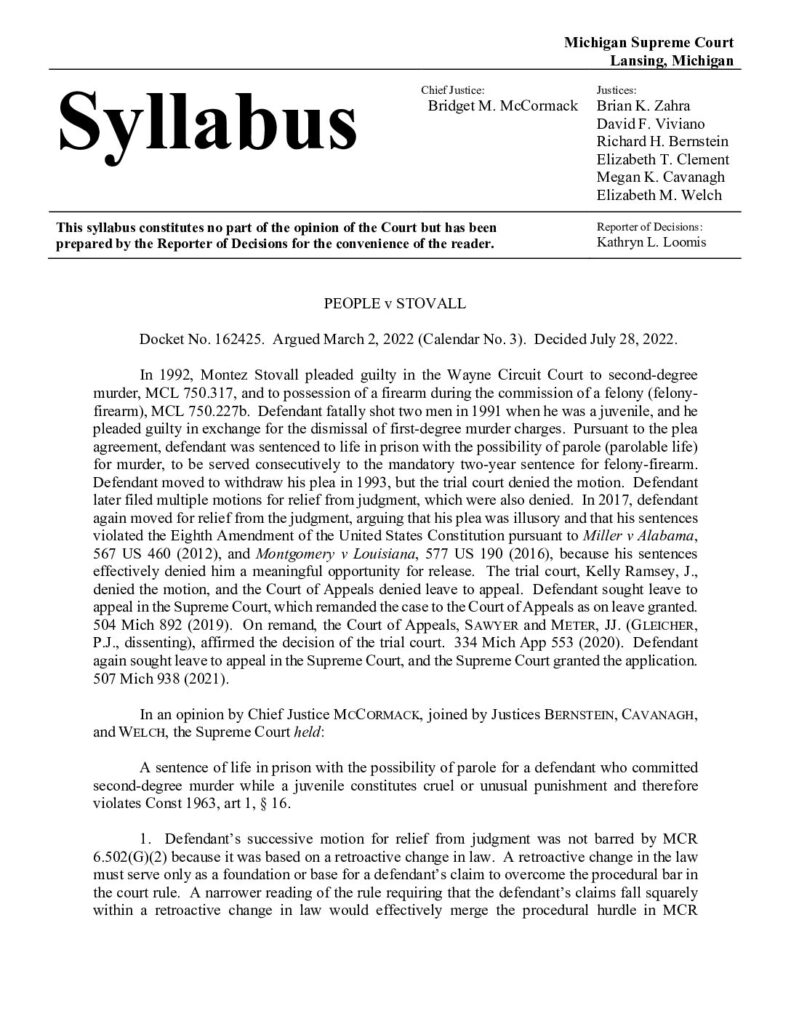
In People v. Stovall, the Michigan Supreme Court vacated Stovall’s sentence of a parolable life sentence for second-degree murder finding it violated Article 1, Section 16 of the Michigan constitution prohibition against cruel and unusual punishment. The court offered the following language in support: “The Michigan Constitution, however, is different. Article 1, § 16 of the Michigan Constitution provides that “[e]xcessive bail shall not be…
From the Introduction: “The Supreme Court has repeatedly recognized that adolescents’ immaturity warrants special protections under the law. In a series of cases over the past decade, the Court has specifically referenced the legal relevance of adolescents’ reduced culpability, compromised legal decision making, and greater amenability to rehabilitation relative to adults. According to the Court,…
