
Juvenile Life Without Parole

A concentration of a few states has unevenly complied with Miller and the possibility of resentencing provided by Montgomery. Some states have refused to comply at all. This uneven implementation of the Miller decision has a particularly profound impact on racial disparities among those serving JLWOP. An analysis of those deemed worth protecting from JLWOP…

This paper is part of the Series on Learning from Civil Rights Lawsuits from the Civil Rights Litigation Clearinghouse and focuses on parole review procedures for individuals serving long sentences for crimes committed under age 18, discusses constitutional dimensions of parole review for this group, and proposes model policies supporting a meaningful opportunities for release. From the Executive Summary: “In recent years, people serving…

A brief timeline of states banning juvenile life without parole.

This article makes the argument against the imposition of life without parole for young people who commit felony murder using an adolescent development framework. The author analyzes existing case law to outline that, just as the U.S. Supreme Court found the death penalty inappropriate for felony murder and relied on adolescent brain development research in…
From the Introduction of the Paper: “The U.S.’s failure to implement an internationally abiding federal law regulating juvenile justice has important implications on the treatment of incarcerated adolescent populations while incarcerated, rehabilitated, and reintegrated into society. This article will analyze the harmful and outdated legal frameworks and institutional structures of the U.S. juvenile justice systems.…

This Article is one of the first to explore the racialized impact of the two most controversial and ubiquitous forms of what we call “imputed liability murder.” An analysis of ten years of murder prosecutions in the state of Minnesota reveals that imputed liability murder is anything but a fringe subtype of homicide: an astounding…

From the Introduction: “Racial inequities are addressed to varying degrees in at least three of the four sections of the Restatement of Children and the Law. This Essay evaluates whether and how well this Restatement advances racial justice and identifies additional opportunities for the ALI to address racial inequities now and in future iterations of the Restatement. The…




Abstract: “Nearly sixty years ago, In re Gault guaranteed children in juvenile court the right to counsel. However, Gault fell short. While recognizing children’s distinct vulnerability, the Court created a right for children that is weaker than that of adults and failed to recognize how youth in fact require a more expansive right to counsel. Grounded in the stories of…

A sample visual timeline capturing specific events in a client’s life for use as mitigation in different stages of a case, including: trial, disposition or post-disposition proceedings, sentencing, or parole advocacy.


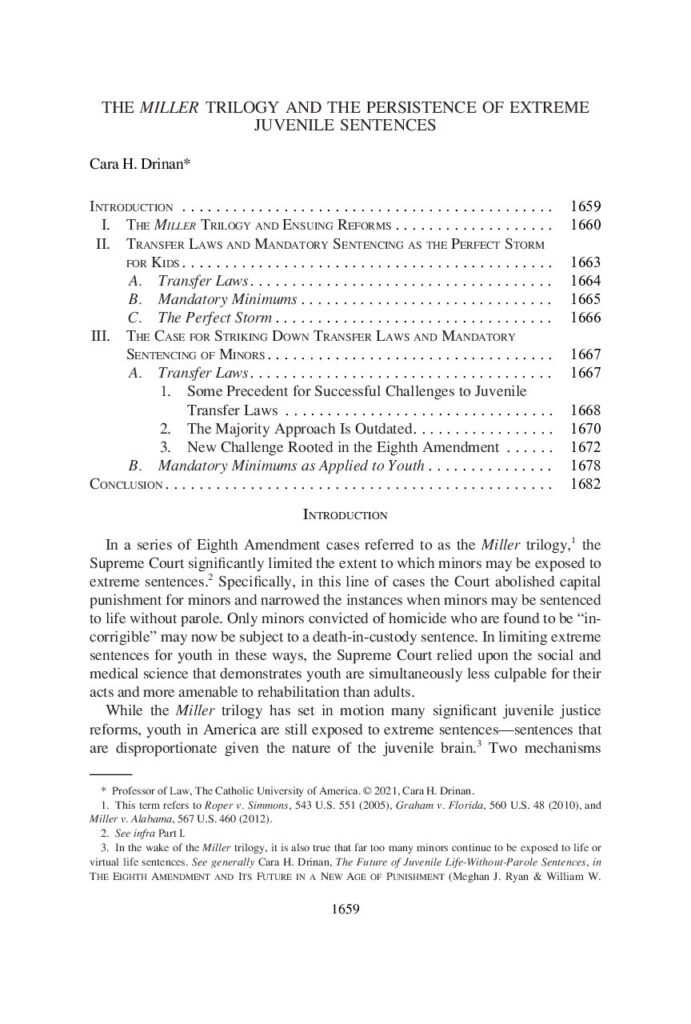
From the Introduction: In a series of Eighth Amendment cases referred to as the Miller trilogy, the Supreme Court significantly limited the extent to which minors may be exposed to extreme sentences. Specifically, in this line of cases the Court abolished capital punishment for minors and narrowed the instances when minors may be sentenced to…
- « Previous
- 1
- 2
- 3
- Next »
