
Youth in Adult Court

Advocates in Maryland created a series of short policy briefs to educate community members about pressing issues. You can see the others in this series here under “Sample Legislative Advocacy Briefs” on the Policy Page of the Racial Justice Toolkit.


On November 15, 2018, a joint settlement was reached to address the conditions of confinement in Florida’s Palm Beach County Jail. The settlement agreement outlines comprehensive changes in the facility, including giving young people time and access to appropriate recreational activities outside of their cells during school hours. The settlement also limits the amount of…

On October 1, 2018, the DOJ filed a Statement of Interest in a federal class action lawsuit on behalf of young people confined in Florida’s Palm Beach County Jail. The DOJ highlights the protections afforded to students with disabilities under the Individuals with Disabilities Education Act (IDEA), and the “independent and shared” responsibilities and obligations…


On June 21, 2018, a federal class action lawsuit was filed on behalf of young people confined in the Palm Beach County Jail, alleging violations of their 8th and 14th Amendment rights under the U.S. Constitution. The plaintiffs are youth whose cases have been direct-filed in adult court in Palm Beach County, Florida. The complaint…
The Kentucky Supreme Court found that competency attaches for young people at transfer hearings pursuant to the 6th and 14th Amendments of the U.S. Constitution as well as Section 11 of the Kentucky Constitution. The Court reasoned that because transfer hearings are critically important proceedings as identified in Kent, competence must be established before transfer…
From the Executive Summary: Florida prosecutes more children in the adult criminal justice system than any other state, and as a consequence, hundreds of children are held in adult county jails2 every year. In the majority of cases, the decision to prosecute a child as an adult is made by the prosecutor, without judicial review…

The New Jersey Supreme Court held the state is required to disclose all discovery in its possession to the child before waiving the child to adult court and offered the following language in support. “N.H. moved for full discovery before the waiver hearing, and the trial court granted the request. The court analogized the filing…
The Campaign for the Fair Sentencing of Youth issued Trial Defense Guidelines for representing youth facing a possible life sentence. “The objective of these guidelines is to set forth a national standard of practice to ensure zealous, constitutionally effective representation for all juveniles facing a possible life sentence (“juvenile life”) consistent with the United States…
From the report: Despite the strong language provided in the Prison Rape Elimination Act, state laws vary widely as to the regulations and parameters for housing youth in adult prisons. In fact, some states have no regulations or parameters governing the treatment of youth sentenced as adults at all. While some states have fully removed…

From the introduction: ” Recent Supreme Court cases have recognized the science underlying the common-sense notion that children are not “little adults.” Their brains function in a completely different manner than those of adults. In 2005, the Court abolished the juvenile death penalty and recognized the neuroscience underlying the claim that those under the age…

The Supreme Court of South Carolina held that individuals sentenced to juvenile life without parole were entitled to resentencing hearings to present evidence about youthfulness, following the U.S. Supreme Court decision, Miller v. Alabama. The court stated in relevant part: “Miller is clear that it is the failure of a sentencing court to consider the…

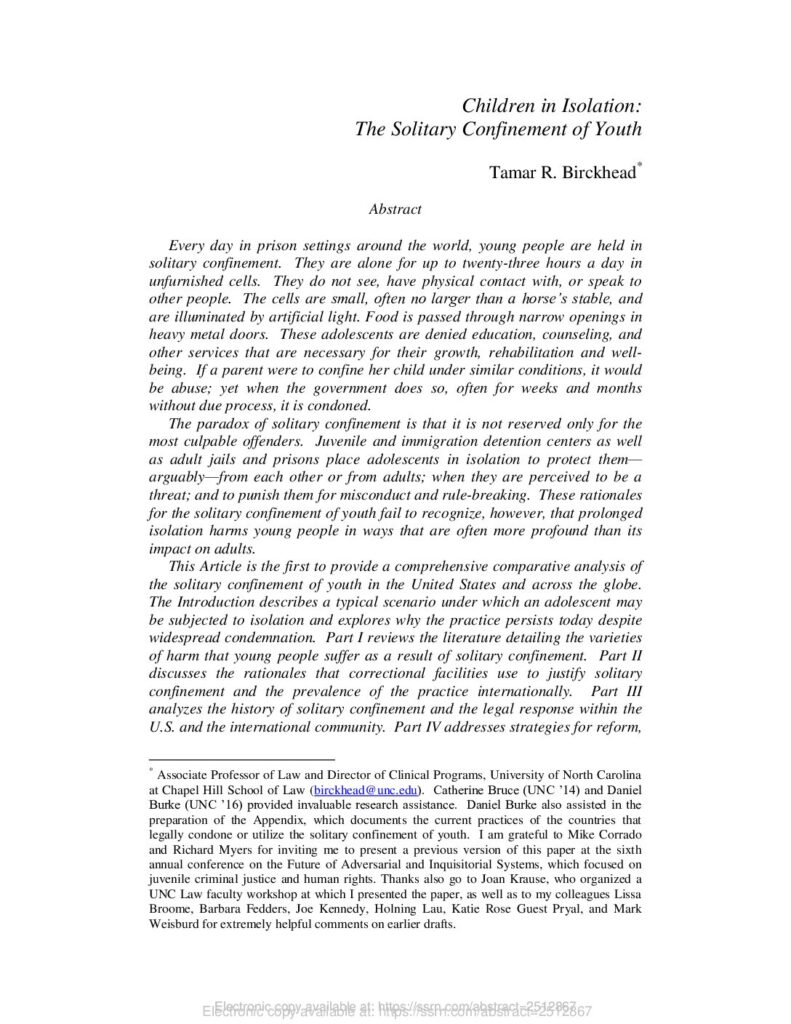
From the Abstract: Every day in prison settings around the world, young people are held in solitary confinement. They are alone for up to twenty-three hours a day in unfurnished cells. They do not see, have physical contact with, or speak to other people. The cells are small, often no larger than a horse’s stable,…


The Iowa Supreme Court struck down mandatory minimum sentencing schemes as applied to a young person transferred to adult court, finding mandatory minimum sentences to be in violation of federal and state prohibitions against cruel and unusual punishment and the best interest clause in Iowa’s juvenile code. The court notes “the statutory recognition of the…

This report from Human Rights Watch provides an overview of the impact of Florida’s direct file statute on youth tried as adults in the state. Additionally, the report contains recommendations to different systems practitioners and decisionmakers for ending the direct file practice. From the report: Florida transfers more children out of the juvenile system and…

This amicus brief by Juvenile Law Center, The Gault Center, and others argues Ohio’s mandatory bindover statute violates the Due Process protections guaranteed by the 14th Amendment of the U.S. Constitution as the mandatory scheme does not allow for individualized sentencing and recognition of the unique characteristics of youth. Further, amici argue individualized transfer proceedings…

This amici brief by Juvenile Law Center, Loyola Civitas Childlaw Clinic, and others argues automatic prosecution and mandatory sentencing of young people charged with felony murder is unconstitutional in light of recent Supreme Court case law as Illinois law does not allow for individual sentencing based on maturity and culpability. Furthemore, the brief argues the…
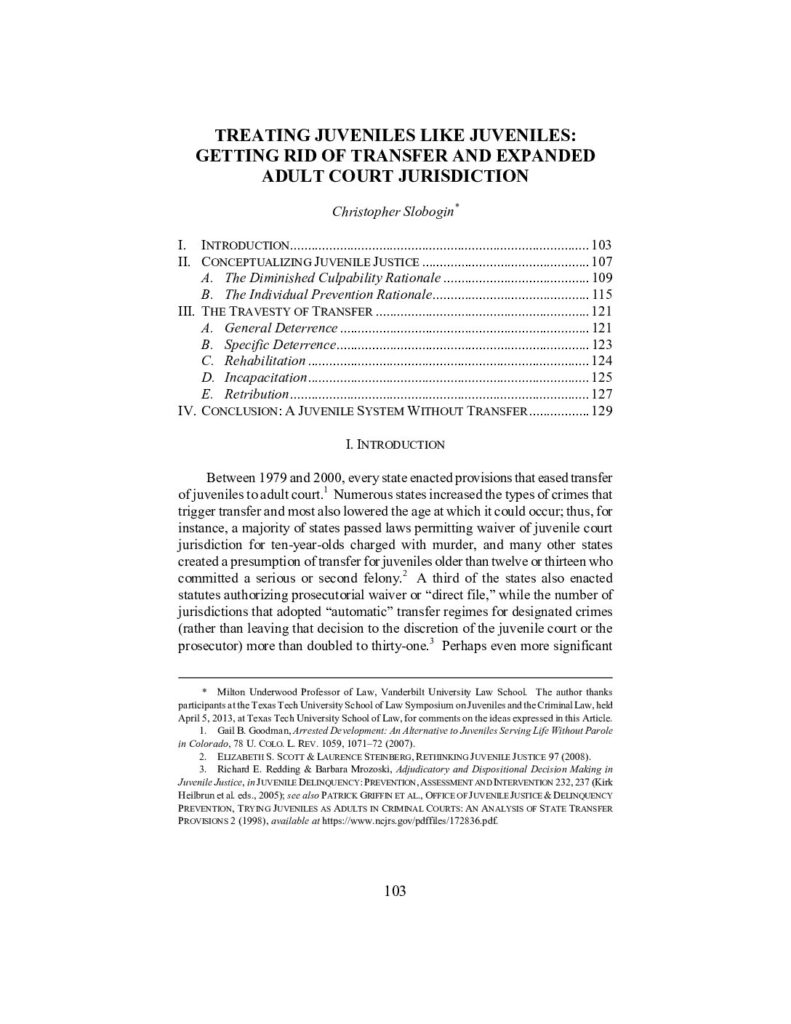
From the Abstract: The number of juveniles transferred to adult court has skyrocketed in the past two decades and has only recently begun to level off. This symposium article argues that, because it wastes resources, damages juveniles, and decreases public safety, transfer should be abolished. It also argues that the diminished culpability rationale that has…
This amicus brief by Juvenile Law Center and others argues California Penal Code 190.5(b) is unconstitutional because it presumes life without parole is the appropriate sentence for certain young people in adult court and it disregards Miller’s requirement of individualized sentencing. Furthermore, amici argue that a young person’s sentence must provide a “meaningful opportunity to…

This amicus brief prepared by Children’s Law Center, Inc., the Office of the Ohio Public Defender, The Gault Center, and others argues that due process and fundamental fairness, pursuant to the 5th Amendment, the 14th Amendment and Ohio law, require the state to provide full discovery to a young person prior to a probable cause…
