
14th Amendment
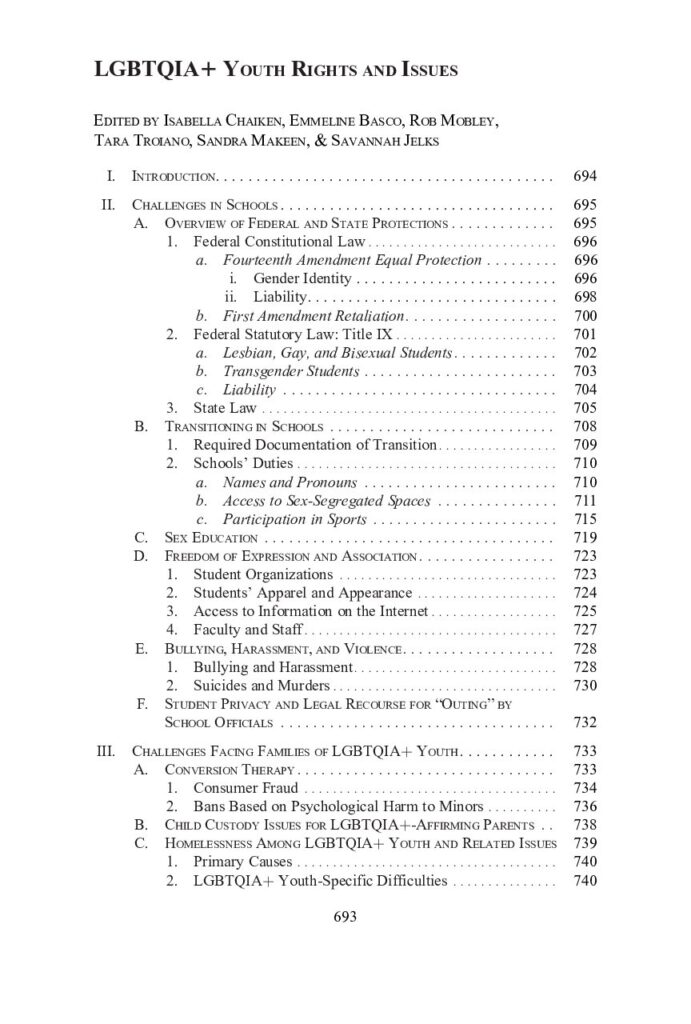
From the introduction: “This Article discusses the myriad challenges lesbian, gay, bisexual, transgender, and questioning (LGBTQIA+) youth face in the United States (U.S.). The Article focuses on issues LGBTQIA+ (the “plus” holds space for other sexual identities not represented within the acronym) youth confront in school as well as the issues faced by families with…


Challenging the Status Quo: Mobilizing Youth Defense Teams to Uphold Youth Rights & Uproot Injustice
This Racial Justice Webinar was hosted by the Gault Center and Georgetown Law’s Juvenile Justice Clinic & Initiative on May 29, 2024. The webinar focused on a collective call to action for the youth defense community to transform the juvenile legal system by centering youth and their constitutional rights to freedom, liberty, and equality. This…

From the introduction: “The report begins by examining the racial impact of the Persistent Offender Accountability Act (POAA) through data. The racially disparate application of the Three Strikes Law has been documented since shortly after the law’s passage and has held constant for more than two decades. This report presents the most recent data related…

From the introduction: “In this chapter, I consider the reciprocal effect of Black girls living within spaces and environments influenced by structural racism who are subjected to abuse at higher rates. I argue that there is a uniquely gendered and raced pipeline for these girls that warrants closer inspection. Here, I describe the pipeline that…


This checklist can be used to assess the presence of constitutional violations throughout the course of a client’s case. Please refer to the National Youth Defense Systems Standards and their accompanying User Guide for litigation strategies to challenge potential constitutional violations noted in this checklist.

This User Guide provides advocates with a step-by-step outline of how to actualize the vision of the National Youth Defense System Standards to equip and invest in youth defense teams to fight for the liberation of all youth.The User Guide outlines constitutional rights detailed in the System Standards, provides a checklist to assess the presence…

Appeal from the Circuit Court of Pemiscot County, Division I Thirty-Fourth Judicial Circuit, Pemiscot County No. 18PE-JU00022 The Honorable W. Keith Currie, Judge

On May 15, 2024, the DOJ submitted a letter to Kentucky Governor Andy Beshear to notify the state of the commencement of a DOJ investigation into nine juvenile facilities operated by the Kentucky Department of Juvenile Justice (DJJ). The specific issues the DOJ outlined they would investigate include excessive use of chemical force, physical and…

A concentration of a few states has unevenly complied with Miller and the possibility of resentencing provided by Montgomery. Some states have refused to comply at all. This uneven implementation of the Miller decision has a particularly profound impact on racial disparities among those serving JLWOP. An analysis of those deemed worth protecting from JLWOP…

This paper is part of the Series on Learning from Civil Rights Lawsuits from the Civil Rights Litigation Clearinghouse and focuses on parole review procedures for individuals serving long sentences for crimes committed under age 18, discusses constitutional dimensions of parole review for this group, and proposes model policies supporting a meaningful opportunities for release. From the Executive Summary: “In recent years, people serving…

From the introduction: “Although racial discrimination in the Deep South is not the outright focus of this Note—many other scholars have tackled this subject—it remains an underlying ugly truth that is woven into the conversation throughout. Rather than illuminate an already expansive area of jurisprudence, the Author has sought to address racial disparities in sentencing…

This report reviews the expanding infrastructure of police surveillance in public schools and highlights the failure of AI technologies and digital surveillance in making schools safer. Further, the report discusses the harms these technologies may cause to Black and Latine youth and youth from other historically vulnerable communities. Calling on youth justice advocates, youth leaders,…
Abstract: “This article demonstrates how advocates can leverage empirical literature regarding adultification bias to craft doctrinal interventions that recognize and remedy the disproportionately harsh treatment of Black youth in the juvenile and adult criminal legal system. Through case examples, all of which I litigated in the Civil Rights Clinic at Seattle University School of Law, I demonstrate how adultification…


Outlines steps that states must take to comply with the minimum requirements of the U.S. Constitution to protect the rights of youth facing deprivations of liberty.


