
14th Amendment

A sample motion arguing child pornography laws are unconstitutional as applied to a children engaging in sexting. The motion argues the statute is void-for-vagueness since it fails to provide fair notice regarding prohibited conduct for children under 18 and it encourages arbitrary and discriminatory enforcement because the distinction between offender and victim is blurred. Furthermore,…

On December 14, 2016, the U.S. Department of Justice entered into a settlement agreement with the St. Louis County Family Court to remedy constitutional violations. The settlement agreement covers policies and practices to ensure the due process and equal protection rights of all youth are upheld. This includes early appointment of youth defense counsel, prohibition…

On November 28, 2016, the DOJ filed a Statement of Interest in response to a lawsuit filed in South Carolina, challenging two state statutes as void for vagueness in violation of the Due Process Clause. The lawsuit alleged that the vague language in the statute resulted in the criminalization of common youthful behavior, racial disparities,…

“This pocket edition of the In re Gault opinion provides youth defenders, children’s advocates, and champions of justice with an invaluable tool: the constitutional mandate for the protection of children’s rights. The 1967 U.S. Supreme Court decision forever changed the landscape of youth justice. No longer could judges or probation officers use good intentions as…

On January 12, 2016, the DOJ released its second investigation findings on the Leflore County Juvenile Detention Center in Greenwood, Mississippi. The DOJ found “reasonable cause to believe that the provision of special education and related services at the Detention Center violate the federal rights of children under IDEA.” Specifically, the DOJ stated, “Our investigation…

On December 9, 2015, the U.S. District Court for the Southern District of Ohio Eastern Division terminated the consent decree, finding the Ohio Department of Youth Services in substantial compliance with the consent decree. Notable improvements made to the Ohio juvenile facilities include: “meaningful grievance system and easy access to attorneys to address concerns related…
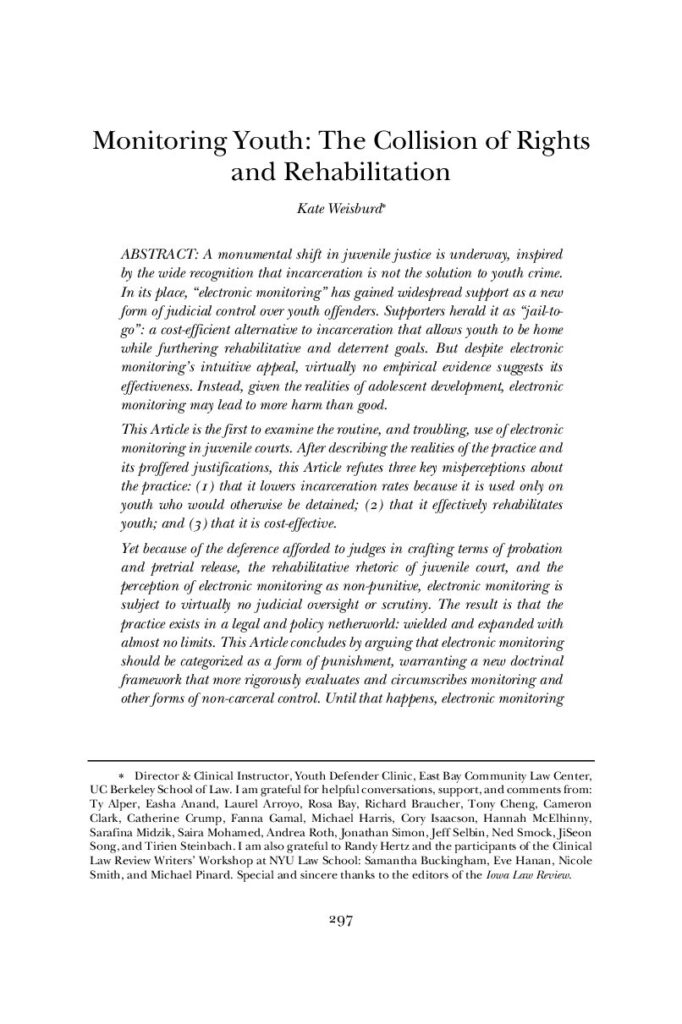
From the abstract: “A monumental shift in juvenile justice is underway, inspired by the wide recognition that incarceration is not the solution to youth crime. In its place, “electronic monitoring” has gained widespread support as a new form of judicial control over youth offenders. Supporters herald it as “jail-to-go”: a cost-efficient alternative to incarceration that…
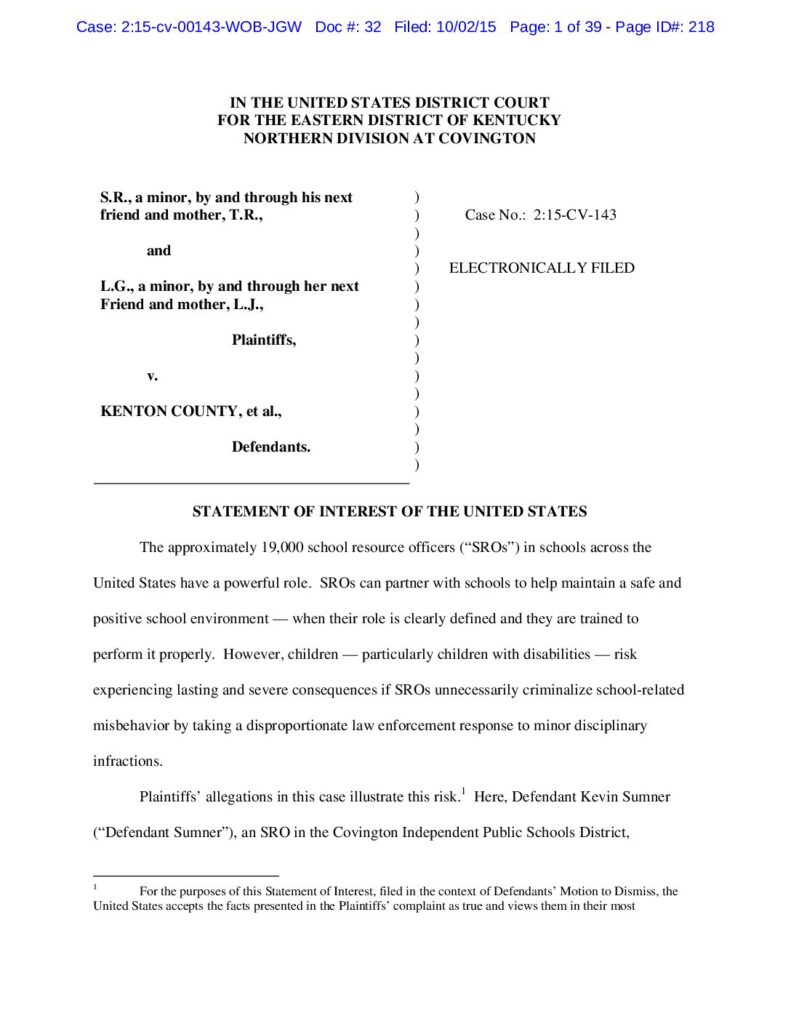
On October 2, 2015 the DOJ filed a Statement of Interest in a federal lawsuit on behalf of two students who were seized and handcuffed by a school resource officer (SRO), alleging violations under the Fourth and Fourteenth Amendments and Title II of the Americans with Disabilities Act (ADA). The DOJ asserted that the Sheriff’s…

On September 18, 2015, the U.S. Department of Justice entered into a settlement agreement with the city of Meridian to address the practice of arresting students in schools. The settlement agreement includes provisions that limit school-based arrests, including “for behavior that is appropriately addressed as a school discipline issue, including incidents involving public order offenses…

On September 18, 2015, the U.S. Department of Justice entered into a settlement agreement with the state of Mississippi about their probation and diversion practices. The settlement agreement includes provisions on protecting a youth’s right against self-incrimination, requiring probation orders to be written in simple terms to prevent arbitrary and discriminatory enforcement, and ensuring the…

On August 6, 2015, the DOJ released an updated findings letter on several juvenile facilities in Puerto Rico. The DOJ finds that young people confined in juvenile facilities face substantive due process and equal protection violations, in addition to infringements to their federal rights under the Individuals with Disabilities Education Act and the Rehabilitation Act…

On July 31, 2015, the U.S. Department of Justice released its investigation findings into the St. Louis County Family Court, finding due process and equal protection violations. The findings include right to counsel violations by denying constitutionally adequate defense representation, privilege against self-incrimination violations by requiring a child to admit to allegations for diversion, inadequate…

On March 31, 2011, Leflore County, Mississippi entered into a Memorandum of Agreement (MOA) with the United States to address the DOJ’s investigation findings into the Leflore County Juvenile Detention Center (LCJDC). The MOA outlines that LCJDC must provide young people with reasonably safe conditions of confinement, protect youth from harm, limit the use of…

On May 12, 2015, the DOJ filed a complaint in the U.S. District Court for the Northern District of Mississippi against Leflore County, Mississippi for engaging “in a pattern or practice of conduct that violates the Constitutional and statutory rights of youth at the Detention Center.” The complaint outlines 14th Amendment violations based on Leflore…

On March 13, 2015, the U.S. Department of Justice filed a Statement of Interest in a lawsuit challenging the deprivation of children’s right to meaningful representation in the Cordele Judicial Circuit of Georgia. In upholding the constitutional necessity of youth defense specialization, the DOJ asserted, “The right to counsel means more than just a lawyer…

From the introduction: ” Recent Supreme Court cases have recognized the science underlying the common-sense notion that children are not “little adults.” Their brains function in a completely different manner than those of adults. In 2005, the Court abolished the juvenile death penalty and recognized the neuroscience underlying the claim that those under the age…

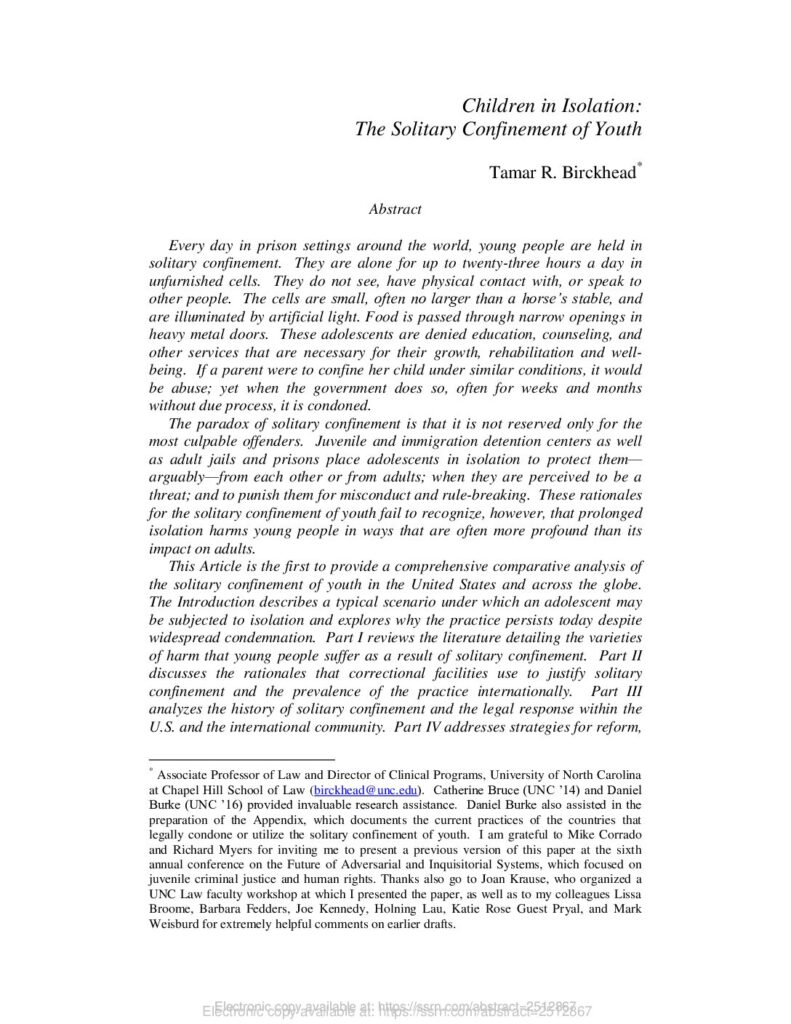
From the Abstract: Every day in prison settings around the world, young people are held in solitary confinement. They are alone for up to twenty-three hours a day in unfurnished cells. They do not see, have physical contact with, or speak to other people. The cells are small, often no larger than a horse’s stable,…

On August 1, 2024, the U.S. Department of Justice released its investigation findings into the Texas Juvenile Justice Department, finding violations of the 8th and 14th Amendments of the U.S. Constitution, the Individuals with Disabilities Education Act (IDEA), and the Americans with Disabilities Act (ADA).

On March 20, 2014, the DOJ filed a Statement of Interest in a federal conditions lawsuit on behalf young people under the age of 18 confined in the Michigan Department of Corrections, alleging violations of the Prison Rape Elimination Act (PREA). The DOJ emphasizes that “[s]tate correctional facilities. . . are subject to both the…

This amicus brief by Juvenile Law Center, The Gault Center, and others argues Ohio’s mandatory bindover statute violates the Due Process protections guaranteed by the 14th Amendment of the U.S. Constitution as the mandatory scheme does not allow for individualized sentencing and recognition of the unique characteristics of youth. Further, amici argue individualized transfer proceedings…

Report to Colorado General Assembly on the State of the Youth Defense System in Colorado pursuant to House Join Resolution 13-1019, whose purpose was to “examine and make recommendations on current laws, procedures and practices for the appointment of counsel, advisement of rights and waivers of counsel for children in juvenile delinquency court.” This report…

This amicus brief prepared by Children’s Law Center, Inc., the Office of the Ohio Public Defender, The Gault Center, and others argues that due process and fundamental fairness, pursuant to the 5th Amendment, the 14th Amendment and Ohio law, require the state to provide full discovery to a young person prior to a probable cause…
