
14th Amendment

This amicus brief by The Gault Center, Juvenile Law Center, and National Center for Lesbian Rights argue that strict liability statutes run counter to the principles of adolescent development. Here, amici argue that a 12-year old child who engaged in non-forcible sexual conduct with his peer, who was then prosecuted under a strict liability sex…

On July 14, 2010, the DOJ entered into a settlement agreement with the State of New York to remedy constitutional violations in the juvenile facilities. The settlement agreement outlines that the state shall not subject youth to undue restraints and must provide adequate and appropriate mental health care and treatment to youth. Related actions: [New…

On July 14, 2010, the DOJ filed a complaint in the U.S. District Court for the Northern District of New York against the State of New York, alleging that the state “disregarded known or serious risks of harm to youths at the Facilities . . . . constituting a pattern or practice that violates the…
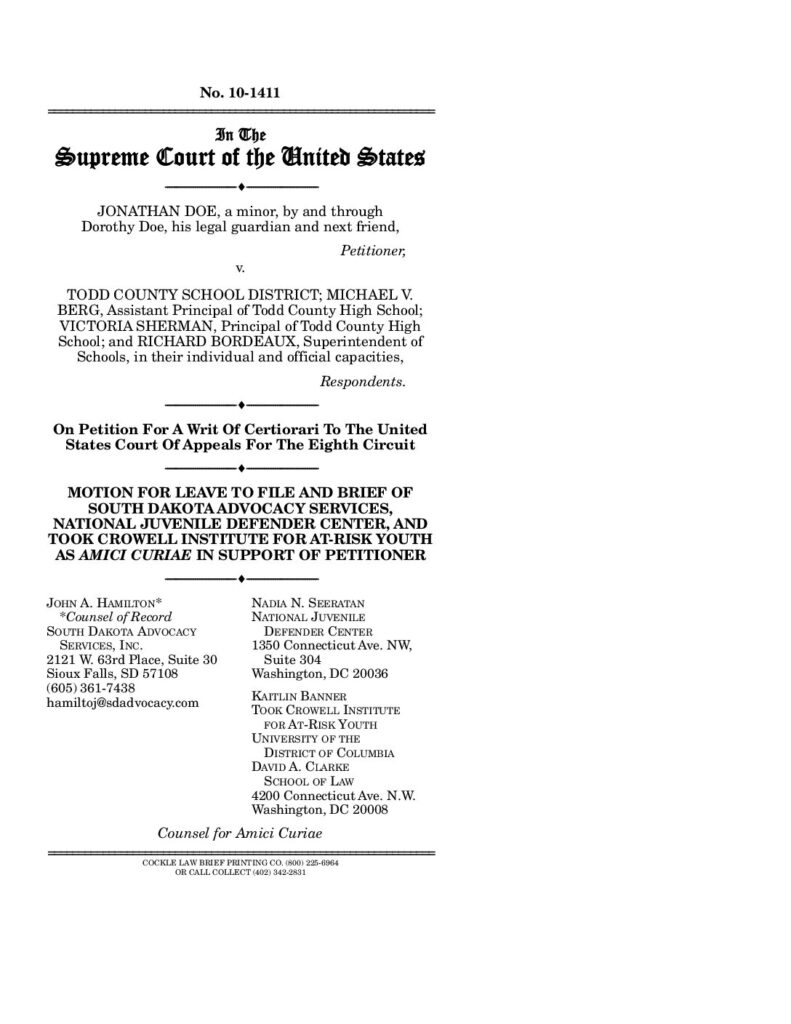
This amicus brief by South Dakota Advocacy Services, The Gault Center, and others argues the 8th Circuit’s interpretation of IDEA’s procedural safeguards are unconstutional under the 14th Amendment Due Process Clause and violate the plain language of the statute. The brief also outlines procedural protections from school exclusion for students with disabilities. As stated in…

On March 29, 2010, the Memorandum of Agreement (MOA) between Los Angeles County and the United States regarding the Los Angeles County Probation Camps was amended. The amended MOA includes language outlining that “The Monitor shall ensure that the subset of the Monitoring Team that participates in these visits has the requisite experience and expertise…

On January 29, 2010, the Department of Justice issued a findings letter regarding an investigation of the Indianapolis Juvenile Correctional Facility (ICJF) pursuant to the Civil Rights of Institutionalized Persons Act, 42 U.S.C. § 1997 (CIPRA), and the pattern or practice provision of the Violent Crime Control and Law Enforcement Act of 1994, U.S.C. §14141…

On November 23, 2009, the DOJ and the Ohio Department of Youth Services entered into an amended consent decree to address the remaining conditions of confinement in the Scioto Juvenile Correctional Facility, following the closure of the Marion Juvenile Correctional Facility. Related Actions: [Ohio] Marion Juvenile Correctional Facility: Investigation [Ohio] DOJ Complaint in U.S. v.…

On August 14, 2009, the DOJ released its investigation of four juvenile facilities in New York, finding that conditions violate federal and constitutional rights of youth. Specifically, the investigation highlights the facilities’ use of excessive force and inappropriate restraints and its failure to provide adequate mental health care and treatment for youth, in violation of…

This amicus brief prepared by The Gault Center and Juvenile Law Center argues that Louisiana must grant jury trials in juvenile court given the persistent deficiencies in Louisiana’s juvenile legal system including the punitive nature of consequences youth face and the dire and harmful conditions of the state’s jails. Furthermore, amici argue there is a…

On October 31, 2008, the Department of Justice released their findings report after an investigation into the Los Angeles County Probation Camps (“the Camps”). The DOJ found that “[y]outh residing in Los Angeles County’s Camps are not adequately protected from harm . . . and the County fails to provide adequate suicide prevention and mental…


On May 16, 2008, the DOJ filed a complaint against the State of Ohio in the Southern District of Ohio Eastern Division for engaging in a pattern or practice of constitutional violations in juvenile facilities. Specifically, the complaint alleges that the state has engaged in a pattern or practice of violating young people’s right to…
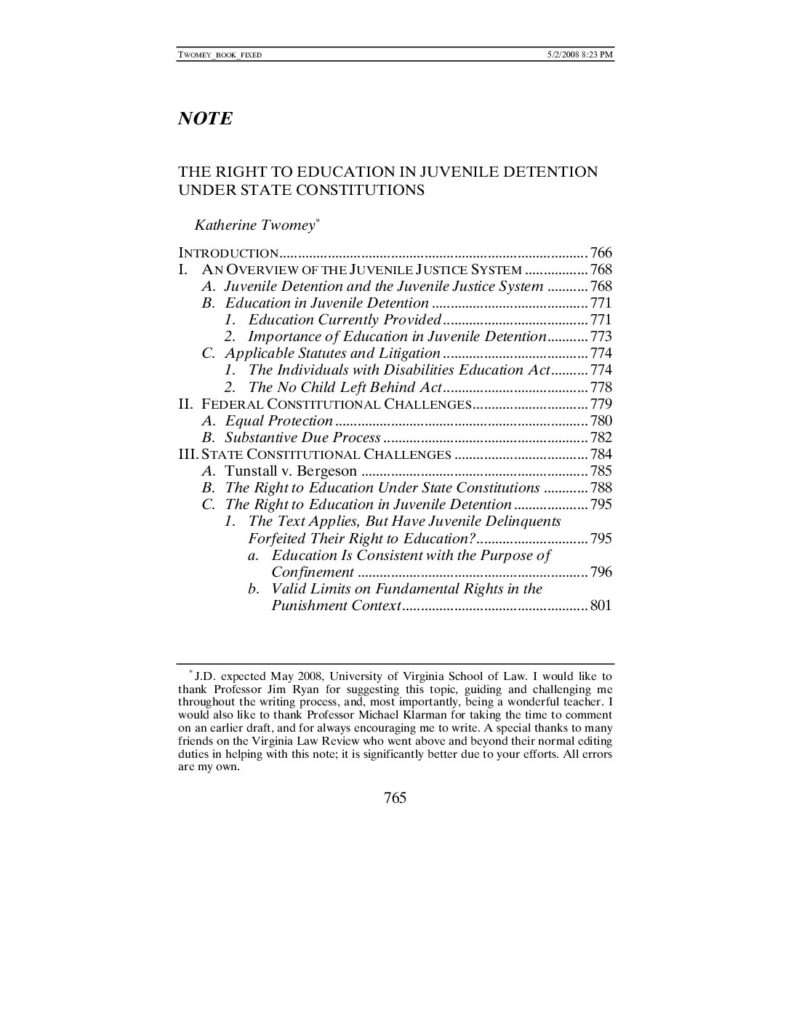
From the introduction: “This Note will argue that children in juvenile detention have a right to an adequate education based on state constitutional guarantees of education. This right can be used to challenge the inadequacy of the current educational services provided in juvenile detention facilities. The argument will proceed in three parts. Part I will…

This amicus brief by The Gault Center and others argues Nevada’s certification statute violates a child’s right to effective assistance of counsel as it interferes with counsel’s ability to plan and participate in the adversarial fact-finding process and it fails to measure up to essentials of due process and fair treatment. Furthermore, amici argue this…

This amicus brief by Southern Poverty Law Center, The Gault Center, and others argues Sherri Jefferson, a youth defense attorney in Georgia, must have her contempt conviction overturned after she professionally and zealously advocated on behalf of her young client in an adjudication in juvenile court. Amici argue the Supreme Court clearly held that children…
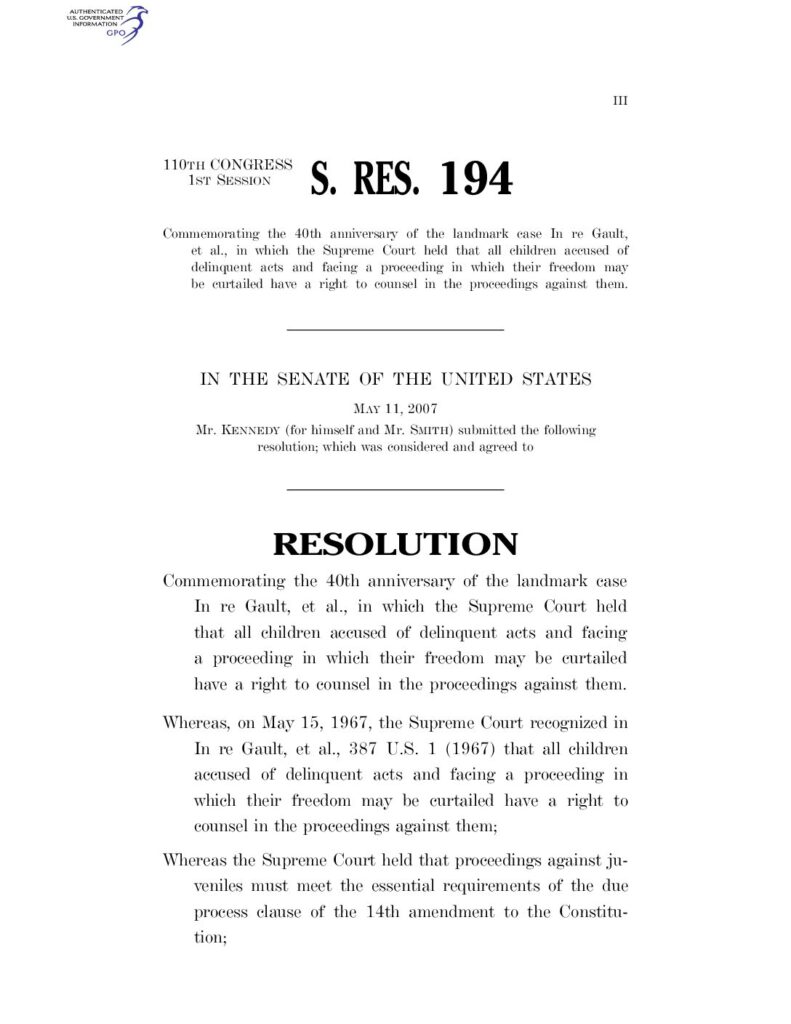
On May 11, 2007, the Senate passed a resolution commemorating the 40th anniversary of the In re Gault decision, which upheld the right to counsel for children in juvenile court. The resolution reiterates the Supreme Court’s holding that juvenile court proceedings must “meet the essential requirements of the due process clause of the 14th Amendment to the…

On May 9, 2007, the DOJ released its investigation of the Scioto Juvenile Correctional Facility, finding that the conditions violate federal and constitutional rights of youth. Specifically, the investigation highlights violations of young people’s right to reasonable safety, right to adequate mental health care, and right to special education services. Related actions: [Ohio] Marion Juvenile…

On May 9, 2007, the DOJ released its investigation of the Marion County, Ohio Juvenile Correctional Facility, finding that the conditions violate federal and constitutional rights of youth. Specifically, the investigation highlights violations of young people’s right to reasonable safety, right to adequate mental health care, and right to special education services. Related actions: [Ohio]…

This research paper from the Journal of Interpretation looks at the intersection of a subset of deaf people, who are classified as semilingual (meaning they are functionally illiterate (reading level grade 2.9 or below) and lack proficient English or sign language skills.), and their involvement in the legal system. The research paper examines eleven frequently…
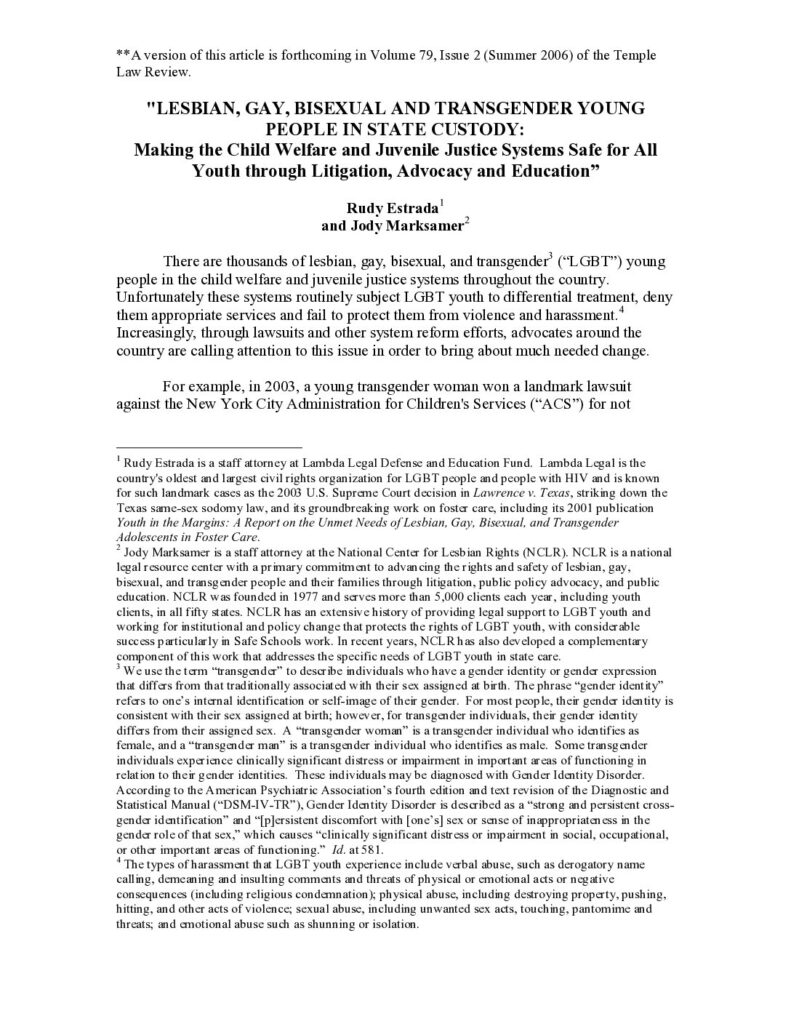
From the Conclusion: “For too long, LGBT young people in the child welfare and juvenile justice systems have been overlooked, ignored and mistreated. Because of the hard work of hundreds of advocates who have come together through coordinated national efforts, a cultural shift has begun. These advocates are creating effective nondiscrimination policies, best practices guidelines,…


