
Culpability
The Illinois 1st District Court of Appeals granted an individual to proceed on a postconviction hearing to challenge his life sentence based on the state’s proportionate penalties clause. The court held that the individual who 18 at the time of the offense was entitled to present mitigating evidence about his age and youthfulness. The court…
This infographic series on advancing best practices in youth justice from the RFK Community Alliance’s National Resource Center for the Transformation of Youth Justice provides accessible research on core practices driving change in youth justice and includes research on adolescent development and emerging adulthood, positive youth development and growth-focused case management, the negative effects of…
The D.C. Court of Appeals held that age and youthfulness should be considered as mitigating evidence in sentencing reconsiderations pursuant to D.C.’s Incarceration Reduction Amendment Act. The court stated in relevant part: As our prior decisions have made clear, the “[District of Columbia] Council initially passed the IRAA in response to several ‘constitutional imperatives’ declared…
“In New York State, children as young as thirteen can be processed as adults and sentenced to mandatory minimum sentences. Mandatory minimum sentences require judges to sentence the defendant to a statutorily set minimum term of imprisonment. Practitioners, judges, and researchers question the efficacy of mandatory minimum sentences, finding that they are ineffective at deterring…
The Kansas Court of Appeals held that a youth may not be prosecuted as an adult if they were under the age of 13 at the time of the offense based on the court’s statutory interpretation of K.S.A. 38-2347. The court stated in relevant part: “From this review, we do not find that the Legislature…
The Supreme Court of Pennsylvania ended the use of mandatory life without parole for felony murder cases based on the state constitution’s prohibition against cruel punishment. Finding that Pennsylvania’s constitutional safeguards against cruel punishment offers greater protections than the 8th Amendment of the U.S. Constitution, the Court reasoned that the blanket imposition of mandatory life…
The Oregon Court of Appeals held that a trial court must consider mental health attributes at sentencing pursuant to the Eighth Amendment and the Oregon state constitution’s prohibition against cruel and unusual punishment. The court stated in relevant part: “We agree with defendant that ORS 131.295 and ORS 131.300 provide that objective societal standard. Through…

The California Supreme Court found that a small amount of loose marijuana scattered on the rear floor of a car does not violate a state statute prohibiting driving while under the impairment of marijuana. The court further held that these circumstances did not create probable cause to conduct a search of the vehicle. The court…

The Illinois appellate court reversed the trial court’s sentence of 14 years for an aggravated driving under the influence and reckless homicide conviction based on defense counsel’s failure to produce evidence related to youth-based factors in mitigation. The court offered the following language in support. “Because defendant was a minor when the crash occurred, the…

From the abstract: “Hundreds of thousands of children are brought under the jurisdiction of delinquency courts every year in the United States. Despite the reality that most children engage in delinquent behavior during their adolescence, poor children, children of color, children with disabilities, and children who identify as LGBTQIA+ comprise a disproportionate number of those who become delinquency system-involved. These disparities exist…

From the Abstract: In Maine, there is no such thing as a child too young to be prosecuted. Maine’s Juvenile Code grants the juvenile court jurisdiction over a child of any age, even one who would have been considered too young to prosecute in the fifteenth century. As of 2024, just over half of states…

In this amicus brief (and a companion brief filed in Michigan v. Andrew Czarnecki), Fair and Just Prosecution urges the Michigan Supreme Court to extend 19- and 20-year olds its finding that life without parole sentences for young people violate state and federal constitutional protections against cruel and unusual punishment.
This amicus brief by forty developmental science scholars and nonprofits argues transformative growth during ages 18-20 makes mandatory LWOP for individuals in that age range a disproportionate sentence in violation of Article 1, Section 16 of the Michigan constitution. From the Summary of the Argument: “People v Parks held that Article 1, Section 16…
This amicus brief from American Academy of Pediatric Neuropsychology, the American Civil Liberties Union of New Jersey, the Gault Center, and others argues there is no reasonable, scientific basis for drawing the line for adolescence at age 18, and therefore protections from Comer (including reconsideration of lengthy sentences for homicide offenses committed by individuals under 18) should extend to young people who were 18 to 20 years old. Additionally, the brief…
This amicus brief from the Center for Law, Brain, and Behavior highlights the adolescent capacity for significant growth and social maturation as well as criminological evidence on the unlikelihood of reoffending and responsiveness to evidence-based treatment among youth accused of sex offenses. The brief ultimately calls for the court to find that a de facto life without parole sentence is grossly disproportionate based on developmental science and research. From the Summary of Argument: “Evan McCarrick Jerald is…

Abstract: “While there has been momentum at both the federal and state levels to curtail extreme punishments for justice-involved juveniles (The Campaign for the Fair Sentencing of Youth, 2023), 22 states continue to permit the sentence of juvenile life without parole (JLWOP). Pennsylvania is among them. This essay focuses on judicial rationale in five JLWOP re-sentencing cases in…

This paper is part of the Series on Learning from Civil Rights Lawsuits from the Civil Rights Litigation Clearinghouse and focuses on parole review procedures for individuals serving long sentences for crimes committed under age 18, discusses constitutional dimensions of parole review for this group, and proposes model policies supporting a meaningful opportunities for release. From the Executive Summary: “In recent years, people serving…

The Antiracism and Community Lawyering Practicum at Boston University School of Law, Fred T. Korematsu Center for Law and Equality, and the NAACP Legal Defense and Educational Fund submitted a brief in support of the appellant, Derek Lee, in a case before the Supreme Court of Pennsylvania regarding the use of mandatory life without parole…
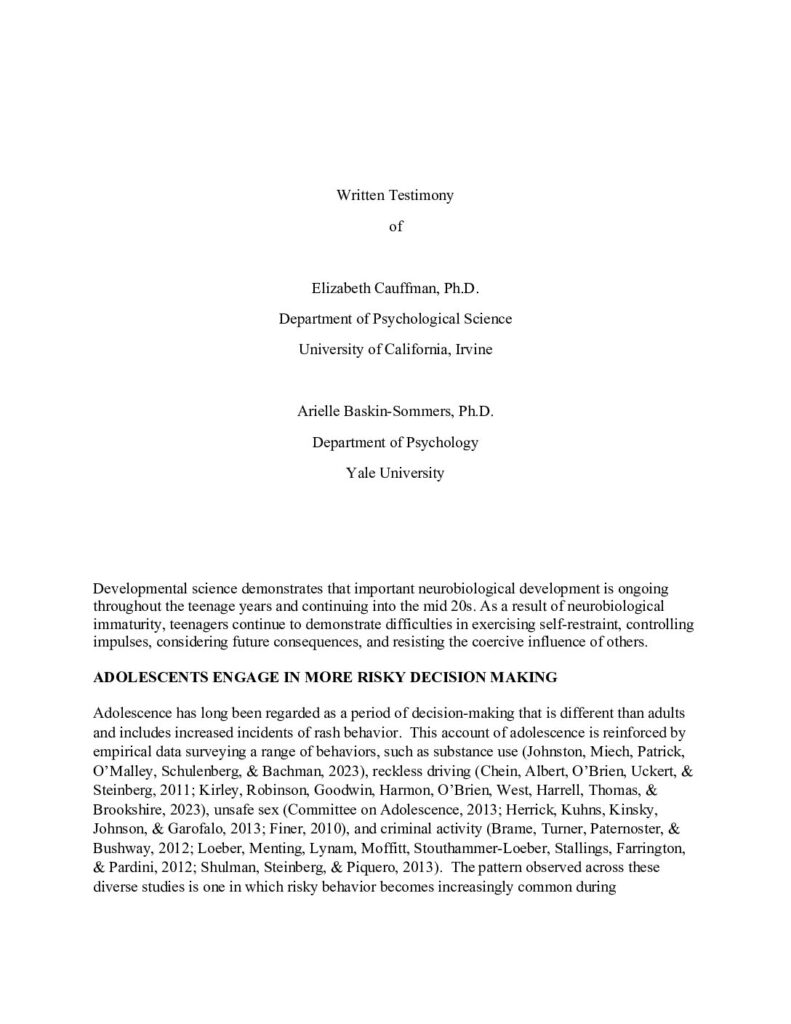
This written testimony from Elizabeth Cauffman, Ph.D. and Arielle Baskin-Sommers, Ph.D. discusses what developmental science says about the impact of brain development on adolescent risk taking, decision making, and susceptibility to social and peer influence as it relates to a young person’s culpability. The testimony also provides information on diversion and its impact on lower recidivism and improved public safety. Below is an excerpt from…

This amicus brief by American Civil Liberties Union and others argues that denying an opportunity for parole for young adults between the ages of 18 and 25 raises an equal protection violation given the racially disproportionate impact of life without parole sentences on young adults, resulting from “tough on crime” politics based in racial bias. From the Introduction: “In analyzing Petitioner Hardin’s equal protection…

This amicus brief by the Santa Clara County Independent Defense Counsel Office argues the decision in People v. Hardin should be affirmed because historical legacies of racism disparately expose some adolescents to the legal system and this does not justify lifelong punishment without considering rehabilitation. From Introduction & Summary of Argument: “Youthful offender parole is authorized by age at the…
From the Introduction: “This Article will focus on the difficulties ex-juvenile offenders face when seeking expungement of their juvenile records to prevent collateral consequences. Specifically, I will argue that a person under the age of eighteen should not be subject to the same statutory expungement bar as adults when seeking an expungement in New Jersey.…
This amicus brief by the Massachusetts Committee for Public Counsel Services argues the remedy of considering parole after fifteen years can be extended to late adolescents from 18-20 years old with life without parole sentences while still protecting public safety. Additionally, the brief argues judicial findings regarding the capacity of late adolescents to change are…
This amicus brief from former Massachusetts judges, the Boston Bar Association, and the Massachusetts Bar Association argues life without parole sentences violate the Commonwealth’s prohibition on cruel and unusual punishment for late adolescents between 18-20 years old for the same reasons they did for youth under 18 years old (as articulated in Diatchenko). Additionally, the brief argues late adolescents have a great propensity…
