
Purpose Clause
From the Introduction: “This Article will focus on the difficulties ex-juvenile offenders face when seeking expungement of their juvenile records to prevent collateral consequences. Specifically, I will argue that a person under the age of eighteen should not be subject to the same statutory expungement bar as adults when seeking an expungement in New Jersey.…
The Maryland Supreme Court held the Circuit Court did not properly consider Petitioner Howard Davis’ amenability to treatment in any institution, facility, or available programs under Md. Code Ann., Crim. Proc. § 4-202.2(b) and remanded the case, ordering the trial court to apply the principles and conclusions regarding amenability to treatment to Howard Davis’ Case. The court offered the following language in support: “To determine amenability to treatment, the court…

The Ohio Appellate Court vacated a youth’s convictions and transfer order and offered the following language in support. “Because the juvenile court (1) did not identify all of the factors it considered, i.e., the “other information factors” referenced at the amenability hearing, (2) did not identify or discuss the factual or evidentiary basis for its…


This article from the American Criminal Law Review “argues that our judicial system and legislatures, when crafting juvenile justice law, policy, and practice, cannot stop with merely incorporating the research behind the impact of normal adolescent development on the decisionmaking abilities of youth; they must also incorporate the research behind how the experience of trauma…

This expert affidavit from Dr. Louis Kraus, a child psychiatrist, and chief of child and adolescent psychiatry at Rush University Medical Center, describes the traumatic impacts of indiscriminate shackling on young people in the juvenile legal system. The affidavit highlights how shackling interferes with the purported goals of the juvenile legal system and with a…

From the introduction: ” Recent Supreme Court cases have recognized the science underlying the common-sense notion that children are not “little adults.” Their brains function in a completely different manner than those of adults. In 2005, the Court abolished the juvenile death penalty and recognized the neuroscience underlying the claim that those under the age…

The Iowa Supreme Court struck down mandatory minimum sentencing schemes as applied to a young person transferred to adult court, finding mandatory minimum sentences to be in violation of federal and state prohibitions against cruel and unusual punishment and the best interest clause in Iowa’s juvenile code. The court notes “the statutory recognition of the…
This amici brief by Juvenile Law Center, Rutgers Legal Clinic, The Gault Center, and others argues trial courts retain jurisdiction post-disposition to modify or change dispositional orders that are contrary to the purpose of the juvenile code. Further, the brief argues trial courts must provide oversight to ensure the safety of young people in abusive…

This amicus brief by Juvenile Law Center and The Gault Center argues Illinois automatic transfer law does not comply with recent research and findings on adolescent development as recognized by the Supreme Court jurisprudence in Roper and Graham. Further, amici argue the state’s automatic transfer statute violates the proportionality clause of Article I, Section 11…

This amicus brief by The Gault Center, Children’s Law Center, Inc., and the American Civil Liberties Union of Ohio Foundation, Inc. argues mandating young people to register on sex offender registries is improper since youth adjudicated of sex offenses are vastly different from adults convicted of sex offenses, registries frustrate the purpose of juvenile court,…

This amicus brief prepared by The Gault Center and Juvenile Law Center argues that Louisiana must grant jury trials in juvenile court given the persistent deficiencies in Louisiana’s juvenile legal system including the punitive nature of consequences youth face and the dire and harmful conditions of the state’s jails. Furthermore, amici argue there is a…

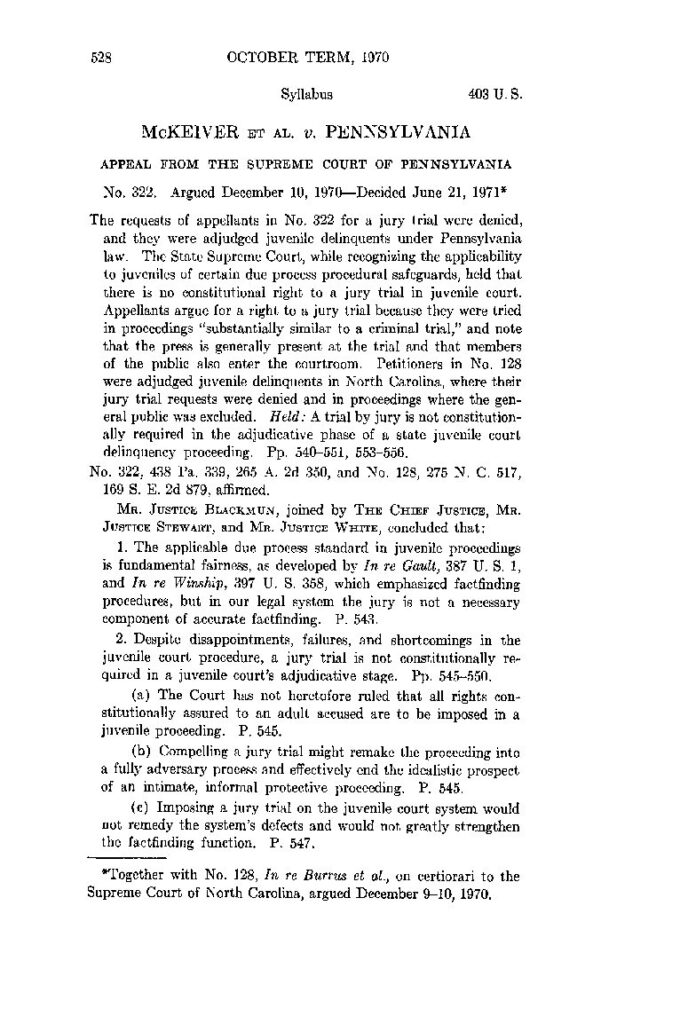
The U.S. Supreme Court ruled the Due Process Clause of the Fourteenth Amendment did not assure the right to a jury trial for youth in juvenile court. Here is excerpted language from the decision: “The juvenile concept held high promise. We are reluctant to say that, despite disappointments of grave dimensions, it still does not…
- « Previous
- 1
- 2
