
Purpose Clause

The Oregon Court of Appeals vacated and remanded a judgment placing a youth in state custody because of the trial court’s failure to provide adequate written findings as required by state statute. The court stated in relevant part: Finally, the findings taken together are too conclusory to satisfy ORS 9C.478(1). See State v. D. J. P., 342 Ore.…

In this sample motion to release due to educational deprivation from Louisiana, defense counsel argues for release of their client from detention or secure placement in the juvenile facility due to violation of their educational rights under both state and federal law. This resource is a template with space for defenders to put their individual…
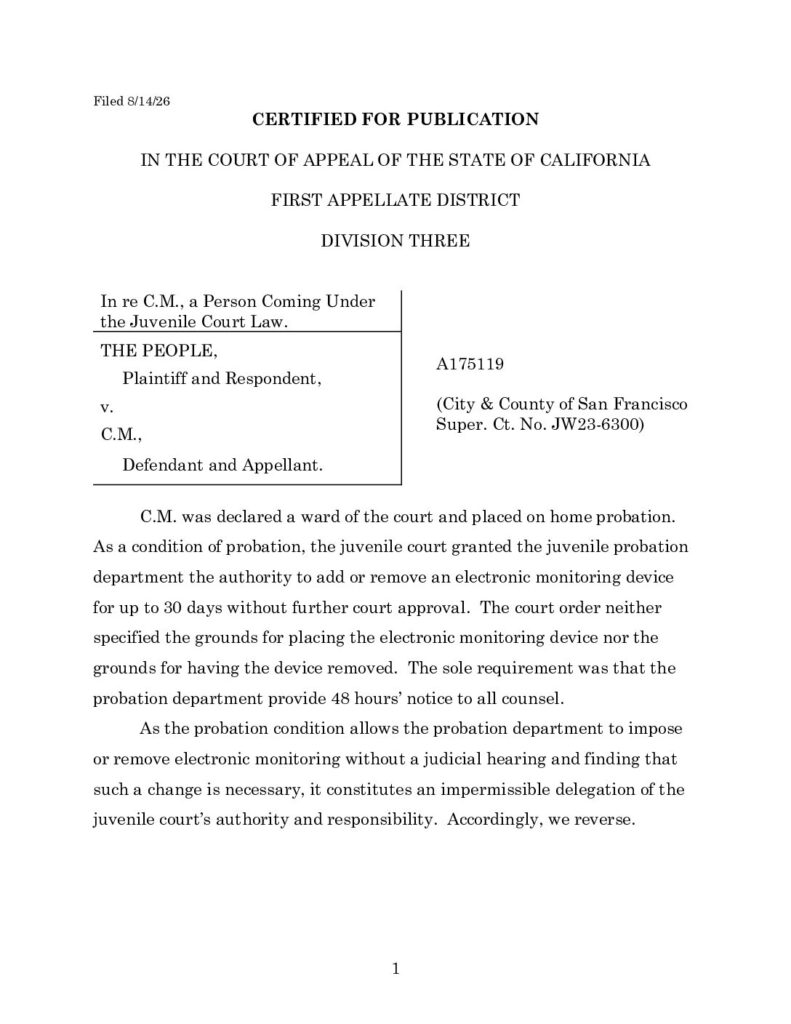
The California 1st District Court of Appeal reversed a probation condition authorizing the probation department to add or remove electronic monitoring without court approval, holding that it is “an impermissible delegation of the juvenile court’s authority and responsibility.” The court stated in relevant part: The “general rule [is] that a court may dictate the basic…
The Gault Center and Juvenile Law Center filed an amicus brief in the Second Circuit Court of Appeals involving New York Police Department’s collection and storage of DNA. From the summary of argument: Amici write in support of Appellant to address the particularly harmful impact that Appellees’ DNA collection and storage practices have on children,…
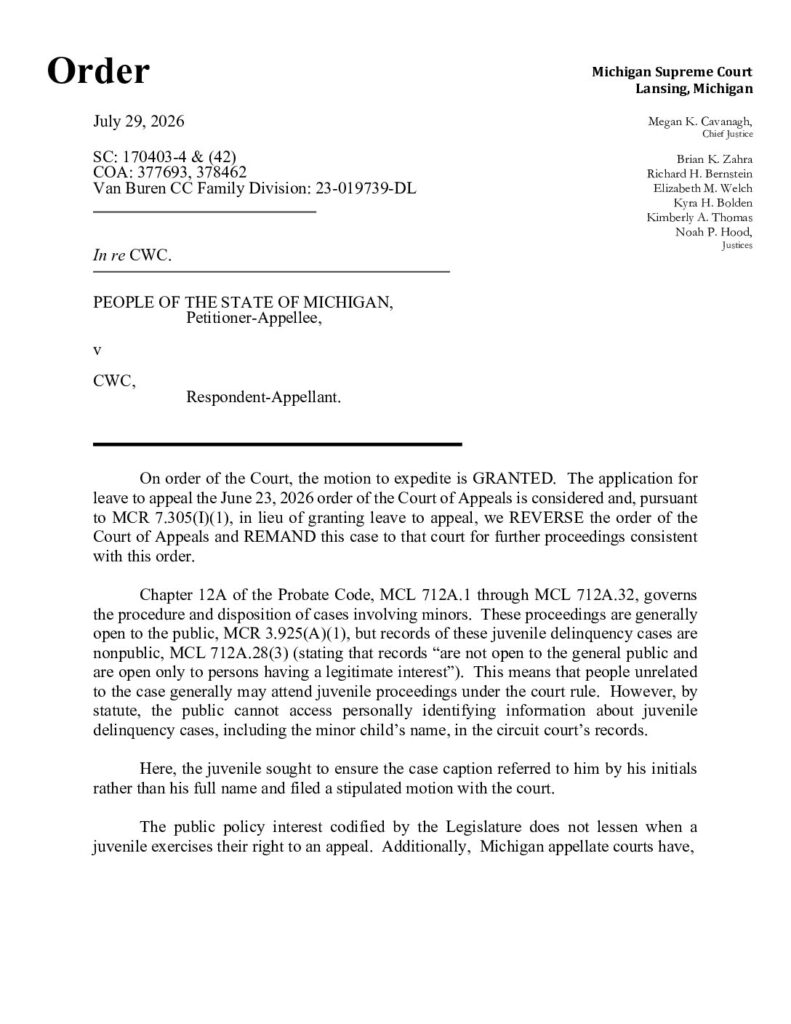
The Michigan Supreme Court granted a motion to ensure that case captions referred to a youth by their initials, as opposed to their full name, in line with statutory privacy interests for youth in the state. The court stated in relevant part: Chapter 12A of the Probate Code, MCL 712A.1 through MCL 712A.32, governs the…

A concurring statement in a Pennsylvania Supreme Court case highlights the need for expedited appeals related to transfer determinations. From the concurring statement by Justice Wecht: This problem reveals a challenging conflict of interests. There is nothing improper in the Commonwealth’s exercise of its right to appeal an adverse decertification order, and it should not…
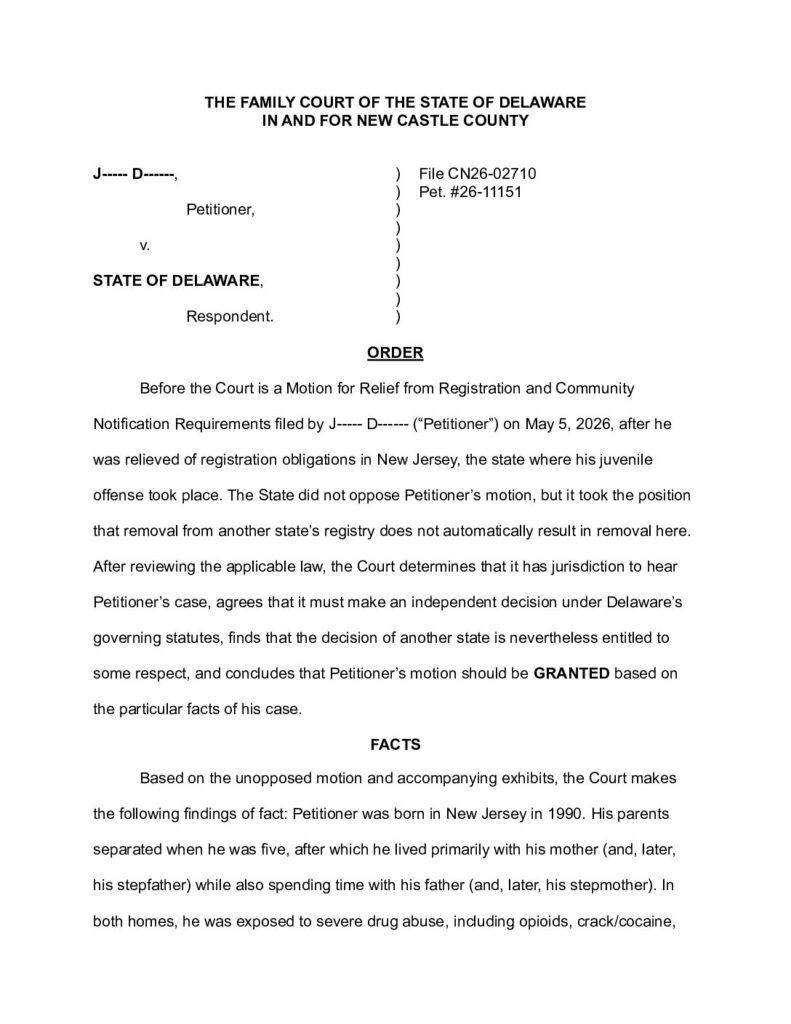
The Delaware Family Court granted a motion for relief from sex offender registration requirements in Delaware in a case involving an individual who was adjudicated of a sex offense as a youth in New Jersey and now works full-time in Delaware. The court stated in relevant part: First, under the Privileges and Immunities Clause of Article…
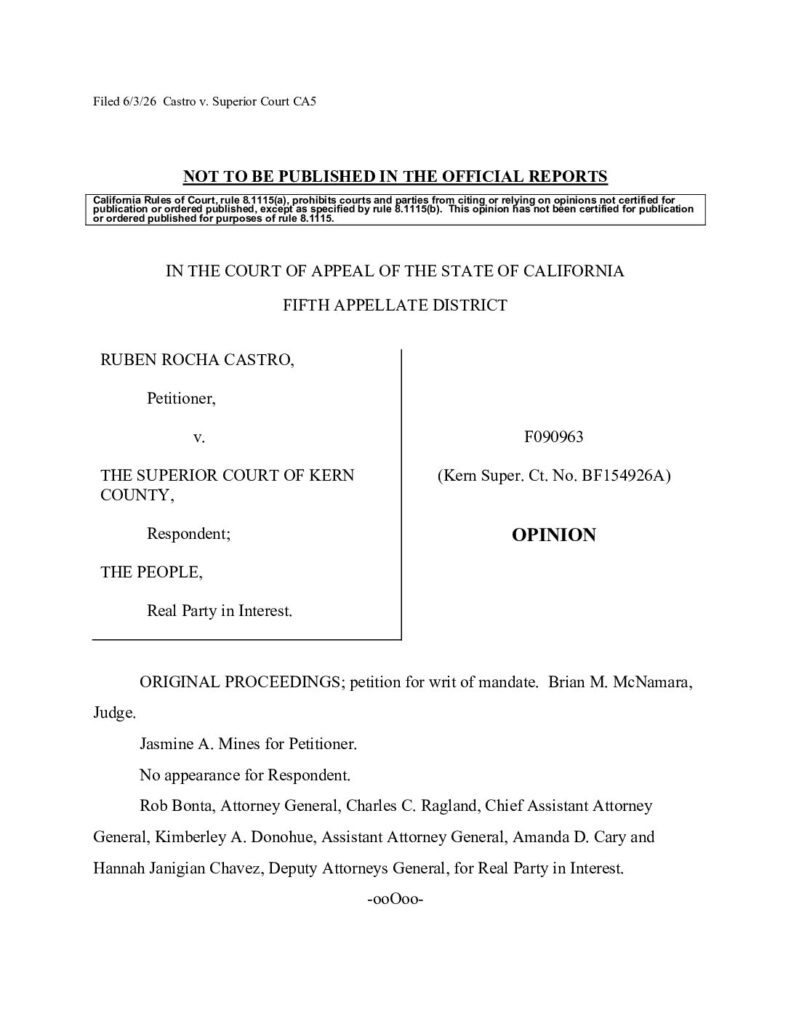
The California 5th District Court of Appeal held that the defense was entitled to discovery related to racial disparities in plea deals to voluntary manslaughter, finding that defense’s statistical evidence showing that Latine individuals in Kern County were more likely to be charged with murder and receive longer sentences than white individuals satisfied the “plausible…

From the Sentencing Project: “Despite their many flaws, juvenile courts are better for youth who break the law than are adult courts. Contrary to critics’ beliefs, juvenile courts regularly address serious and violent crimes. Juvenile courts do not offer a “slap on the wrist;” they often issue harsh punishments. The frequent alternative, sending youth to…

“The modern American criminal justice system emerged not simply from Progressive-Era reform, but from the intertwined projects of eugenics, psychiatry, and legal modernism. Drawing upon archival, historical, and doctrinal sources, this Article reveals how early twentieth-century reformers—including judges, criminologists, and social scientists—recast criminal law as a mechanism for identifying and controlling hereditary “defect.” Under the…
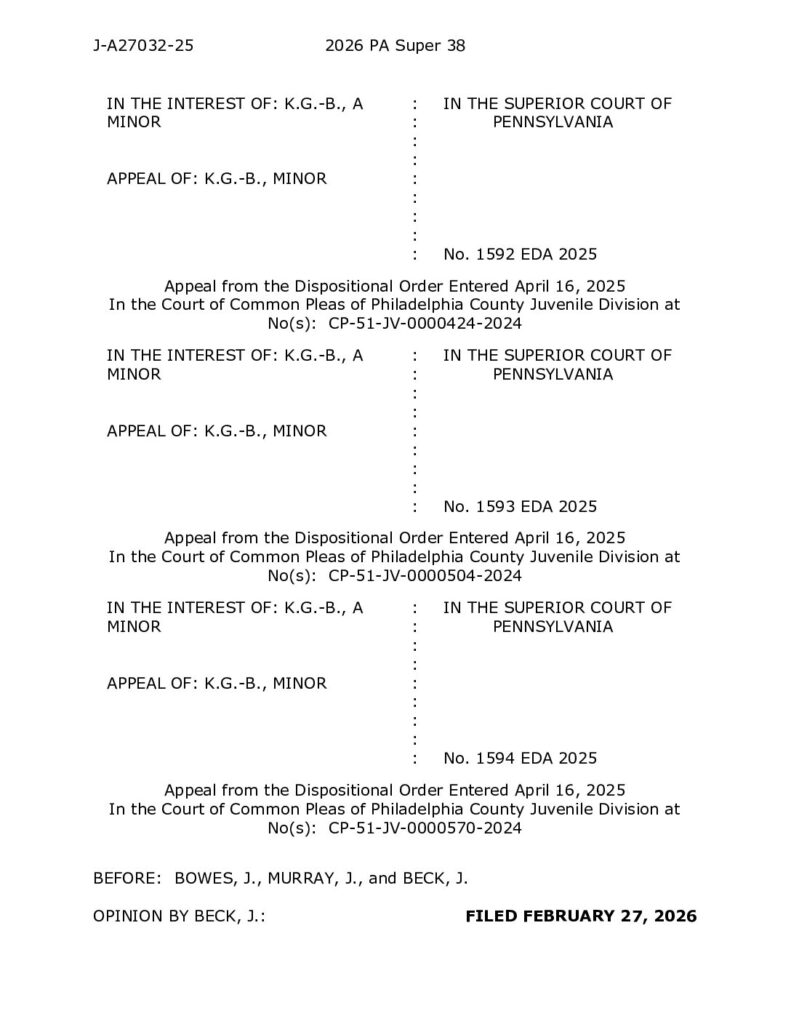
The Pennsylvania Superior Court reversed a young person’s probation revocation, finding that the state’s failure to provide defense counsel with notice and discovery violated the young person’s due process rights. The court stated in relevant part: We recognize that “[d]ue process is a flexible concept which ‘varies with the particular situation.’” Bundy v. Wetzel, 646 Pa.…
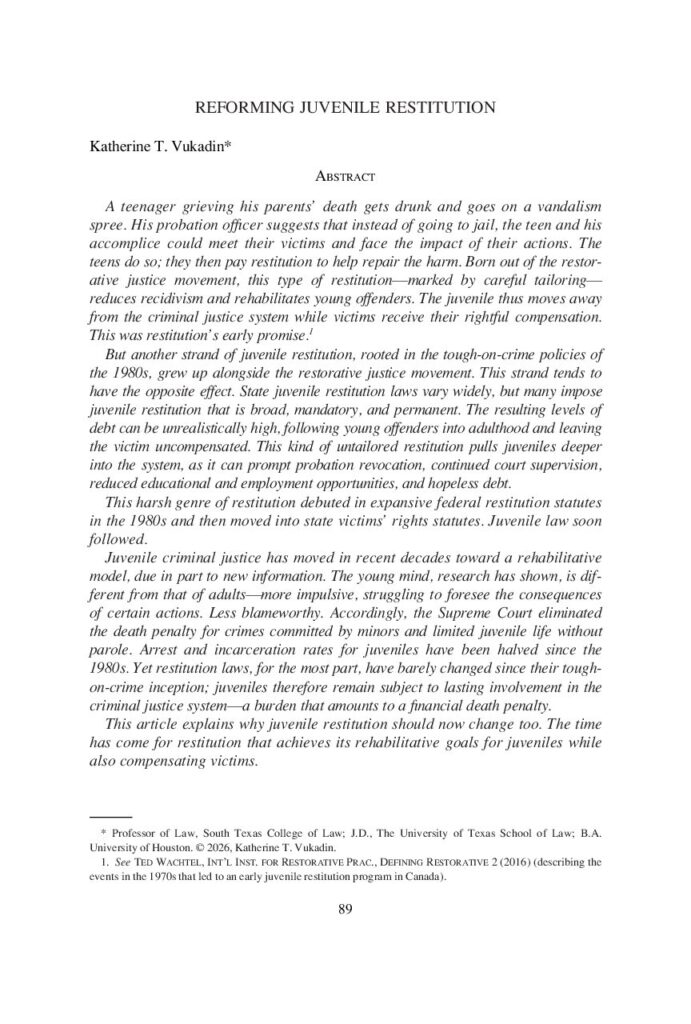
“Restitution laws, for the most part, have barely changed since their tough on-crime inception; juveniles therefore remain subject to lasting involvement in the criminal justice system—a burden that amounts to a financial death penalty. This article explains why juvenile restitution should now change too. The time has come for restitution that achieves its rehabilitative goals…
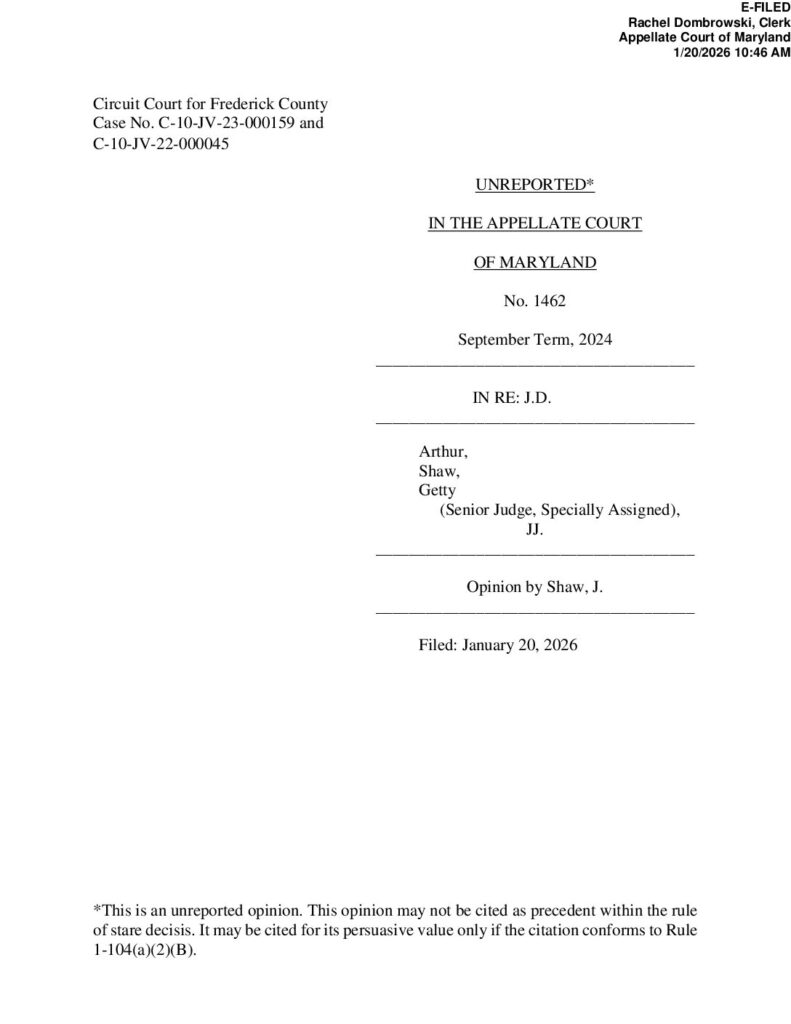
In re J.D., the Appellate Court of Maryland vacated the circuit court’s imposition of a suspended commitment to the Department of Juvenile Services because this dispositional option is not authorized by the Maryland Rules or the Juvenile Causes Act. The court offered the following language in support: “In our review of the Juvenile Causes Act, we found the statute to be clear and unambiguous. It plainly provides for three types of disposition: probation, commitment…
Abstract: “Records generated by youth legal systems—or “juvenile justice systems”—are increasingly being used against young people in immigration proceedings. This practice undermines the core purpose of these youth-focused systems and can have devastating, life-altering consequences, including the denial of immigration benefits or deportation. Juvenile justice systems in the United States are founded on the recognition…
This amicus brief from over 26 juvenile justice amici, including the Gault Center, , argues 1) the spirit and text of New York’s passage of landmark Raise the Age Law rejects the attitudes that underlay the Juvenile Offender Act of 1978, 2) New York’s Raise the Age Law and its legislative history demands a youth subject to adult prosecution only in “extremely rare and exceptional cases”, 3) before courts…

A California appellate court reversed a juvenile court’s disposition order committing a youth to a secure youth treatment facility and offered the following language in support. “Before committing a minor to a secure facility, the court must find no less restrict alternative disposition is suitable. In making this determination, “the court shall consider all relevant…


Professor Kris Henning and Rebba Omer authored a law review article on decriminalizing normal adolescent behaviors, race, and disabilities. This article maps a way forward for all system actors in the juvenile legal system to mitigate and buffer against the harms of juvenile legal system involvement for youth with disabilities. Specifically, this article outlines youth…

The Supreme Court of Montana reversed a trial court’s decision denying a sentence reduction for a young adult who was convicted of a homicide offense when he was 16 years old. Noting that transferring a youth to adult court cannot mean that the state “forget[s] about his age,” the Court relies on the juvenile court…

In State v. T.S., the Ohio Court of Appeals ruled the juvenile court abused its discretion when it transferred T.S.’s case to adult court pursuant to R.C. 2152.12(B) (Ohio’s discretionary transfer law). The court found the evidence presented in the transfer hearing, did not support a finding that T.S. was not amenable to rehabilitation within the juvenile system. The court offers the following language in support of its decision:: “Few,…

A sample disposition and mitigation memorandum filed in a juvenile court in Ohio.
