


From the abstract: “Roughly one in four juveniles arrested in the U.S. spend time in a detention center prior to their court date. To study the consequences of this practice for youth, we link the universe of individual public school records in Michigan to juvenile and adult criminal justice records. Using a combination of exact…

From the introduction: “One of our goals in producing this report is to inform school administrators, board members, and parent and student stakeholders, giving details about which groups of students are disproportionately arrested and about the gaps that exist in data reporting. We also want to provide guidance on how to address these issues. We…

On December 21, 2021, the DOJ released its investigation of the Connecticut Manson Youth Institution, finding that the conditions violate young people’s rights under the Eighth and Fourteenth Amendments and the Individuals with Disabilities Education Act. In its Investigation, the DOJ stated “specifically, we find that Manson’s isolation practices and inadequate mental health services seriously…


On May 26, 2021, the DOJ filed a Statement of Interest in a federal class action lawsuit on behalf students confined in the DC Jail during the Covid-19 pandemic, alleging violations of the Individuals with Disabilities Education Act (IDEA). The DOJ asserted that “[s]tudents with disabilities do not forfeit their right to special education and…


This article from Education Week examines the implications of the Pasco County sheriff’s office in Florida using school data and records from the Department of Children and Families to create a list of students that were “at-risk for a life of crime.” Data privacy experts shared with the media that the actions of the Sheriff’s…

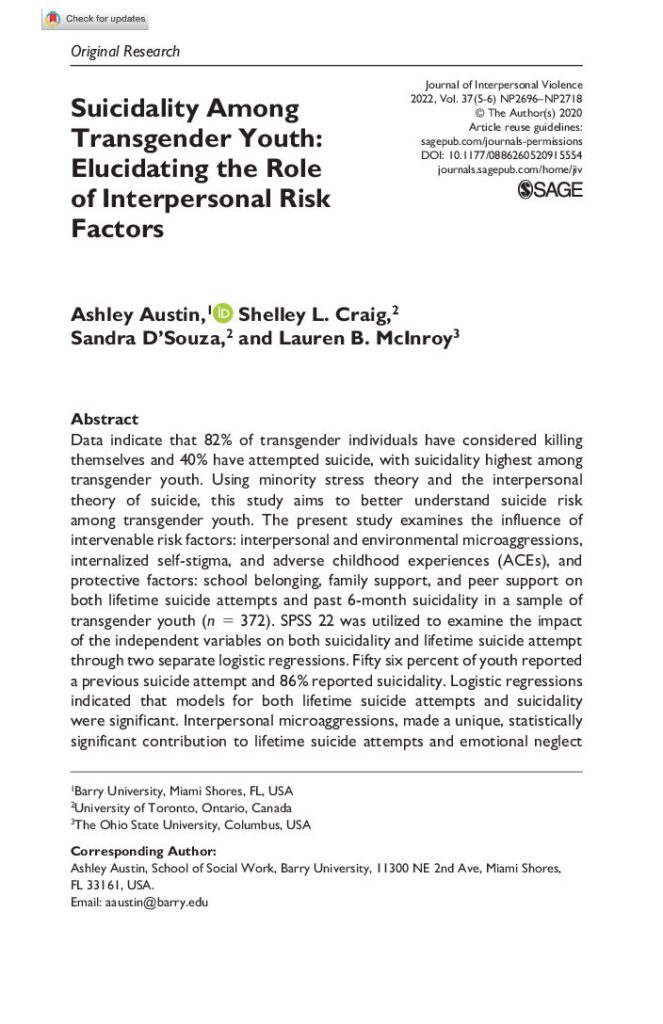
From the Abstract: Data indicate that 82% of transgender individuals have considered killing themselves and 40% have attempted suicide, with suicidality highest among transgender youth. Using minority stress theory and the interpersonal theory of suicide, this study aims to better understand suicide risk among transgender youth. The present study examines the influence of intervenable risk…

This Article explores how race functions to ascribe and criminalize disability. It posits that for White students in wealthy schools, disabilities or perceived disabilities are often viewed as medical conditions and treated with care and resources. For students of color, however, the construction of disability (if it exists) may be a criminalized condition that is…

From the executive summary: ‘This comprehensive study of 804 New York City public middle and high schools sought to isolate the independent impacts of suspension, as well as to disentangle the effects, if any, of student, school, and neighborhood characteristics. Conversely, the study also explored the relationship of restorative justice and other positive practices to…

On June 26, 2019, the DOJ closed its investigation of the Leflore County Juvenile Detention Center. In its closing letter, the DOJ stated “[w]e recognize that the state has made many improvements at the Detention Center School over the course of our involvement. . . . Specifically, the Detention Center School has made strides to…


On November 15, 2018, a joint settlement was reached to address the conditions of confinement in Florida’s Palm Beach County Jail. The settlement agreement outlines comprehensive changes in the facility, including giving young people time and access to appropriate recreational activities outside of their cells during school hours. The settlement also limits the amount of…

On October 1, 2018, the DOJ filed a Statement of Interest in a federal class action lawsuit on behalf of young people confined in Florida’s Palm Beach County Jail. The DOJ highlights the protections afforded to students with disabilities under the Individuals with Disabilities Education Act (IDEA), and the “independent and shared” responsibilities and obligations…


On June 21, 2018, a federal class action lawsuit was filed on behalf of young people confined in the Palm Beach County Jail, alleging violations of their 8th and 14th Amendment rights under the U.S. Constitution. The plaintiffs are youth whose cases have been direct-filed in adult court in Palm Beach County, Florida. The complaint…
The Indiana Supreme Court found that B.A. was in police custody and under police interrogation when he was taken to the Vice Principal’s office, interviewed and asked to write down information related to a bomb threat at school. The court stated in relevant part: “Ultimately, as the law-enforcement presence grows in today’s schools, so does…
The Ohio Court of Appeals Second District affirmed the juvenile court’s suppression of L.G.’s statements, finding that L.G. was in custody when he was questioned by Dayton Public Schools’ Executive Director of Safety and Security, requiring Miranda warnings. The court held in relevant part: “[T]he juvenile court reasonably concluded that, when viewing the totality of the…

On November 28, 2016, the DOJ filed a Statement of Interest in response to a lawsuit filed in South Carolina, challenging two state statutes as void for vagueness in violation of the Due Process Clause. The lawsuit alleged that the vague language in the statute resulted in the criminalization of common youthful behavior, racial disparities,…
