

The U.S. District Court for the District of New Jersey heard two Motions to Dismiss filed by the Plainfield Public School District, Board of Education, and others, stemming out of a lawsuit filed by fifteen-year-old I.A.’s parents after the detention, search, arrest and prosecution of I.A., by Plainfield school officials and Plainfield Police Officers. In…
The Colorado Supreme Court held that generative AI images using “deepfake technology” purportedly created by S.G.H., were not prohibited by the relevant statutory provisions in effect on the dates of the charged offenses, and therefore his case must be dismissed. The court ¶37 For three reasons, we infer from the statutory and legislative histories of…

The Center for Democracy & Technology released a report on the current status of AI use in schools and emerging risks. This report covers the interaction of AI with the classroom, students, IEPs, literacy, deepfakes, student activity monitoring, and student privacy. From the report: “Artificial intelligence (AI) has continued to alter the educational experiences of…
This school pushout assessment and campaign development guide is a companion tool to Dignity in Schools Campaign’s Model Code on Education and Dignity and Youth Participatory Action Research Project. This checklist tool provides a framework for individuals and groups working in schools to assess school policies and practices around discipline, safety, curriculum, logistics, staffing, and other processes to prevent young people from being pushed…


This memorandum from the Public Defender Service for the District of Columbia discusses the contemporary research and literature on electronic monitoring and its impacts on school attendance, family, and employment. The memorandum also discusses the real-world practicalities that make it difficult for youth to comply with the restrictive rules that often accompany electronic monitoring orders. From the memorandum: “The literature regarding the electronic monitoring of youth with disabilities has not yet been fully synthesized to…


From the conclusion” “Conclusion There is no question that the statistical picture of special education is bleak. But after its meeting of stakeholders, interviews with experts, and review of the research, NCD believes that IDEA and other related disability laws, with improved enforcement, can and should benefit at-risk students who are properly referred and served.…


The Annie E. Casey Foundation released its annual Kids Count Data Book, which offers a national analysis on four indicators of child wellbeing: economic wellbeing, education, health, and family and community. This report is part of the Kids Count Data Center, which provides demographic and wellbeing data on children and families. This report includes data…

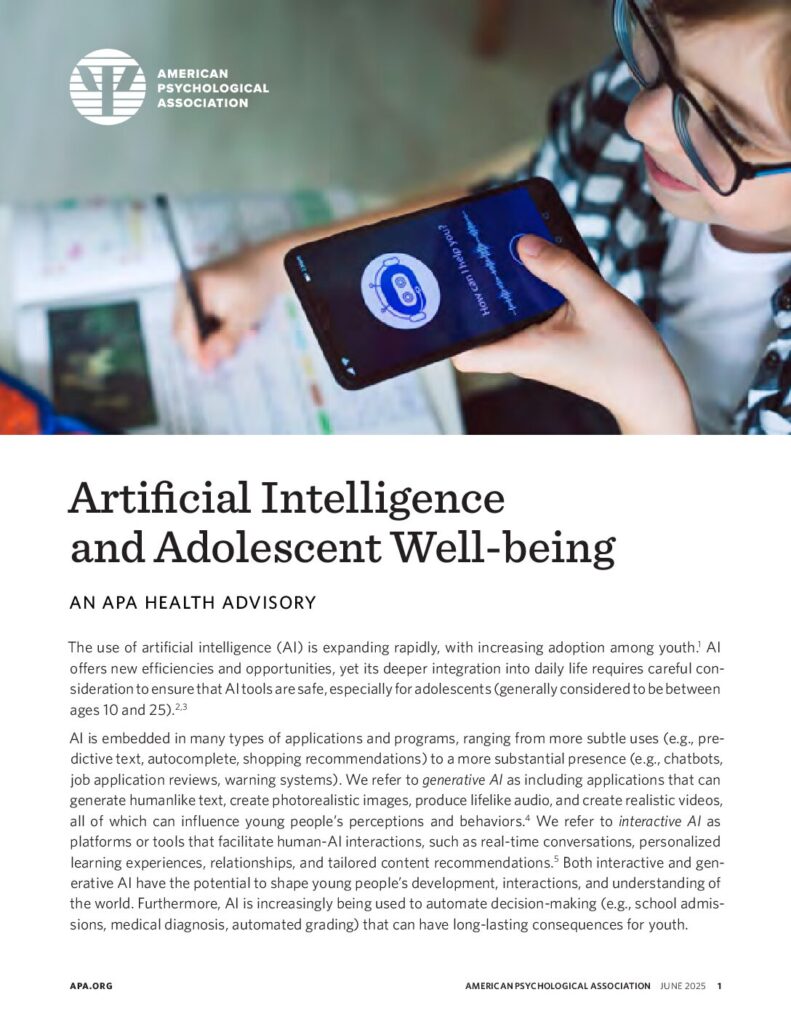
The American Psychological Association’s health advisory examines the growing use of AI among youth. While AI offers many benefits, its increasing role in children’s daily lives requires careful consideration. Because AI is embedded in many applications that shape perceptions and behaviors, it can have lasting impacts on children’s development. The advisory outlines these potential risks and offers recommendations to…

Professor Kris Henning and Rebba Omer authored a law review article on decriminalizing normal adolescent behaviors, race, and disabilities. This article maps a way forward for all system actors in the juvenile legal system to mitigate and buffer against the harms of juvenile legal system involvement for youth with disabilities. Specifically, this article outlines youth…
From the abstract: “The ever-expanding yet increasingly amorphous nature of criminal records is a driver of inequity in America. Criminal records are a significant barrier to community participation. They impact whether you can vote or serve on a jury, where you can live, and if you can work. And as criminal records become more easily…

This report, by the U.S. Department of Justice Civil Rights Division outlines key highlights of the Division’s work from 2021 to 2024 across policing, juvenile facilities, schools and beyond.

This research report by the NAACP Legal Defense Fund provides an in-depth overview of the “At-Risk Youth Program” created by the Pasco County Sheriff’s Office in Tampa Bay, Florida. The Pasco County sheriff’s office relied on a “rudimentary, person-based predictive policing system” based on inherently biased criteria to identify young people who were “destined to…


A sample disposition and mitigation memorandum filed in a juvenile court in Ohio.

The Center for Democracy & Technology (CDT) released a report on the impact of generative artificial intelligence (AI) on students in schools. CDT surveyed students, teachers, and parents to understand the prevalence of deepfakes and related issues in K-12 schools. The report offers an overview of non-consensual intimate imagery (NCII), the impact of current responses…
