
Waiver of Rights
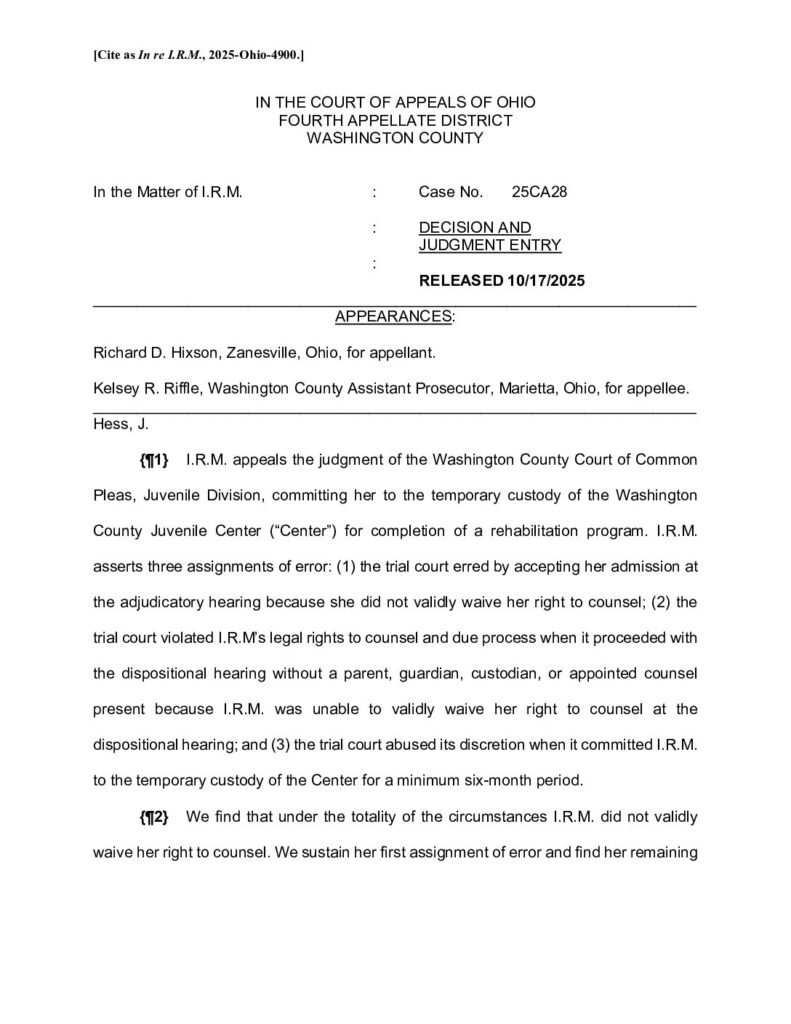
The Ohio Court of Appeals, Fourth Appellate District, held that the trial court erred in accepting I.R.M.’s plea because she did not validly waive her right to counsel, proceeded to disposition without a parent, guardian or custodian present, and abused its discretion by placing I.R.M. in a facility for six months. The court stated in…

The Oregon Court of Appeals held that a plea colloquy has to affirmatively demonstrate that a young person understands the “consequences of an admission, including the maximum disposition associated with it”. The court stated in relevant part: “For an admission by a youth to be valid, the youth must be aware, in a manner consistent…

This resource offers a brief overview of how children are transferred or bound over to adult court in Ohio and discusses what is at stake in the case of State v. D.T., 2024-Ohio-4482 (Ohio Ct. App. 2024) pending before the Ohio Supreme Court. The Gault Center filed an amicus in this case here. Oral arguments were…

The Supreme Court of Maine vacated a conviction, finding that custodial statements should have been suppressed because there was no waiver of the privilege against self-incrimination, and offered the following language in support. “McLain did not clearly waive his privilege against self-incrimination and instead answered that it “depend[ed] on the questions” when asked if he…


NJDC is proud to partner with the Players Coalition to eliminate barriers to that prevent young people from accessing their constitutional right to counsel.


New England Patriot Devin McCourty and Players Coalition team up with the National Juvenile Defender Center to raise awareness that far too many young people in juvenile court don’t ever get lawyers.

“What we know is that when access to justice depends on a child’s ability to pay for their own defense, the disparities of class, race, and ethnicity are magnified.”

Outlines steps that states must take to comply with the minimum requirements of the U.S. Constitution to protect the rights of youth facing deprivations of liberty.


The New York Supreme Court Appellate Division reversed the guilty plea and conviction of Mr. Thorne after the court denied his motion to suppress, finding that the arresting officers lacked requisite reasonable suspicion to stop him. The Court, citing several inconsistencies in the radio description of the assailant compared to Mr. Thorne, offered the following language in support: “The officers did not have reasonable…

Creates a case for holding states liable for abdicating their duty to ensure that all children have zealous representation.

The landmark case Miranda v. Arizona (1966), the United States Supreme Court required law enforcement agencies to advise all suspects of their “Miranda warnings,” or Constitutional protections, prior to interrogation. Previous research demonstrates that the Miranda warnings in the United States are largely unregulated and highlights how inadequate translations can impact comprehensibility. The present study…

The Ohio Appellate Court vacated a youth’s convictions and transfer order and offered the following language in support. “Because the juvenile court (1) did not identify all of the factors it considered, i.e., the “other information factors” referenced at the amenability hearing, (2) did not identify or discuss the factual or evidentiary basis for its…

“Not once does the judge or probation officer explain how expensive it’s going to be if you plead guilty without an attorney… The probation officer that said, ‘it’s really expensive to have a lawyer,’ neglected to say ‘it’s really expensive to have a probation officer.’” – NJDC’s Legal Director, Tim Curry on children waiving the…

Access Denied found that “[n]o jurisdiction in the United States wholly fulfills the constitutional promise of justice for children.” So, no matter where you live and practice, your jurisdiction can improve. As juvenile defense advocates, we have a responsibility to identify and work to correct systemic deficiencies and to honor our clients’ dignity and well-being.…
