
Adjudication
The Washington Appeals Division 2 reversed a conviction involving allegations of an 11-year-old child charged with attempted rape of a child, finding that the state failed to produce clear and convincing evidence that the child was capable of committing a criminal sexual act. The court stated in relevant part: “A child of at least 8…
The Alabama Criminal Appeals Court reversed an adjudication of making a terrorist threat in the second degree based on insufficient evidence. The court stated in relevant part: “The definition of “threaten” in § 13A-10-242(2) specifically refers to three people. Subsection a. refers to the person who “makes [the] statement.” Subsection b. refers to the person to…
The Nevada Supreme Court reversed an adjudication finding insufficient evidence for possession of a stolen vehicle. The court stated in relevant part: “Viewing the evidence in the light most favorable to the State, we conclude that the evidence presented at the adjudicatory hearing by the State was insufficient to demonstrate that A.W. had possession of…

The New Mexico Court of Appeals held that Malachi D. was reserved his right to appeal despite his plea, and the trial court erred in granting counsel’s request to dismiss the cause as the adjudication hearing was not heard in a timely manner. The court reasoned in part: “We believe that the judgment and disposition…
This resource from Citizens for Juvenile Justice offers practical guidance for immigrant youth and families interacting with the juvenile legal system. From the resource: “A young person learning that they are being summoned to appear in juvenile court can be stressful. This is especially the case when a young person is from an immigrant background,…

The Florida 6th District Court of Appeal reversed a youth’s adjudication of grand theft of a motor vehicle based on the State’s failure to prove ownership of the car involved. The Court stated in relevant part: “The delinquency petition charged J.N.S. with stealing Redenti’s “Nissan automobile.” But neither J.N.S.’s confession, witness testimony, nor other evidence established…

The Third District Court of Appeal in California vacated a felony murder conviction based on insufficient evidence to support the state’s required “reckless indifference” finding, which must also take into consideration youthfulness at the time of the incident. The court stated in relevant part: “Finally, defendant’s youth also cuts against a finding of reckless indifference. In Moore, supra,…
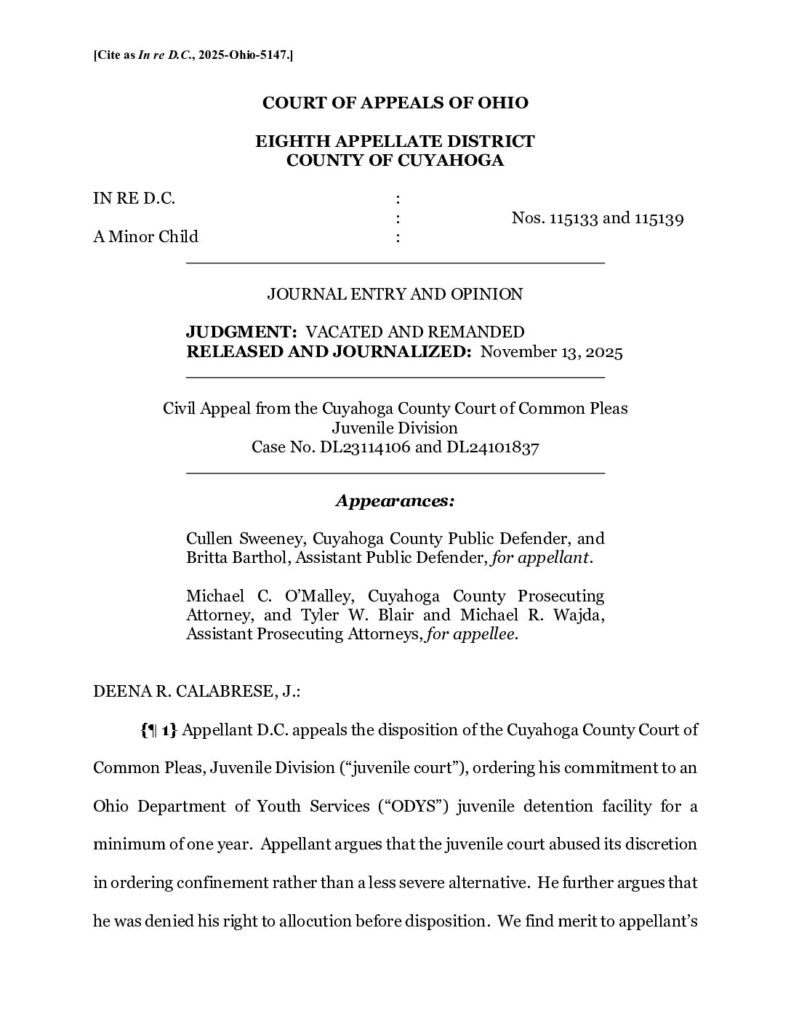
The Court of Appeals of Ohio, Eighth District, held that the trial court erred when it did not permit D.C. an opportunity to speak on his own behalf during the dispositional hearing, particularly when the trial court emphasized D.C.’s purported lack of remorse. The court stated in relevant part: “While appellant’s counsel spoke on his…

The Georgia Court of Appeals reversed a part of the adjudication and vacated the order of disposition based on insufficient evidence. The court stated in relevant part: “As to the second count of aggravated assault, K. R. argues that there was insufficient evidence to show that the nail clippers were an object that was likely…

This is a sample “youth report to the court” document (created by a Juvenile Court Judge in Iowa), for youth who are currently under the juvenile court jurisdiction. This report is provided to young people when they appear in court, asking if they would like the space to share pertinent information and ask questions of…

The Oregon Court of Appeals held that a plea colloquy has to affirmatively demonstrate that a young person understands the “consequences of an admission, including the maximum disposition associated with it”. The court stated in relevant part: “For an admission by a youth to be valid, the youth must be aware, in a manner consistent…
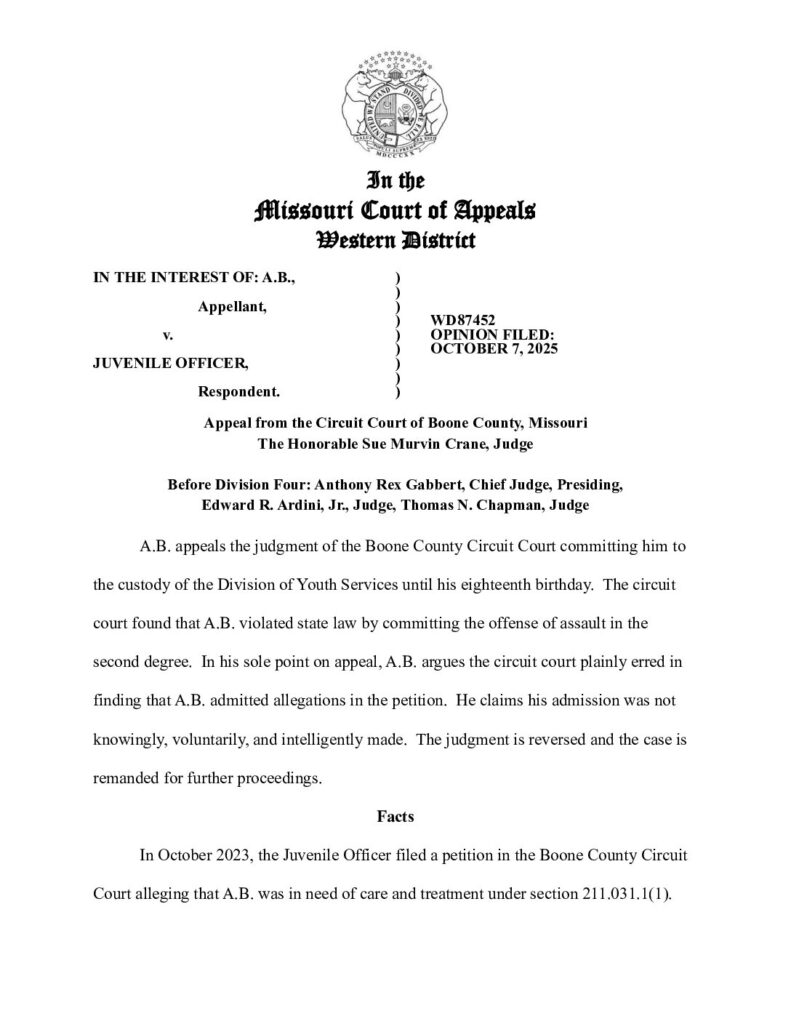
The Missouri Court of Appeals, Western District held that courts must ensure that a juvenile court admission is voluntarily, knowingly and intelligently made, and requires the court to establish a factual basis. The court stated in relevant part: ““A plea of guilty is constitutionally valid only to the extent it is ‘voluntary’ and ‘intelligent.’” Booker…
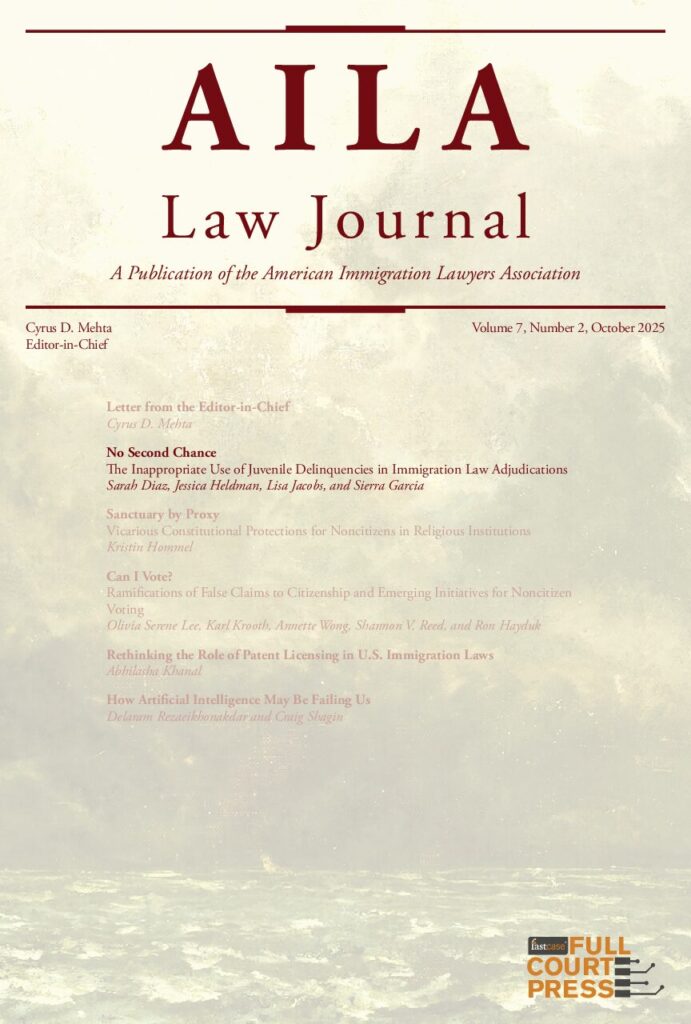
Abstract: “Records generated by youth legal systems—or “juvenile justice systems”—are increasingly being used against young people in immigration proceedings. This practice undermines the core purpose of these youth-focused systems and can have devastating, life-altering consequences, including the denial of immigration benefits or deportation. Juvenile justice systems in the United States are founded on the recognition…

The Court of Appeals in North Carolina vacated a judgment adjudicating L.K. delinquent for indecent liberties between minors and imposing a Level 1 disposition upon him, based upon the trial court’s failure to state a standard of proof. The court stated in relevant part: “In the case sub judice, our review of the transcripts and…

Walks through practical and concrete steps juvenile court judges can take to ensure safe and equitable access to courts for noncitizen and immigrant youth.

The Oregon Court of Appeals reversed the adjudication finding of the trial court, holding that there was insufficient evidence to support a finding that the youth intended to damage playground equipment. The Court of Appeals offered the following language in support: “There is an appreciable difference between intentional action—that is, acting with a conscious objective…

This report from National Institute for Criminal Justice Reform offers six principles of a positive youth justice system (‘PYJS’) including: 1) Minimize contact with the juvenile justice system, 2) partner with youth and families to develop and share ownership of case plans, 3) community-based organizations should take the lead, 4) build on youth assets and…
