
Conditions of Confinement

On November 15, 2018, a joint settlement was reached to address the conditions of confinement in Florida’s Palm Beach County Jail. The settlement agreement outlines comprehensive changes in the facility, including giving young people time and access to appropriate recreational activities outside of their cells during school hours. The settlement also limits the amount of…

On October 1, 2018, the DOJ filed a Statement of Interest in a federal class action lawsuit on behalf of young people confined in Florida’s Palm Beach County Jail. The DOJ highlights the protections afforded to students with disabilities under the Individuals with Disabilities Education Act (IDEA), and the “independent and shared” responsibilities and obligations…
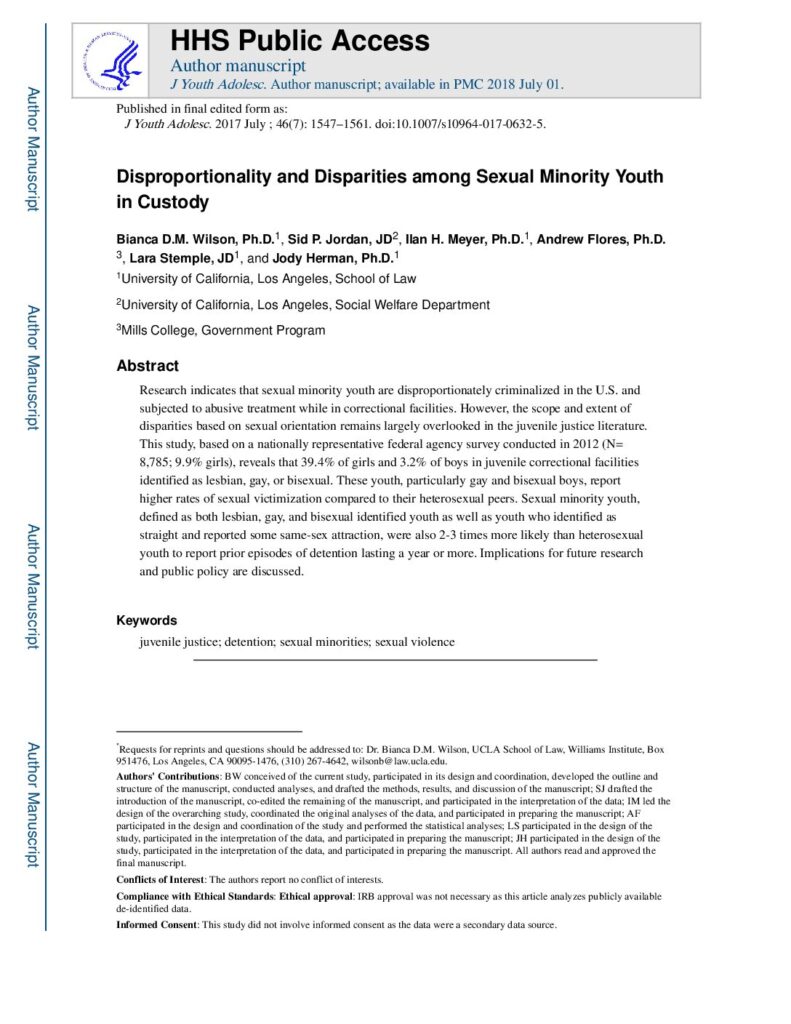
Abstract: Research indicates that sexual minority youth are disproportionately criminalized in the U.S. and subjected to abusive treatment while in correctional facilities. However, the scope and extent of disparities based on sexual orientation remains largely overlooked in the juvenile justice literature. This study, based on a nationally representative federal agency survey conducted in 2012 (N=8,785;…

On June 21, 2018, a federal class action lawsuit was filed on behalf of young people confined in the Palm Beach County Jail, alleging violations of their 8th and 14th Amendment rights under the U.S. Constitution. The plaintiffs are youth whose cases have been direct-filed in adult court in Palm Beach County, Florida. The complaint…

On October 17, 2017, the DOJ closed its investigation of the Pendleton Juvenile Correctional Facility, citing improvements made to the facility. The letter states, “Most broadly, the State has made system-wide efforts to minimize incarceration of youth; to move toward a rehabilitative juvenile justice model; to increase youth’s access to community-based alternatives to incarceration; and…

This report by the Center for American Progress, Movement Advancement Project, and Youth First offers an overview of youth incarceration in the United States and in particular, data on the experiences and challenges of LGBTQ youth incarcerated in the juvenile legal system. It concludes with several recommendations for reducing system involvement, ensuring fair treatment within…


This policy report features interviews of young people who have been incarcerated in youth facilities in Colorado and details the harmful conditions and culture in these programs. From the Executive Summary: “Despite a mission of rehabilitation rather than punishment, the culture of the Colorado Division of Youth Corrections (DYC) is plagued by punitive practices that…

On January 3, 2017, the DOJ filed a Statement of Interest in a case involving the use of solitary confinement for 16 and 17 year olds in the Onondaga County Justice Center in New York. This brief outlines the harms of solitary confinement as applied to young people in light of their brain development and…

On November 28, 2016, the DOJ filed a Statement of Interest in response to a lawsuit filed in South Carolina, challenging two state statutes as void for vagueness in violation of the Due Process Clause. The lawsuit alleged that the vague language in the statute resulted in the criminalization of common youthful behavior, racial disparities,…
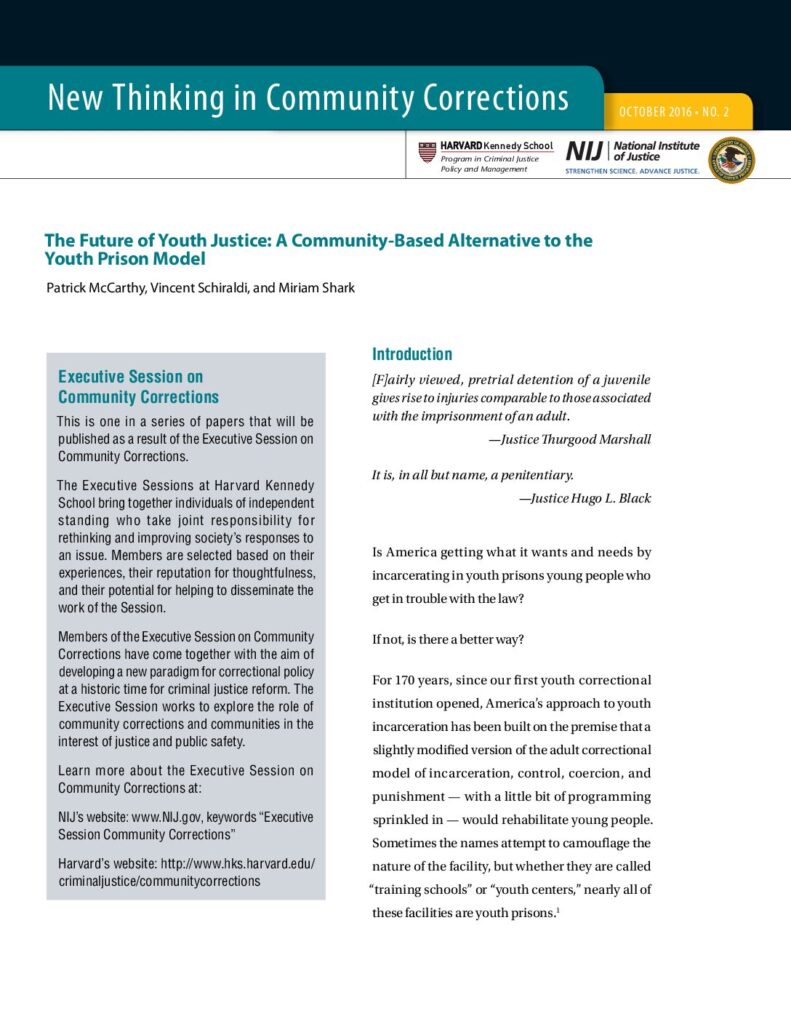
This paper from the Executive Session on Community Corrections at the Harvard Kennedy School examines the history of youth incarceration and discusses how the inherently flawed model of youth prisons demands systemic reforms, including closure of youth prisons, to actualize safer communities, and positive youth outcomes. From the introduction: “For 170 years, since our first youth correctional institution opened, America’s approach…

On December 9, 2015, the U.S. District Court for the Southern District of Ohio Eastern Division terminated the consent decree, finding the Ohio Department of Youth Services in substantial compliance with the consent decree. Notable improvements made to the Ohio juvenile facilities include: “meaningful grievance system and easy access to attorneys to address concerns related…

On August 6, 2015, the DOJ released an updated findings letter on several juvenile facilities in Puerto Rico. The DOJ finds that young people confined in juvenile facilities face substantive due process and equal protection violations, in addition to infringements to their federal rights under the Individuals with Disabilities Education Act and the Rehabilitation Act…

On March 31, 2011, Leflore County, Mississippi entered into a Memorandum of Agreement (MOA) with the United States to address the DOJ’s investigation findings into the Leflore County Juvenile Detention Center (LCJDC). The MOA outlines that LCJDC must provide young people with reasonably safe conditions of confinement, protect youth from harm, limit the use of…

On May 12, 2015, the DOJ filed a complaint in the U.S. District Court for the Northern District of Mississippi against Leflore County, Mississippi for engaging “in a pattern or practice of conduct that violates the Constitutional and statutory rights of youth at the Detention Center.” The complaint outlines 14th Amendment violations based on Leflore…

On March 20, 2014, the DOJ filed a Statement of Interest in a federal conditions lawsuit on behalf young people under the age of 18 confined in the Michigan Department of Corrections, alleging violations of the Prison Rape Elimination Act (PREA). The DOJ emphasizes that “[s]tate correctional facilities. . . are subject to both the…

On February 13, 2014, the DOJ filed a Statement of Interest in a federal class action lawsuit on behalf of young people confined in the Contra Costa County Juvenile Hall, alleging violations of the Individuals with Disabilities Education Act (IDEA). The DOJ reiterated that “Defendants (Contra Costa County) are required to provide special education and…
This amicus brief by American Friends Service Committee and others argues federal class action status is appropriate when members of a class challenge a policy or practice that exposes them to an injury. In this case, the class challenged Arizona Department of Corrections’ failure to provide minimally adequate medical and mental health to people in…

From the introduction: “This report will describe, dissect, and draw lessons from Connecticut’s striking success in juvenile justice reform for other states and communities seeking similar progress. The first section details the timeline and dimensions of change in Connecticut’s juvenile justice system over the past two decades. In 1992, Connecticut routinely locked up hundreds of…

On December 17, 2012, the U.S. Department of Justice entered into a settlement agreement with Shelby County and the Juvenile Court of Memphis and Shelby County in Tennessee following their investigation into the juvenile court system. The settlement agreement includes remedial measures to align the following practices with the U.S. Constitution: probable cause determinations, notice…

On August 22, 2012, the DOJ released its investigation findings into the Pendleton Juvenile Correctional Facility in Indiana. The investigation finds that “Pendleton exposes incarcerated youth to significant harm in violation of their constitutional and federal statutory rights. Pendleton fails to take reasonable steps to prevent youth from committing suicide, fails to provide reasonably safe…


On December 17, 2012, the U.S. Department of Justice entered into a settlement agreement with Shelby County and the Juvenile Court of Memphis and Shelby County in Tennessee following their investigation into the juvenile court system. The settlement agreement includes remedial measures to align the following practices with the U.S. Constitution: probable cause determinations, notice…

On March 20, 2012, the DOJ released its investigation findings into the conditions of confinement at the Walnut Grove youth Correctional Facility (WGYCF) in Walnut Grove, Mississippi. The investigation concludes, “the State of Mississippi is deliberately indifferent to the constitutional rights of young men confined at WGYCF. Evidence discovered at WGYCF reveals systematic, egregious, and…
